
Travel connectivity guide
Puerto Viejo eSIM for Mobile Internet
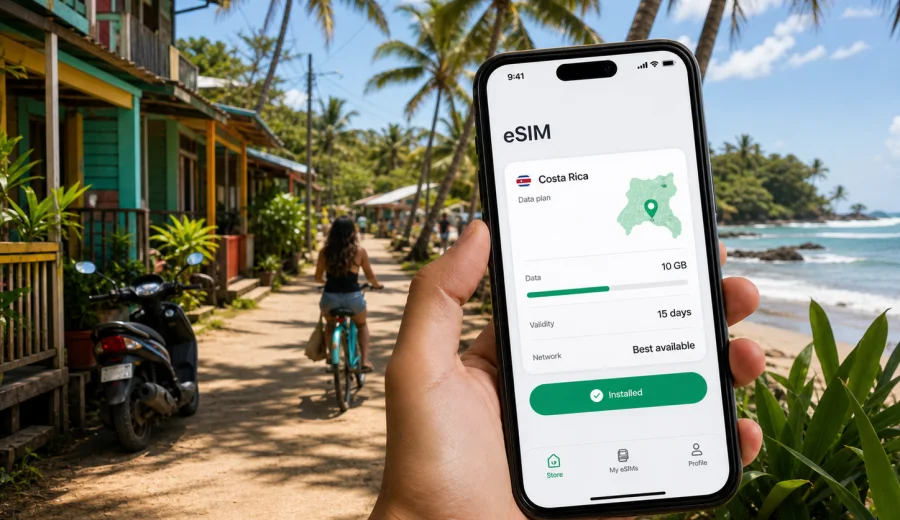
Puerto Viejo eSIM: mobile connection and internet for Costa Rica's Caribbean coast
Puerto Viejo is one of Costa Rica's most relaxed Caribbean destinations, but a trip here is easier when your mobile internet is ready before the first beach road, shuttle stop, hotel gate, or rain shower. The town is spread along the coast rather than stacked around one compact center. You may land in San Jose, continue by bus or private transfer, arrive after dark, then spend the next days moving between Playa Negra, Playa Cocles, Playa Chiquita, Punta Uva, Manzanillo, cafes, rental houses, yoga studios, dive shops, and restaurants where directions are often given by landmarks.
An eSIM can make that rhythm simpler. It gives you mobile data through a digital SIM profile, so you do not need to look for a physical SIM card as soon as you arrive. For Puerto Viejo, that matters because many practical travel moments happen outside a hotel lobby: checking a shuttle pickup point, confirming a bike rental, using maps on the beach road, paying attention to weather, translating a menu, sending a location to friends, or contacting your host when the road sign is not obvious.
This guide focuses on Puerto Viejo as a city base, not on Costa Rica in general. It explains where mobile data is useful, how to think about coverage and data usage, what to prepare before arrival, and how to choose an eSIM-tariff for a trip centered on Costa Rica's Caribbean coast.
Why mobile internet matters in Puerto Viejo
Puerto Viejo de Talamanca is compact in atmosphere, but not always compact in travel logistics. The main town center has restaurants, bars, small shops, hostels, and tour offices. Beaches and quieter stays stretch along the road toward Cocles, Chiquita, Punta Uva, and Manzanillo. Many visitors move between these areas by bicycle, scooter, taxi, shuttle, rental car, or on foot.
Mobile internet is useful because it helps you handle small decisions quickly:
- checking whether a restaurant, cafe, tour desk, or pharmacy is open before going there;
- finding the correct turn to a guesthouse or rental villa;
- sharing your live location with a driver or travel companion;
- looking up tide, rain, or route information before a beach day;
- using messaging apps when voice calls are not part of your travel data plan;
- keeping boarding passes, hotel confirmations, and shuttle details available on the move.
Puerto Viejo also has a travel style where plans often change. You may decide at breakfast to go to Punta Uva, join a surf lesson in Cocles, take a day trip toward Cahuita, or stay longer in town because heavy rain changes the route. A prepared mobile connection helps you adjust without depending only on cafe Wi-Fi or the front desk at your hotel.
Arrival scenarios: from airport to Caribbean coast
Most international visitors reach Puerto Viejo after arriving at Juan Santamaria International Airport near San Jose. Some travelers spend a night in the capital before continuing. Others go directly by shuttle, bus, or rental car. The road trip can take several hours, and the final part of the journey may include coastal roads, smaller signs, and late arrival times.
Useful mobile data moments during arrival include:
1. Confirming your transfer or bus information after landing.
2. Sending your arrival time to the hotel or rental host.
3. Using maps when the driver asks you to confirm the exact property.
4. Checking whether a food stop, ATM, or shop is open on the route.
5. Keeping a backup channel ready if your shuttle time changes.
If you use a physical SIM card, you usually need to find a sales point, show your device, and handle setup locally. With an eSIM, you can complete much of the preparation before the trip, then activate the mobile data profile according to the instructions for your device and selected tariff. That is especially practical if your Costa Rica itinerary moves quickly from airport to coast.
Where you will use data around town
Puerto Viejo is not a place where you need constant screen time, but it is a place where small bursts of data are valuable. The table below shows typical local situations and the kind of internet access they require.
| Puerto Viejo situation | Why mobile data helps | Typical data load |
|---|---|---|
| Finding a guesthouse off the beach road | Maps and messaging with the host | Low |
| Cycling from town to Cocles or Punta Uva | Route checks and weather updates | Low to medium |
| Booking a tour or surf lesson | Messaging, confirmation, payment page | Low |
| Working from a cafe or rental house | Email, documents, video calls | Medium to high |
| Sharing photos from the beach | Cloud backup and social apps | Medium to high |
| Day trip to Cahuita or Manzanillo | Navigation and transport coordination | Low to medium |
The key point is not only volume. It is availability at the right moment. Hotel Wi-Fi can be enough for planning at night, but it will not help when you need to message a driver at a roadside pickup point or check directions while walking back from dinner.
Puerto Viejo areas where an eSIM is useful
The town center is the easiest place to find restaurants, shops, and services. Still, even there, mobile internet helps when you are comparing menus, checking live maps, or coordinating with a group. If your hotel is near the center, a small to medium data package may be enough for messaging, maps, and travel admin.
Playa Negra is close to town but can feel quieter depending on your accommodation. Mobile data is useful for taxi coordination, walking directions, and checking whether you should go into the center before shops close.
Playa Cocles is popular for surfing, rentals, and beach stays. If you plan lessons, work breaks, or frequent movement between Cocles and the center, you may use more data than expected through maps, chat, photos, and cloud apps.
Playa Chiquita and Punta Uva are more relaxed and spread out. They are beautiful bases, but travelers often rely more on messaging, saved pins, and host instructions. A prepared eSIM helps if you arrive after dark or if your property is down a smaller road.
Manzanillo is a common excursion from Puerto Viejo. If you go there for beaches, nature, or a quiet day, download important information in advance and use mobile data for messages, navigation checks, and return transport.
Choosing a data amount for a Puerto Viejo trip
There is no single correct data package for every traveler. Your needs depend on the length of stay, whether you work during the trip, how often you use maps, and whether your accommodation has reliable Wi-Fi. Use the comparison below as a planning guide.
| Travel style | Example trip | Practical eSIM approach |
|---|---|---|
| Light traveler | 2-4 days, maps and messaging only | Smaller data package for essential access |
| Beach-and-town traveler | 5-7 days, daily maps, photos, restaurant searches | Medium package with room for everyday browsing |
| Remote-work traveler | 1-2 weeks, email, documents, occasional calls | Larger package plus hotel or cafe Wi-Fi |
| Multi-stop Costa Rica route | San Jose, Puerto Viejo, Cahuita, other regions | Choose a tariff valid for Costa Rica and check duration |
| Group coordinator | Managing transfers, bookings, and shared locations | More data than a passive traveler, especially for chat and maps |
Before choosing, look at three details in the tariff conditions: data volume, validity period, and destination. If your trip starts in San Jose and continues to Puerto Viejo, the country-level Costa Rica tariff is the relevant direction to check. Make sure the validity period covers both your travel days and the days when you may still need data on the way back.
Before you buy: device compatibility checklist
Not every phone or tablet can use eSIM. Some devices support eSIM only in certain regions or variants, and some phones may be locked by a mobile operator. Before paying for a tariff, confirm the basics:
- your device supports eSIM;
- your device is not locked to one carrier;
- the operating system is up to date enough for eSIM setup;
- you have internet access for installation;
- you understand when the selected tariff starts counting validity;
- the selected tariff is valid for Costa Rica.
You can also check your device before choosing a tariff. This step is worth doing at home, not after a long transfer when you are trying to reach your accommodation.
How Kaspersky eSIM Store fits the trip
Kaspersky eSIM Store is an app and website where you can choose, order, and activate an eSIM with a suitable mobile internet tariff for an international trip. For Puerto Viejo, the practical value is preparation: you can review available options for Costa Rica, compare data volume and validity, and set up your travel data plan before you are standing in an airport arrivals hall or looking for a local shop.
This does not make the service a mobile operator or a network provider. Your actual connection depends on the selected tariff conditions, compatible device settings, and local mobile network availability. The useful role is simpler: Kaspersky eSIM Store helps you prepare a digital SIM profile for travel mobile data and manage the setup through a clear app or website flow.
If Puerto Viejo is your main base and you want to handle mobile internet before departure, you can choose an eSIM-tariff for your Costa Rica trip after comparing the data amount and validity period with your itinerary.
Installation and activation in plain terms
Install and activate the eSIM when you have a stable internet connection and enough time to follow the steps carefully. Many travelers prefer installing the eSIM before departure, then activating mobile data according to the tariff instructions at the right moment. Read the tariff details because validity can depend on the chosen plan and activation conditions.
A simple setup flow looks like this:
1. Choose Costa Rica as the destination.
2. Select a data amount and validity period that fit your Puerto Viejo itinerary.
3. Complete the order.
4. Open the eSIM details in the app, profile, or email.
5. Add the eSIM to your compatible device.
6. Set the eSIM as the line for mobile data when you are ready to use it.
7. Turn on data roaming for the eSIM if the setup instructions require it.
8. Keep your primary SIM available for calls or SMS if you still need that number.
For device-specific setup, use the instructions for Android or the instructions for iOS. The exact screens can differ by device model and operating system version, so follow the instructions shown for your phone.
Arrival day checklist for Puerto Viejo
Use this short checklist before the shuttle or bus reaches town:
- Save the address and map pin for your accommodation.
- Download offline map areas for Puerto Viejo, Cocles, Punta Uva, and Manzanillo.
- Keep your booking confirmation and host contact available offline.
- Make sure the eSIM is installed and ready to use according to the instructions.
- Confirm which SIM line handles mobile data.
- Keep your primary SIM active only if you need calls or SMS.
- Check your remaining battery before the final part of the journey.
Offline maps are still useful even with an eSIM. Mobile data gives flexibility, but downloaded maps reduce data use and help when the signal is weaker on a specific road or inside a building.
Transport, navigation, and local movement
Puerto Viejo travel is often low-speed and flexible. You may walk in town, rent a bike for beach-hopping, use a taxi for night movement, or join shuttles for longer routes. Mobile internet supports each option differently.
For walking, it helps with maps, restaurant searches, and route sharing. For bikes, it helps when you want to check distance, rain, or the correct entrance to a beach. For taxis and shuttles, it helps you send a location pin and confirm pickup details. For rental cars, it helps with navigation, but you should still avoid relying only on live data; save key routes before leaving.
When moving at night, share your location with someone in your group and keep enough battery for navigation. The town is relaxed, but travel basics still matter: know where you are going, confirm the route, and avoid losing your only communication channel.
Hotels, rentals, work, and Wi-Fi expectations
Many hotels, hostels, rental villas, and cafes in Puerto Viejo offer Wi-Fi, but quality can vary by building, room position, weather, and the number of guests online. Use Wi-Fi for heavy actions such as large photo uploads, operating system updates, long video meetings, and streaming. Use mobile data for moments when you are away from the room: maps, messaging, booking confirmations, translation, transport coordination, and urgent email.
If you plan to work remotely, confirm fixed Wi-Fi with your accommodation before arrival. Then treat the eSIM as a travel backup for outages, transfer days, cafe changes, and important messages. A data package can support essential work tasks, but it should not be your only plan for hours of video calls or large file syncs.
Day trips and short stays
Puerto Viejo is also a base for Cahuita, Manzanillo, cacao tours, wildlife experiences, surf lessons, snorkeling days, and onward transport toward the Panama border. On these trips, mobile data helps with meeting points, route checks, payment confirmations, and messages if plans change. Download important route information first because beaches, trails, and rural roads may not have the same signal conditions as the town center.
For a short two- or three-night stop, focus on maps, saved pins, host messages, shuttle details, and a validity period that covers both arrival and departure. Do not choose only by the smallest data amount if you are managing several bookings from your phone.
Data-saving tips for Puerto Viejo
Small settings can make a travel data package last longer:
- Download offline maps before leaving your accommodation.
- Disable automatic app updates on mobile data.
- Turn off automatic cloud photo backup until you are on Wi-Fi.
- Send compressed photos when full quality is not important.
- Use audio calls instead of video calls when data is limited.
- Save shuttle tickets, hotel details, and QR codes offline.
- Check remaining data during a longer stay.
These habits are useful because Puerto Viejo days are active. You may start with breakfast in town, bike to a beach, stop at a cafe, and return after sunset. Your phone can use data across that whole day unless you control background activity.
What eSIM does and does not cover
An eSIM travel tariff is mainly about mobile data. It may not include a local phone number, traditional voice calls, or SMS unless the specific tariff conditions say otherwise. If you need bank texts, airline alerts, or calls on your home number, keep your primary SIM settings in mind and check roaming charges with your regular mobile operator.
For many Puerto Viejo scenarios, internet-based communication is enough: messaging apps, email, maps, booking platforms, and shuttle coordination. Still, read the selected tariff details before the trip and keep important contacts available in more than one channel.
FAQ: eSIM and mobile internet in Puerto Viejo
Can I use an eSIM before I reach Puerto Viejo?
Yes, if the selected tariff is valid for Costa Rica and your setup is complete according to the instructions. This is useful because many travelers land near San Jose before continuing to the Caribbean coast.
Is hotel Wi-Fi enough?
It may be enough for evening planning or heavy uploads, but it does not help when you are cycling between beaches, confirming a shuttle, or looking for a property entrance.
Should I install the eSIM before the flight?
Installing before departure can be convenient because you have stable Wi-Fi and time to check settings. Activation timing depends on the selected tariff, so read the conditions before using mobile data.
Do I need a large data package?
Not always. Maps, messaging, and bookings use relatively little data. Remote work, video calls, cloud backups, and photo sharing use much more.
Final preparation before the Caribbean coast
Puerto Viejo rewards flexible travel: beach mornings, late lunches, bike rides, rain breaks, quiet roads, and day trips that may change with the weather. A prepared eSIM makes those changes easier to manage because maps, messages, confirmations, and travel details stay close at hand.
Before you leave for Costa Rica, check device compatibility, choose a data amount and validity period that fit your Puerto Viejo route, install the eSIM while you have reliable internet, and save key information offline. Then you can use your phone for the practical moments of the trip without turning mobile setup into an arrival-day chore.
If you want to prepare mobile internet before traveling to Puerto Viejo, review eSIM options for Costa Rica in Kaspersky eSIM Store and choose the tariff conditions that match your stay, route, and expected data use.