Travel connectivity guide
Realme 14 Pro+ eSIM: Compatibility & Setup
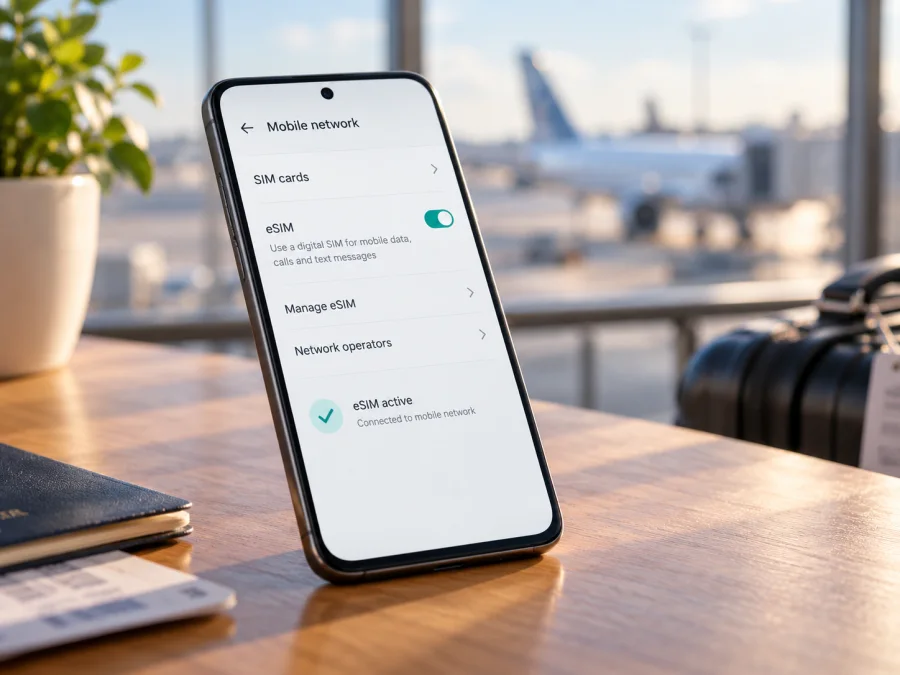
Realme 14 Pro+ eSIM: compatibility and setup guide
Short answer: eSIM support on the Realme 14 Pro+ depends on the market version. realme’s France specifications explicitly list eSIM compatibility. Its Global specifications, by contrast, list two nano-SIM card slots and do not list eSIM. That means the name on the box alone is not enough to confirm that your particular phone can add a digital SIM. Check the exact regional variant and the settings on the handset before choosing a travel plan.
Does the Realme 14 Pro+ support eSIM?
There is no single yes-or-no answer for every phone sold as Realme 14 Pro+. On the French realme product specification page, the “Cellular & Wireless” section says “Compatible eSIM.” On realme’s Global specification page, the listed cellular details include two nano-SIM slots, but eSIM is not listed. The available official material therefore confirms eSIM for at least the French-market specification, while it does not establish support for every region or every unit carrying this model name.
The difference matters when importing a phone or buying a used handset. “Global” on a reseller listing can be an informal label and may not match the manufacturer’s market-specific product page. A device may also have a different software build, carrier configuration, or product code from a superficially similar unit. Do not infer eSIM support from 5G, dual SIM, Android, the phone’s appearance, or the ability to connect to mobile networks. These are separate capabilities.
| Check | What the official pages indicate | What it means for your phone |
|---|---|---|
| France-market Realme 14 Pro+ | realme France lists eSIM compatibility | This is positive evidence for that market version; confirm the exact device in Settings before purchase. |
| Global Realme 14 Pro+ specifications | realme Global lists two nano-SIM slots and does not list eSIM | The page does not confirm eSIM for a phone sold under this market specification. |
| Other country or carrier variants | The market-specific listing may differ | Check the manufacturer page and model or regional code for the country where the phone was sold. |
| Your own handset | An EID and an add-eSIM option are useful checks | Confirm both in the device itself; ask realme or the seller if they are missing or unclear. |
These specifications describe market variants, not service coverage. French-market eSIM support does not guarantee that every plan or destination network will work; compatibility also depends on software, carrier lock status, profile, and local network support.
The France page is an official manufacturer specification that marks its listed version as eSIM-compatible. The Global page does not list eSIM, so do not generalize the France listing to every market. realme notes that product availability differs by market. A reseller’s generic “international” label cannot settle support for your exact unit; check its product code and original country of sale, and ask realme or the seller to confirm if needed.
Check compatibility before buying a travel eSIM
Start with the phone, then confirm the conditions for the plan. Use this checklist while you still have time to contact the seller or support:
- Find the exact market version. Check the box label, invoice, About device screen, or product code. Match it to the country page on realme’s site rather than relying on a generic “international” description.
- Look for an EID. An EID is the identification number associated with the phone’s embedded SIM. On Android, open Settings and search for “EID.” Depending on the software build, it may appear under About device, Status, or SIM status. Menu names can vary.
- Look for an add-eSIM control. In Settings, search for “eSIM,” “Add eSIM,” “Download a SIM,” or “Add mobile plan.” The control should lead to a flow for scanning a QR code or adding a carrier profile. A menu item that only adds a physical SIM is not enough.
- Check both signals. If there is an EID and an eSIM setup option, that is strong evidence that the unit has eSIM capability. If one or both are absent, do not assume that a software update or QR code will enable it; confirm with realme for your product code.
- Check that the handset is unlocked. A carrier-locked phone may reject another provider’s profile or prevent service on a travel plan. Ask the carrier that sold the handset whether it is unlocked for use with other providers.
- Check the trip plan’s terms. Confirm that the destination is included, that the plan is for mobile data, and when its validity begins. Data-only travel eSIMs generally do not replace your usual phone number or include ordinary calls and SMS unless the specific plan says otherwise.
- Keep internet available during setup. The profile normally needs a working Wi-Fi or mobile data connection to download. Install it before leaving, or make sure you will have reliable Wi-Fi on arrival.
If the results are uncertain, treat the phone as unconfirmed until its EID, settings, and exact market version have been checked. A regional variant or carrier restriction may still need confirmation from the seller or manufacturer.
How to find the EID and eSIM setting
Menu paths can change between realme UI updates and regional software. Try Settings search first, because it can locate a renamed option without relying on an old screenshot.
- Connect the phone to Wi-Fi and open Settings.
- Tap the search field and enter EID. If a number appears, note that the handset recognizes an embedded SIM identifier. Do not publish or share the full number; it is a device identifier.
- Search for eSIM. Look for an item such as Add eSIM, Add mobile plan, or Download SIM. If the phone offers a QR-code scanner or lets you add a plan through its SIM settings, open the screen only far enough to confirm the feature is available; you do not need to activate a plan yet.
- If Settings search returns nothing, check Settings → Mobile network or SIM card & mobile data and look for an add-plan control. The wording and order can vary by country and realme UI version.
- If the setting is still absent, install any pending official system update, restart, and check once more. An update can correct a menu or carrier configuration, but it cannot add eSIM hardware to a version that does not have it.
- Compare the result with the product code and original sales market. If the EID or option is missing but the seller claims eSIM support, ask realme support to confirm that exact unit before buying a plan.
An EID is a useful indicator, not a promise that a particular travel profile will install or connect. The plan must be compatible with the phone’s eSIM implementation and available for the destination. A carrier lock, unsupported network bands, temporary provider restrictions, or an outdated software configuration can still prevent use. Before purchase, you can also check your device as a second compatibility reference. If it disagrees with the handset’s settings, use the EID, add-eSIM menu, exact product code, and manufacturer or seller confirmation to resolve the difference.
Before installation: prepare the phone and plan
Use a charged phone and a stable internet connection. Read the plan’s installation and activation conditions first: validity may begin at installation or when the profile connects at the destination. Keep the QR code on another screen or print it. Some activation codes are single-use, so do not delete a profile unless the provider confirms that it can be reinstalled.
For an Android overview, see the Android eSIM installation instructions. The guide notes that steps vary by device and software, and its pictured path is specific to Samsung. Use the labels on your Realme phone. The iOS installation instructions are for Apple devices, not this Android setup.
Install and activate an eSIM on Realme 14 Pro+
Use these general Android steps only if your handset shows eSIM support. The labels may differ slightly with realme UI, region, or carrier settings.
- Open the eSIM setup page. Go to Settings and search for eSIM, or open the phone’s mobile network or SIM settings. Tap Add eSIM or the equivalent option.
- Choose how to add the profile. Select the QR-code option if you have a QR code. If your plan provider supplied manual details or a direct installation flow, use that method as instructed.
- Scan or enter the activation information. Hold the QR code steady and follow the on-screen prompts. If the QR code is displayed on the Realme screen itself, use a second device or printout so the phone can scan it. Do not send the code to someone else.
- Wait for the profile to download. Keep the phone online and do not close the setup screen. When the system asks for confirmation, approve adding the mobile plan. The exact display name may be set by the provider.
- Label the eSIM. Choose a clear name such as “Travel data” so it is easy to distinguish from your home SIM. Naming it does not change the plan or its coverage.
- Choose how each SIM will be used. Keep your usual number selected for calls or messages if you need it, and choose the travel eSIM for mobile data when you are ready. Android may ask which SIM should be the default for calls, messages, or data.
- Follow the plan’s activation timing. If the plan should be activated before travel, follow the provider’s steps. If it should start at the destination, leave the profile installed but follow the plan’s instructions about when to enable it. Avoid deleting and reinstalling the profile to reset its validity.
- At your destination, turn on the travel profile. Ensure the eSIM is enabled, select it as the mobile data SIM, and enable data roaming for that eSIM only if the plan instructions require it. Roaming may be necessary for a travel profile to connect; check the provider’s terms before switching it on.
- Test a web page or app. Turn Wi-Fi off briefly and check that mobile data works. If it does not, give the phone a few minutes to register, then use the troubleshooting steps below.
Kaspersky eSIM Store is an app and website where travelers can choose, arrange, and activate an eSIM with a mobile data plan for an overseas trip. Before paying, confirm that the exact Realme 14 Pro+ variant can add eSIM and that the destination is covered by the plan shown. You can browse current travel eSIM options and compare the destination, data allowance, validity, and activation conditions displayed there. The homepage is a general place to browse; it is not a country-specific tariff page.
Use the eSIM for mobile data while travelling
Once the profile is installed, decide which line should handle each job. A common setup is to keep the home SIM available for calls or verification messages, while the travel eSIM supplies mobile data. This arrangement can still incur charges from your home operator if its line uses roaming, forwards calls, or sends SMS abroad. Review the home plan’s roaming terms and turn off data roaming on that line if you want to avoid unintended mobile data use.
On the Realme 14 Pro+, open SIM or mobile network settings and select the travel profile as the mobile data SIM. Check the name carefully before enabling data. If the phone offers a setting to switch mobile data automatically between SIMs, turn it off while abroad if you want to keep data on the travel eSIM. This prevents the phone from switching back to your home line when the travel profile has a weak signal, though exact labels vary.
A travel eSIM may need data roaming enabled to register on a partner network. Enable roaming for the travel eSIM only when the plan instructions say to do so. The setting does not itself select a destination or guarantee service; the plan, network availability, and local partner coverage determine whether data works. After connecting, check a map or messaging app and review the phone’s data usage periodically. Use Wi-Fi for large downloads and disable automatic app updates if you want to conserve a limited allowance.
Common travel scenarios
- Install at home: Add the profile over Wi-Fi, then follow its activation timing. Enable it on arrival if the plan requires that.
- Install after landing: Use airport or hotel Wi-Fi and scan the code from another screen. Keep the confirmation email or app available.
- Keep your home number: If supported, leave the home SIM on for calls or texts, select the travel eSIM for data, and check home-line roaming charges.
- Visit several countries: Confirm that the plan covers each stop; do not infer coverage from eSIM support or neighboring destinations.
- Use hotspot: Check whether tethering is supported and allowed by the plan. Connected laptops can consume data quickly.
Troubleshooting: eSIM will not install or connect
Check one setting at a time so you can identify the cause.
The QR code is not recognized
Clean the camera lens, show the complete code on another screen at good brightness, and hold the phone steady. If the code was already used or expired, ask the plan provider about a replacement. Enter manual details only if the provider supplied them.
There is no “Add eSIM” option
Search Settings for EID and eSIM, and check the mobile network or SIM screen. Install any pending official update and restart once. If no EID or add-eSIM control appears, treat support as unconfirmed; compare the product code with the market-specific realme specifications or ask the seller/realme. A profile cannot add missing eSIM hardware.
The profile is installed but has no service
Confirm that the profile is enabled and chosen for mobile data, airplane mode is off, and the plan covers your current country and is active. Follow the plan’s instructions for data roaming on the travel profile. Toggle airplane mode once or restart, then allow a few minutes for registration.
Data is on but apps cannot connect
Check that mobile data is assigned to the travel eSIM and that data remains in the plan. Turn Wi-Fi off briefly to test. If the provider gave you an APN (access point name), enter it exactly; do not guess. Contact the plan support team if the connection still fails.
The wrong SIM is being used, or service is weak
Recheck the selected data line and disable automatic data switching if available. Review call and SMS defaults separately. Signal and speed depend on location, network congestion, device bands, and local availability; a 5G badge does not guarantee 5G service on every partner network. If the phone may be carrier-locked, ask the original carrier or seller to confirm its status.
For support, note the product code, realme UI version, country, profile status, and error message. Share these details privately with realme or the plan support team. Do not post your QR code, EID, or account credentials publicly.
Frequently asked questions
Can every Realme 14 Pro+ use eSIM?
No. realme France lists eSIM for its market version; the Global specifications list two nano-SIM slots and do not list eSIM. Check your exact variant and handset settings.
Do two SIM slots or 5G confirm eSIM?
No. Physical SIM slots, 5G, and eSIM are separate capabilities. Look for an EID and an add-eSIM control.
Is an EID enough to confirm that a travel plan will work?
No. It is a useful indicator, but you must also check the profile setup menu, carrier lock status, destination, plan terms, and local network availability.
Can I keep my regular number and use travel data?
Often the home SIM can remain on for calls or texts while the travel eSIM handles data, depending on the handset and carrier. Check roaming charges and remember that data-only plans do not usually include a phone number or regular SMS and calls.
Should data roaming be enabled?
Some travel profiles require roaming on that eSIM. Follow the plan instructions and ensure it is the selected data line. Review roaming settings for the home SIM separately.
Can I move or reinstall the profile?
Rules depend on the provider. Check before removing it; an activation code may be single-use and not transferable.
What if my market version is uncertain?
Treat compatibility as unverified. Check the EID and setup option, match the product code to realme’s country-specific specifications, and ask realme or the seller to confirm before purchase.
Final check before your trip
The Realme 14 Pro+ can support eSIM in at least the France-market specification, but the Global specifications do not confirm that feature. That distinction makes the exact regional variant decisive. Before purchase, check the product code, search Settings for EID and an eSIM setup option, confirm that the phone is unlocked, and verify the plan’s destination and activation terms.
If those checks confirm eSIM, install the profile over a reliable connection, label it clearly, and select it for mobile data when you are ready to travel. Review data roaming settings for both the travel eSIM and your home SIM. If the EID or add-eSIM option is absent, ask the seller or realme to verify the handset before spending money on a plan. Once compatibility is clear, use Kaspersky eSIM Store’s app or website to browse and activate a suitable travel data plan, and keep the provider’s setup details available for the journey.


