Travel connectivity guide
Rodney Bay eSIM: Mobile Internet in Saint Lucia
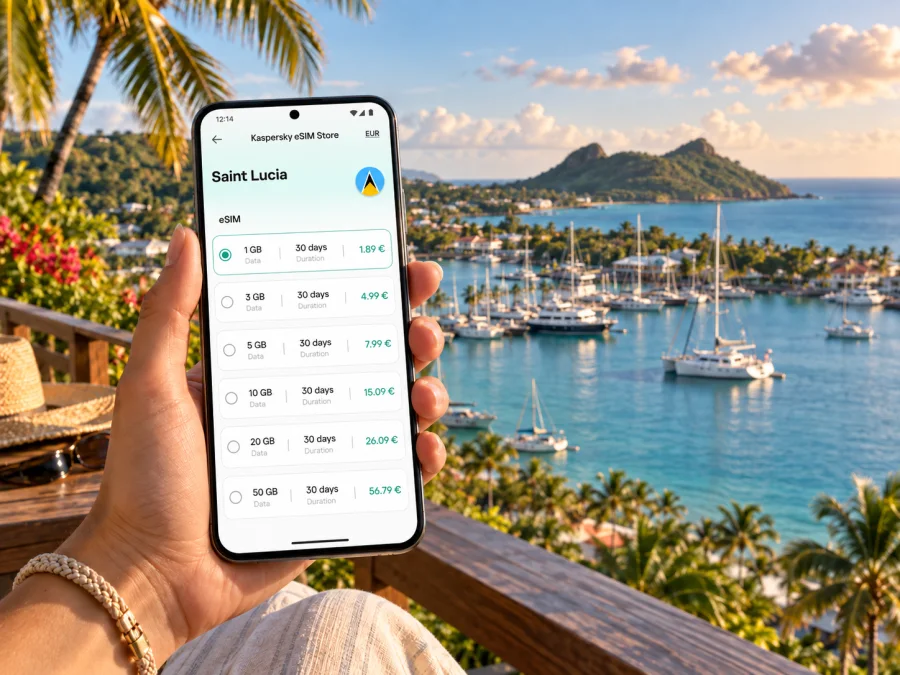
Rodney Bay eSIM: mobile connection and internet for your trip
Rodney Bay is one of the easiest places in Saint Lucia to use as a base: the marina, Reduit Beach, hotels, restaurants and shops are gathered across a compact stretch of the island’s northern coast. A phone with mobile internet can help you coordinate an airport pickup, find your accommodation, check a route to the beach or stay in touch while plans change. Preparing an eSIM before travel can make those first practical steps simpler, while the right setup still depends on your device, tariff and where you go.
This guide focuses on getting around Rodney Bay and using it as a starting point for the north of Saint Lucia. It covers arrival planning, local movement, navigation, day trips and the details to check before choosing an eSIM tariff. It does not assume that a single connection will behave the same way in every building, vehicle or part of the island.
What to know about Rodney Bay before you arrive
Rodney Bay sits in the north of Saint Lucia, within the Gros Islet area. Visitors often use the name for the marina and surrounding resort area, while nearby places have their own character: Reduit Beach fronts the bay, Gros Islet village is close by, and Pigeon Island lies farther north beyond the causeway. Castries, the island’s capital, is south of Rodney Bay. These distinctions matter when you enter a destination into a map or arrange a pickup; a hotel’s exact pin is more useful than searching only for “Rodney Bay.”
The area is a practical base for a mix of plans:
- Beach time: Reduit Beach is the best-known shoreline in the Rodney Bay area, with restaurants and visitor services nearby.
- Marina plans: Rodney Bay Marina is a recognizable meeting point for boat trips, sailing activity and waterfront businesses.
- Evenings in Gros Islet: the village is associated with the Friday Night Street Party. Check locally for current timing and arrangements before building an itinerary around it.
- A north-coast day: Pigeon Island National Landmark is a nearby excursion for visitors interested in coastal views, walking and local history.
- A wider island itinerary: Rodney Bay can be a starting point for trips toward Castries, Soufrière and other parts of Saint Lucia, but distances on a map do not tell the whole story about travel time.
For a first visit, think of Rodney Bay as a cluster of destinations rather than one single point. Your lodging may be close to the beach, along the marina, or on a road set back from the waterfront. That can affect whether a walk, taxi or local transport is the most convenient way to cover the last part of a journey.
Arriving in the north: plan the first connection
Saint Lucia has two airports visitors may encounter. Hewanorra International Airport (UVF) is in the south, while George F. L. Charles Airport (SLU) is near Castries in the north. Your flight determines which one you use. If you arrive at Hewanorra, the transfer to Rodney Bay crosses a substantial part of the island; from George F. L. Charles, the trip starts near Castries. Confirm the pickup point and arrangement with your accommodation or driver.
Before departure, save the hotel address and map pin, confirm how your driver will meet you, and keep the booking details accessible offline. Decide which SIM or eSIM profile should handle data after landing. An offline map of the north is a useful backup: it helps with basic orientation, while live directions and current business searches require a data connection.
If you land in the south, avoid scheduling a tightly timed activity immediately after your flight unless your transport provider has confirmed the details. For either airport, use the exact property pin rather than searching only “Rodney Bay,” and agree on a fallback meeting point if a phone is unavailable. Once connected, check the route and send a short arrival update before leaving the airport.
Moving around Rodney Bay
The right way to get around depends on distance, weather, luggage and the time of day. Some visitors walk between nearby places in the resort area; others use a taxi, arrange a transfer or travel with a local driver. For a day away from the north, ask your accommodation or transport provider about pickup and return arrangements before setting out. Do not assume that a route that looks short on a map will feel comfortable on foot or take the same amount of time at every hour.
| Journey or task | What to prepare on your phone | Practical note |
|---|---|---|
| Hotel to Reduit Beach | Saved map pin and walking directions | Check the exact hotel entrance and ask locally about the most convenient route. |
| Hotel to the marina | Marina pin, meeting time and booking details | A precise meeting point helps when several businesses operate around the waterfront. |
| Rodney Bay to Gros Islet village | Destination pin and agreed return plan | For the Friday evening street party, confirm current local arrangements and plan your way back. |
| Rodney Bay to Castries | Destination, pickup point and time buffer | Castries has several possible stops; specify the market, port or meeting address you need. |
| Full-day excursion | Driver contact, itinerary and offline notes | Confirm what is included in the return transfer before leaving the north. |
A map app is most helpful when you use it to confirm details, not just to follow a blue line. Pin the actual entrance for a hotel or restaurant, check whether the destination is in Rodney Bay or nearby Gros Islet, and compare the suggested route with local advice. When mobile data is limited, search and load the route while you have a connection, then keep an offline map available for basic reference.
Choosing mobile internet for Rodney Bay
A city-focused eSIM plan is still selected for the country or region it covers. For Rodney Bay, check that the tariff applies to Saint Lucia and review its data allowance, validity period, price and activation conditions. Kaspersky eSIM Store is an app and website where you can choose, arrange and activate an eSIM with a suitable tariff for mobile internet while travelling abroad. The tariff conditions determine what is included; do not infer voice calls or SMS unless they are explicitly listed.
Before choosing, estimate how you expect to use data. Messaging and occasional map checks are different from frequent video calls, cloud backups or streaming. Hotel Wi‑Fi may cover some routine use, but it is useful to consider what you need while moving between the airport, accommodation, marina and beach. If your itinerary includes other destinations in Saint Lucia, check that the tariff’s stated coverage and validity match the whole trip rather than only your Rodney Bay stay.
You can review eSIM tariff options for Saint Lucia and compare the conditions shown for the available plans. Look at the data amount and duration together: a larger allowance is not automatically a better fit if your stay is short, while a long validity period may be useful if the trip includes several stops. Keep the purchase confirmation and installation information somewhere accessible.
A simple way to estimate data
Use your usual habits as a starting point, with extra room for navigation and coordination. These are planning prompts; actual app use varies with settings, media quality and background activity.
| Your likely use in Rodney Bay | What to consider |
|---|---|
| Mostly messages and occasional searches | A modest allowance may suit light use, but account for route checks and updates. |
| Frequent navigation and photos | Allow for repeated map loading, photo uploads and messages with hosts or drivers. |
| Remote work or video meetings | Check whether the plan’s allowance and validity suit your working days; test calls over Wi‑Fi before relying on mobile data. |
| Island touring over several days | Include route lookups, coordination and time away from accommodation Wi‑Fi in your estimate. |
To manage use, pause automatic updates and large photo backups on mobile data, and download media before travel. Keep data available for navigation and messages away from your accommodation.
Prepare your phone before the trip
Check device support before purchasing: eSIM availability can vary by model and region, and a carrier lock may prevent activation. Check whether your device supports eSIM and confirm the exact model in your settings or manufacturer information. Read the tariff instructions and note when validity begins; this can depend on the selected plan. If setup requires stable Wi‑Fi, install before departure and configure the line as instructed.
Installation steps
- Connect to Wi‑Fi and open the installation details for your tariff.
- Add the eSIM using the method shown for your device, such as scanning its QR code.
- Label the line clearly, for example “Saint Lucia data.”
- Select it for mobile data when you are ready to use it, and follow the tariff instructions for data roaming.
- After arrival, check that data is assigned to the intended line.
Use the Android eSIM installation instructions or iOS eSIM installation instructions for device-specific steps. Menu names vary by software version. Keep the QR code private, and do not delete an installed eSIM profile unless the instructions or support team say to do so.
Navigation, work and short stays
Rodney Bay supports different itineraries, each with its own data needs.
- Short stopover: save the hotel or meeting pin, arrange both transfers and keep the schedule offline. Use data for pickup updates and route changes.
- Business trip: save meeting addresses and contact details. Include a venue name or exact entrance; “Rodney Bay” alone may not identify the right place.
- Beach visit: save the route back and coordinate transport before settling in. Protect the phone from sand, water and heat.
- Marina activity: store the charter’s meeting instructions, departure time and contact details. Use the booking’s meeting point rather than a general marina pin.
- Gros Islet evening: check current local information about the Friday Night Street Party, agree where to meet and decide how you will return before the evening begins.
A saved landmark and an offline note are useful backups when a live map is not available.
Day trips from Rodney Bay
Rodney Bay can be a starting point for trips toward Castries, Soufrière and other parts of Saint Lucia. Roads and journey times can make a mapped distance misleading, so confirm pickup, route and return plans with your driver or excursion provider. Specify the exact stop in Castries; for a trip toward Soufrière and the Pitons, allow the time recommended locally rather than stacking distant stops tightly.
Before leaving the north, save pickup and drop-off points, driver details, an offline map and your accommodation address. Confirm whether the excursion includes a return transfer. These details help if plans change and make it easier to choose a tariff duration that covers the whole trip.
Troubleshooting a connection
If mobile data does not work as expected, check that the eSIM is enabled and selected for data, and confirm the plan is valid for Saint Lucia and within its allowance. Review its instructions for network selection and roaming. You can briefly toggle airplane mode or restart the phone, then try again in a different location; building interiors and local conditions can affect reception. If the issue continues, use Wi‑Fi to check the order details or contact support. Do not remove the eSIM profile unless the instructions say to.
A successful setup does not guarantee the same signal in every room, vehicle or coastal location. For an important work call, arrange a backup such as venue Wi‑Fi.
Frequently asked questions
Is Rodney Bay a city or an area?
The name is commonly used for a coastal resort and marina area in northern Saint Lucia. Nearby Gros Islet, Reduit Beach and Pigeon Island are distinct places, so use an exact address when arranging transport.
Which airport should I use?
Your itinerary determines whether you arrive at Hewanorra International Airport in the south or George F. L. Charles Airport near Castries. Confirm the transfer from your actual arrival airport.
Can I use an eSIM only in Rodney Bay?
Tariffs are generally selected for their stated country or region, not a neighborhood. Check Saint Lucia coverage conditions and whether other stops are included; reception varies by location.
Does a data eSIM include a regular phone number?
Not unless the tariff explicitly says so. Internet-based messaging or calls may work through compatible apps when you have data or Wi‑Fi.
What should I save offline?
Keep your accommodation address, airport transfer details, bookings, meeting points and a map of the north available. This helps before the eSIM connects or between destinations.
Set up for a smoother Rodney Bay stay
A little preparation makes the first hours in Rodney Bay easier: know which airport you are using, save your exact accommodation pin, agree on the transfer and keep key details available offline. Once you are settled, use mobile internet for navigation, messages and changing plans, while checking tariff conditions and local arrangements as you go.
Kaspersky eSIM Store helps you choose, arrange and activate an eSIM with a suitable tariff for mobile internet during an international trip. Review the Saint Lucia options, compare data and validity for your itinerary, and choose an eSIM tariff for your Saint Lucia trip before you travel.