
Travel connectivity guide
Rome eSIM for mobile internet in Italy
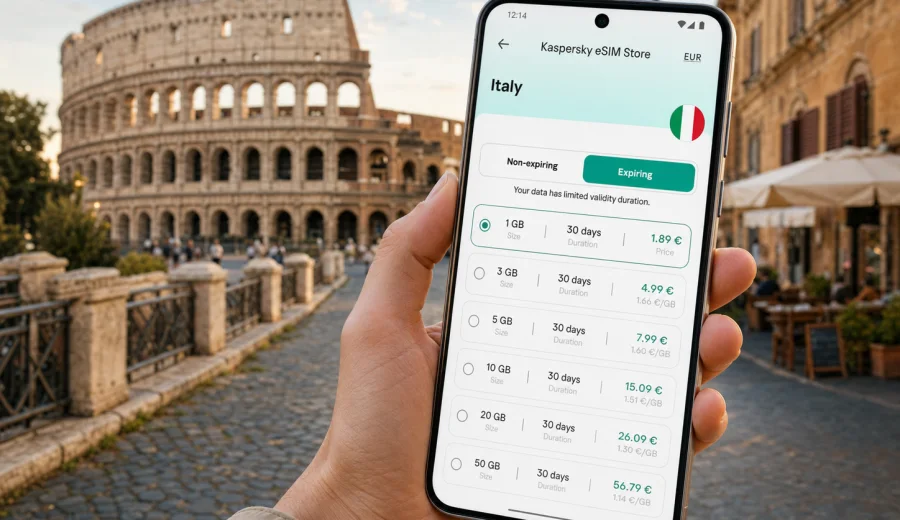
Rome eSIM: mobile connection and internet for your trip
Rome is a city where mobile internet becomes useful almost immediately. You may need it at Fiumicino Airport while checking a train platform, at Ciampino while arranging a transfer, near Termini when confirming a hotel address, or in a narrow street where offline maps do not show the last turn clearly enough. A Rome eSIM helps you prepare mobile data for the trip without looking for a physical SIM card after arrival.
For many visitors, the first hours in Rome are busy: airport signs, ticket machines, luggage, taxi queues, apartment check-in messages, and a route across a city that mixes ancient streets with modern traffic. With an eSIM on a compatible phone, you can choose a suitable data plan before the flight or shortly after landing, then use mobile internet for maps, transport apps, bookings, messengers, and travel updates.
This guide focuses on Rome rather than Italy in general. It explains where mobile data is especially useful in the city, how to estimate traffic for a short break or longer stay, what to check before buying an eSIM plan, and how Kaspersky eSIM Store can help you choose, order, and activate an eSIM for a trip to Italy.
Why mobile internet matters in Rome
Rome rewards walking, but it also demands navigation. The historic center is compact on a map and complicated in real life. Streets bend around ruins, buses do not always follow a grid, metro lines cover only part of the city, and a hotel that looks close to a landmark can still require a careful route.
Mobile data is useful in Rome for practical tasks:
| Travel moment | Why internet helps |
|---|---|
| Arrival at Fiumicino or Ciampino | Check train, bus, taxi, and transfer details before leaving the terminal. |
| Moving through Termini | Confirm platforms, metro entrances, meeting points, and hotel directions. |
| Walking in the historic center | Use maps around alleys, piazzas, fountains, and pedestrian streets. |
| Visiting the Colosseum or Vatican area | Access booking confirmations, timed-entry details, and group messages. |
| Staying in apartments | Contact hosts, open check-in instructions, and navigate to less visible entrances. |
| Business trips | Join calls, receive schedule changes, and move between meetings without relying on hotel Wi-Fi. |
Public Wi-Fi can be useful in hotels, museums, restaurants, and offices, but it is not a travel plan on its own. You may need internet before you reach the hotel, between meetings, at a taxi stand, or while deciding whether to walk, take a bus, or use the metro. An eSIM plan for Italy can reduce dependence on public Wi-Fi and make the city easier to handle from the first route.
Arrival scenarios: Fiumicino, Ciampino, and Termini
Most international visitors arrive through Rome Fiumicino Airport, while some European routes use Ciampino. Both airports are outside the central districts, so your first connection task is usually transport.
At Fiumicino, mobile internet can help you compare the Leonardo Express to Termini, regional trains, airport buses, taxis, ride-hailing options where available, and private transfers. If your accommodation is near Trastevere, Ostiense, Prati, Monti, or the Spanish Steps, the fastest route may not be the same for every arrival time. With data active, you can check the route while still inside the airport instead of deciding under pressure.
At Ciampino, mobile data is useful because the journey often combines an airport bus, regional transport, taxi, or metro connection. If you land late, a live route check matters more than a route saved earlier in the day.
Termini is another point where online access is valuable. It is Rome's main rail hub and a common place for airport arrivals, intercity trains, metro transfers, and hotel routes. A working data connection helps you check platform changes, message a driver or host, find the correct metro line, and avoid walking in the wrong direction with luggage.
Where eSIM is useful inside the city
Rome has different travel patterns depending on where you stay and why you are visiting. A couple staying near Piazza Navona will use mobile data differently from a conference visitor in EUR or a family staying near San Giovanni.
In the historic center, maps and walking routes matter most. Around the Pantheon, Campo de' Fiori, Trevi Fountain, and the Spanish Steps, small streets can make short walks confusing. Mobile internet helps you adjust routes without stopping for Wi-Fi.
In Trastevere, Testaccio, and Ostiense, you may rely on a mix of walking, tram, bus, taxi, and regional train links. These areas are popular for food, nightlife, and apartment stays, so you may also use mobile data for reservations, shared locations, and late-evening transport checks.
In Prati and the Vatican area, timed entries and meeting points can be important. Mobile internet helps you keep confirmations available, coordinate with companions, and check routes back across the Tiber after a visit.
For business trips, Rome can involve offices, embassies, coworking spaces, hotels, and event venues spread across districts. If you need to answer messages between meetings or use a laptop through tethering, check whether the selected eSIM plan allows hotspot mode and whether the included data volume is enough for your work pattern.
How much data do you need for Rome?
Your data use depends on trip length, habits, and whether you stream video on mobile networks. For most Rome city trips, navigation, messaging, email, bookings, and light browsing are the core tasks. Video calls, cloud backups, short-form video, and laptop tethering can increase usage quickly.
Use this practical estimate as a starting point:
| Trip style | Typical Rome use | Data planning note |
|---|---|---|
| 1-2 day stopover | Maps, messages, airport transfer, ticket confirmations | A smaller package may be enough if you avoid streaming. |
| 3-4 day city break | Daily navigation, restaurant searches, museum bookings, social sharing | Choose a plan with room for repeated map and browsing use. |
| 5-7 day stay | More districts, day trips, frequent photos, regular calls over apps | Consider a larger package, especially if hotel Wi-Fi is unreliable. |
| Business trip | Email, calendars, video calls, document access, hotspot use | Check hotspot support and choose more data than a leisure traveler. |
| Family trip | Shared routes, messaging, entertainment for children, multiple devices | Each traveler may need a separate plan or a clear sharing strategy. |
Avoid choosing only by the smallest price. Look at the destination, data volume, validity period, and whether the plan matches your route. A plan that expires too soon or runs out during a long walking day can be less convenient than a slightly larger option selected in advance.
Choosing an eSIM plan for Rome
For a Rome trip, the destination of the plan should match Italy unless your route continues across several countries and a regional option is more suitable. Rome is the city focus, but the mobile data plan is usually selected by country or region. That means a visitor flying into Rome and staying in Florence, Naples, or Venice later should check whether the same Italy plan fits the whole trip.
Before selecting a plan, answer five questions:
1. How many days will you be in Rome and Italy?
2. Will you use only a phone, or do you also need hotspot mode for a laptop or tablet?
3. Will you make video calls or stream content on mobile data?
4. Will you visit other Italian cities during the same trip?
5. Do you need mobile data immediately after landing, or can you wait until reaching the hotel?
Kaspersky eSIM Store is an app and website where you can quickly choose, order, and activate an eSIM with a suitable data plan for mobile internet during an international trip. It helps you compare the main plan conditions before you commit: destination, data allowance, validity period, and price. For Rome, the practical next step is to view mobile internet options for Italy and select a plan that fits your arrival, stay length, and route.
What to check before buying
An eSIM is convenient only when your phone is ready for it. Before purchasing a plan for Rome, check compatibility and basic device settings.
Essential checks:
- Your smartphone or tablet supports eSIM.
- The device is not locked to another mobile operator.
- You can access the internet during installation, either through Wi-Fi or existing mobile data.
- You understand when the selected plan starts and how long it remains valid.
- You know whether calls and SMS are included. Many travel eSIM data plans are for mobile internet only unless the plan terms say otherwise.
- You know whether tethering or hotspot mode is allowed under the selected plan.
If you are unsure whether your device can use eSIM, use the compatibility check before choosing a plan: Check your device. This is especially important for travelers using older phones, phones bought through a carrier contract, or devices from markets where eSIM support can vary by model.
How to install an eSIM before or during a Rome trip
Installation is best done before departure when you have stable Wi-Fi and time to check the settings. You can also install an eSIM after arrival if you have Wi-Fi at the airport, hotel, office, or apartment. The exact steps depend on the device and operating system, so follow the instructions shown after ordering your eSIM.
A simple preparation flow looks like this:
1. Check that your device supports eSIM and is not carrier-locked.
2. Choose Italy as the destination for a Rome trip, unless your route requires a regional plan.
3. Select data volume and validity period based on your stay.
4. Order the plan and open the installation details.
5. Install the eSIM using the on-screen steps or QR code.
6. When you are ready to use it, select the eSIM for mobile data.
7. If the instructions require it, enable data roaming for the eSIM profile.
For device-specific setup, use the Android installation guide or the iOS installation guide. Keep your primary SIM available if you need your usual number for banking messages or calls, and set the eSIM as the mobile data line when you want to use the travel plan.
Rome transport and navigation with mobile data
Rome transport can be efficient, but it is not always obvious to first-time visitors. The metro is useful for some major points, but many routes depend on buses, trams, walking, or taxi connections. Mobile internet helps you adapt when a bus is delayed, a street is closed, or a walking route changes around a crowded landmark.
Common situations where data helps:
- Checking whether to use Metro A, Metro B, a bus, or a taxi.
- Finding the correct exit from a metro station.
- Confirming the last part of a walk through narrow streets.
- Sharing a live location with companions.
- Opening digital tickets, restaurant reservations, or hotel messages.
- Translating short notices or menu details.
- Checking travel time before leaving a museum, office, or dinner.
Rome is also a city of timed decisions. If you have a Colosseum entry slot, a Vatican Museums booking, a train from Termini, or a dinner reservation in Trastevere, mobile data can help you choose the route that matches the current conditions rather than yesterday's plan.
Districts, stopovers, and trips from Rome
Mobile internet helps with different tasks in different parts of Rome. In Centro Storico and Monti, it is mostly about walking routes, restaurant searches, museum confirmations, and finding the right street near the Colosseum or Pantheon. In Trastevere, Testaccio, and Ostiense, it helps with late transport checks, shared locations, reservations, and apartment details. In Prati, it is useful for Vatican-area timings and routes across the Tiber. In EUR, it supports business travel: calendars, messages, hotel-office transfers, and hotspot use if the selected plan allows it.
Rome is also a common stopover city. If you spend one night near Termini, Fiumicino, or the historic center, install the eSIM before the flight if possible, save key addresses offline, keep the eSIM ready for mobile data, and avoid heavy streaming unless your plan has enough allowance.
Many Rome trips include a day outside the city, such as Tivoli, Ostia Antica, Naples, Pompeii, Florence, or coastal towns. A data plan for Italy can help with train platforms, regional routes, attraction confirmations, and return options. If you plan several day trips, choose data volume for the whole route rather than only for central Rome.
eSIM, roaming, and local SIM cards in Rome
Travelers usually compare three options: standard roaming from their home operator, buying a local physical SIM card, or using an eSIM data plan. The right choice depends on your phone, trip length, data needs, and existing mobile contract.
| Option | Practical advantage | What to consider |
|---|---|---|
| Standard roaming | Uses your existing number and operator settings | Costs and data limits depend on your home plan. |
| Local physical SIM | Can be useful for longer stays or local phone needs | Requires a physical SIM slot and time to buy and set up. |
| Travel eSIM | Can be prepared before arrival and used without changing a physical SIM | Requires eSIM-compatible, unlocked device; usually focused on mobile data. |
An eSIM is especially practical when you want mobile data for maps, messengers, bookings, and web access while keeping your usual SIM in the phone. It is not automatically the best choice for every traveler, and it is not a replacement for checking the terms of your selected plan. Review data volume, validity, included destinations, and any usage conditions before the trip.
Practical checklist before you fly to Rome
Use this checklist a day or two before departure:
- Confirm your arrival airport: Fiumicino or Ciampino.
- Save the address of your hotel or apartment.
- Check whether your device supports eSIM.
- Confirm that the device is not carrier-locked.
- Choose a plan for Italy or a regional route if your trip continues beyond Italy.
- Install the eSIM while you have stable Wi-Fi.
- Keep installation instructions available in your email or account.
- Decide which SIM will handle calls and which line will handle mobile data.
- Turn off unnecessary background updates if you want to preserve data.
- Save key bookings offline in case you temporarily lose signal indoors or underground.
Rome has many stone buildings, underground spaces, crowded areas, and narrow streets. Mobile performance can vary depending on location, network conditions, device, and the selected plan. Treat eSIM as a practical way to prepare mobile internet, while still keeping important addresses and confirmations available offline.
Common mistakes to avoid
Do not wait until you are outside the airport if you can install the eSIM earlier. Do not assume every recent phone supports eSIM. Do not delete an installed eSIM profile unless the instructions say it is safe. Do not forget that some plans need data roaming enabled for the eSIM line. Do not rely on a small data package for tethering, video calls, or cloud backups unless you have checked the allowance.
FAQ
Can I use a Rome eSIM only inside Rome?
For most city trips, you select a plan by country or region rather than by a single city. For Rome, that usually means choosing a plan for Italy. Check the destination and coverage conditions of the selected plan before ordering.
Does an eSIM include phone calls and SMS?
Many travel eSIM plans are designed for mobile data. Standard phone calls and SMS are not included unless the specific plan terms say they are. You can usually use messengers and calling apps over mobile internet.
Should I install the eSIM before arriving in Rome?
Installing before departure is often more comfortable because you can use stable Wi-Fi and avoid rushing at the airport. Activation and data usage rules depend on the selected plan, so read the instructions before you travel.
Can I keep my usual SIM active?
On many dual-SIM phones, you can keep your usual SIM for calls or messages and use the eSIM for mobile data. Device behavior varies, so check your phone settings before departure.
Is eSIM useful for business trips to Rome?
Yes, especially if you need maps, email, calendars, messaging, and occasional hotspot use between hotels, offices, and event venues. Before relying on hotspot mode, check whether the selected plan allows it and choose enough data for work tasks.
What if I visit Florence or Naples after Rome?
If your onward route stays within Italy, an Italy plan may fit the broader trip. If you continue to several countries, compare the included destinations and validity period of country and regional plans before choosing.
Prepare mobile internet for Rome with Kaspersky eSIM Store
Rome is easier to navigate when mobile data is ready before the first transfer. You can check airport routes, find your hotel, open reservations, coordinate with companions, and move between districts without depending only on public Wi-Fi.
Kaspersky eSIM Store helps you choose, order, and activate an eSIM with a suitable data plan for international travel. Before your trip, check device compatibility, review the plan conditions, install the eSIM on a compatible phone, and keep your travel details available offline as a backup.
For a Rome city break, business visit, stopover, or longer route through Italy, you can prepare an eSIM plan for your trip to Rome and arrive with a clearer mobile internet setup.