
Travel connectivity guide
Russian Federation eSIM for mobile internet
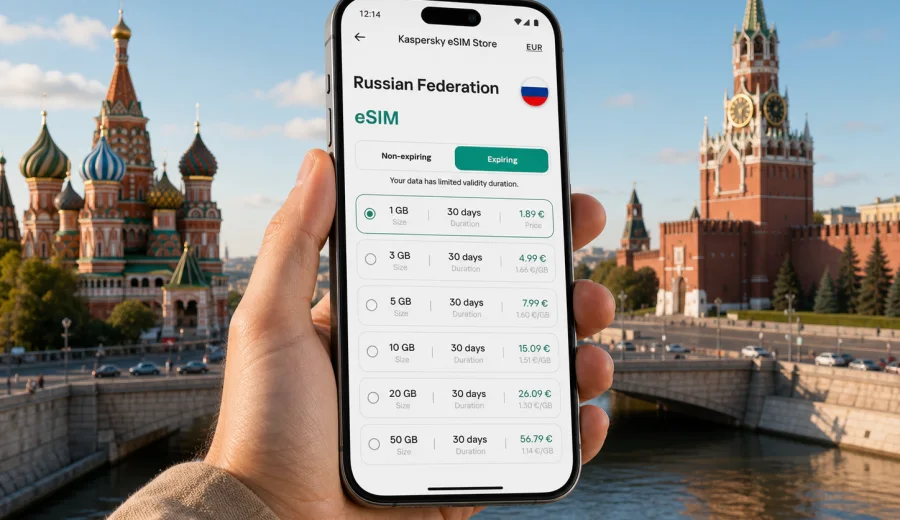
eSIM in the Russian Federation: mobile connection and internet for your trip
The Russian Federation is a large destination, and a trip can involve long airport transfers, intercity trains, hotel check-ins, maps, ride-hailing apps, work messages and translation tools. In that setting, mobile internet is not just a convenience. It helps you move through the first hours after arrival with less friction and gives you a clearer plan for staying online without searching for a local SIM card shop.
An eSIM, or embedded digital SIM, can be a practical way to prepare mobile connection before you travel. Instead of inserting a physical SIM card, you install an eSIM profile on a compatible phone or tablet and use a selected data plan for the destination. Kaspersky eSIM Store helps you choose, arrange and activate an eSIM with a suitable tariff for mobile internet during an international trip.
This guide explains how to think about eSIM for the Russian Federation, how to estimate data usage, what to check before buying, how installation works and when a regional or global option may make sense.
Why eSIM can be useful in the Russian Federation
Travel in the Russian Federation can be very different depending on your route. Some visitors stay mostly in Moscow or Saint Petersburg. Others combine business meetings with domestic flights, railway journeys, regional cities or longer stays with remote work. In each case, mobile data supports practical tasks from the moment you land.
Typical uses include:
- opening maps after arrival at the airport or railway station;
- contacting a hotel, host, colleague or driver;
- using messaging apps when a regular phone number is not needed;
- checking transport routes and booking confirmations;
- translating menus, signs and service messages;
- managing banking, travel insurance and airline apps;
- sharing a hotspot with a laptop when your tariff and device settings allow it;
- avoiding unnecessary dependence on public Wi-Fi in cafes, stations and hotels.
An eSIM is especially convenient when you want to prepare before departure. You can review the data volume, validity period and destination coverage in advance, then install the profile on a compatible device. Activation and data use depend on the selected plan, your phone settings and local network conditions, so it is important to read the tariff details before purchase.
eSIM, roaming and local SIM cards: what changes for travelers
There is no single best option for every traveler. The right choice depends on trip length, expected data use, device compatibility and how much time you want to spend arranging connectivity after arrival.
| Option | What it is good for | What to check |
|---|---|---|
| Standard roaming | Short trips when your home operator has clear conditions | Daily fees, speed limits, data caps and destination availability |
| Local physical SIM | Long stays when you are ready to visit a shop and follow local purchase rules | Required documents, opening hours, language barrier and phone lock status |
| Travel eSIM | Preparing mobile internet before or during the trip without a physical SIM card | Device compatibility, data volume, validity period and activation rules |
An eSIM for travel usually focuses on mobile data. It may not include a regular local phone number, voice calls or SMS unless these are clearly stated in the conditions of the selected tariff. For calls and messages, many travelers use internet-based apps over mobile data.
How much data you may need
Data use varies widely. A traveler who mostly checks maps and messages may need much less than a person who works on video calls or uploads media every day. Before choosing a tariff, list the apps you expect to use most often and estimate the daily rhythm of your trip.
Here is a practical planning guide:
| Trip style | Common online activity | Data planning note |
|---|---|---|
| Weekend city trip | Maps, messengers, taxis, bookings, light browsing | A smaller package may be enough if you avoid video streaming |
| One-week sightseeing route | Daily navigation, photo sharing, travel apps, translation | Consider extra margin for map use and airport transfers |
| Business trip | Email, documents, messengers, occasional tethering | Check whether hotspot use is allowed by the tariff and device |
| Remote work stay | Calls, cloud tools, file transfers, backup connection | Choose a larger package and keep Wi-Fi as the main connection where reliable |
| Multi-country route | Several countries before or after the Russian Federation | Compare country-specific, regional or global options where available |
To reduce unnecessary usage, download offline maps before departure, disable automatic cloud photo upload on mobile data, update apps on Wi-Fi and set streaming quality to a lower level. These habits are useful even when you choose a larger data package.
What to check before buying an eSIM
Before choosing any eSIM tariff for the Russian Federation, check your device and the conditions of the plan. This step prevents the most common problems: unsupported phones, operator-locked devices, misunderstood validity periods and accidental data use on the wrong SIM profile.
Use this checklist:
- Your smartphone or tablet supports eSIM.
- The device is not locked to a single mobile operator.
- You know whether your phone can keep your physical SIM active alongside eSIM.
- You understand when the validity period starts.
- You know whether the tariff is data-only or includes any other services.
- You have stable internet access for installation.
- You can receive the QR code or open the app profile before travel.
- You understand whether data roaming must be enabled for the eSIM profile.
If you are not sure whether your phone supports eSIM, check your device before you choose a tariff. Compatibility depends on the device model, country version, firmware and operator restrictions. A model name alone is not always enough.
A simple route-based way to choose a tariff
The Russian Federation covers long distances, so it helps to choose a tariff around your actual route rather than only the number of travel days. A city stay, a domestic flight itinerary and a multi-country journey place different demands on mobile internet.
For a city-focused trip, think about airport arrival, taxis, museum tickets, maps, reservations and messaging. For business travel, add email, calendar changes, document access and backup tethering. For a rail or domestic flight route, leave extra data for delays, station navigation and last-minute changes. For a route that includes neighboring countries or another region, compare the destination-specific option with regional or global plans if those are available for your itinerary.
Once you know your route and likely usage, you can review eSIM tariff options for the Russian Federation and choose a package that matches the country, data amount and validity period you need. The first thing to compare is not only price, but also how the plan fits your trip dates and daily data habits.
Preparing before departure
The best time to prepare eSIM is usually before the day you fly. You do not need to activate mobile data too early if the tariff conditions say usage starts after a certain trigger, but you should give yourself enough time to install the profile, check settings and save instructions.
Before you leave, prepare the following:
1. Confirm your phone supports eSIM and is not operator-locked.
2. Make sure your operating system is up to date enough for stable eSIM management.
3. Choose a tariff based on destination, duration and expected data use.
4. Keep your account email accessible on the same or another device.
5. Save any QR code or installation details where you can find them offline.
6. Keep your home SIM active if you need bank confirmation messages.
7. Turn off automatic updates and heavy cloud sync on mobile data.
It is also useful to name the eSIM profile clearly in your phone settings, for example "Travel data". That makes it easier to select the correct line for mobile data and avoid using your home SIM by mistake.
How to install and activate eSIM
Installation is usually a short process, but the exact flow depends on your device and operating system. After purchase, the eSIM profile may appear in your account or app, and you may also receive a QR code or on-screen instructions. Follow the steps carefully and keep the device connected to the internet during installation.
For detailed device guidance, use the Android installation instructions or the iOS installation instructions. The general sequence is:
1. Open the eSIM installation details on a stable internet connection.
2. Add the eSIM profile in your phone settings or through the provided flow.
3. Assign the eSIM as the mobile data line when you are ready to use it.
4. Enable data roaming for the eSIM profile if the instructions or plan conditions require it.
5. Keep your primary SIM selected for calls or messages if you still need it.
6. Test mobile data after arrival or when the plan is meant to become active.
Do not delete the eSIM profile unless you are sure you no longer need it. In many cases, removing a profile can prevent reuse, and a new installation may not be possible under the same conditions.
Practical scenarios for the Russian Federation
Different trips create different mobile internet needs. These examples can help you choose a data package more calmly.
Arrival in Moscow or Saint Petersburg. You may need mobile data immediately for transport, maps, hotel messages and payment confirmations. A prepared eSIM can reduce the need to connect to airport Wi-Fi before you know your way around.
Business travel. Meetings often change, and mobile data keeps calendar updates, messengers and map routes available while you move between offices, hotels and airports. If you expect to use a laptop hotspot, check the tariff conditions and your phone settings first.
Longer regional route. When you travel between cities, data use can rise because you rely on maps, tickets, translation and messaging more often. A larger package can provide a buffer, but you should still avoid heavy streaming on mobile data.
Family or group trip. Each traveler should check device compatibility separately. One phone can sometimes share a hotspot, but this may drain battery quickly and depends on the plan and device. For reliable use, frequent internet users may prefer their own eSIM profile.
Backup connection for hotel Wi-Fi. Hotel Wi-Fi quality can vary. An eSIM can act as a backup for essential tasks, but it is still wise to reserve mobile data for priority use when you have a limited package.
What eSIM does not replace
It is important to understand the limits before you travel. A travel eSIM is mainly a way to use mobile data on a compatible device. It is not a privacy tool, a traffic-routing product or a way to change how online services treat your location. It also does not guarantee service in every building, road or remote area, because actual connectivity depends on local network conditions, device settings and the selected tariff.
An eSIM also does not automatically include:
- a local phone number;
- regular voice calls;
- SMS;
- unlimited data;
- a guarantee that every app will work exactly as at home;
- permanent transfer to another device after activation.
Read the tariff details before purchase. If a feature is essential for your trip, such as hotspot use, long validity or very high data volume, check it before you rely on it.
Data-saving tips during the trip
Good settings can make a moderate data package last longer. Before your first full day in the Russian Federation, review your phone settings and app behavior.
Use these practical controls:
- set the eSIM profile as the mobile data line only when needed;
- disable mobile data for apps that run in the background;
- download maps, playlists and documents on Wi-Fi;
- stop automatic video playback in social apps;
- use lower quality for video calls when possible;
- pause cloud photo backup until you are on Wi-Fi;
- check data usage in your phone settings every day or two;
- keep your charger or power bank ready when using maps for long periods.
These steps are simple, but they help you keep the package for essential tasks: navigation, messaging, transport, bookings and work.
Common mistakes to avoid
Many eSIM issues come from setup details rather than the eSIM itself. Avoid these mistakes:
- buying before checking whether the device supports eSIM;
- trying to install the profile with unstable airport Wi-Fi and low battery;
- deleting the eSIM profile after installation;
- leaving the home SIM selected for mobile data by accident;
- assuming that data-only eSIM includes a phone number;
- ignoring the validity period of the selected plan;
- waiting until the last minute to find instructions;
- using high-resolution video or cloud backup on a small package.
If something does not work after arrival, check the basics first: the eSIM profile is installed, mobile data is assigned to that profile, roaming data is enabled if required, airplane mode is off and the device has had a few minutes to register on a local network.
FAQ
Can I install eSIM before I arrive in the Russian Federation?
In many cases, yes. Installation can often be done before travel if you have a stable internet connection and follow the instructions. Activation and validity rules depend on the selected tariff, so read the plan details before you install or start using mobile data.
Will eSIM give me a Russian phone number?
Do not assume that it will. Travel eSIM tariffs are often data-focused and may not include a regular phone number, voice calls or SMS. If calls are important, check the exact tariff conditions and consider internet-based calling apps for everyday communication.
Do I need to keep my physical SIM card?
Many travelers keep their home SIM active for bank messages, account verification or incoming calls, while using eSIM for mobile data. Your phone settings decide which line handles data, calls and messages.
Can I use eSIM as a hotspot?
It may be possible on some devices and tariffs, but you should check the plan conditions and device settings. Hotspot use can consume data quickly, especially with laptops, cloud sync and video meetings.
What if my phone does not support eSIM?
You will need another connection option, such as roaming or a physical SIM, depending on your trip. Check compatibility before purchase so you do not buy a tariff your device cannot install.
Is eSIM always cheaper than roaming?
Not always. Costs depend on your home operator, destination, trip length and data needs. eSIM can be a practical alternative because you can see the data volume, validity period and price before choosing a tariff, but you should compare it with your own roaming conditions.
Final preparation checklist
Before departure, make sure you can answer these questions:
- Is my device compatible with eSIM?
- Is the phone unlocked for mobile network use?
- Which SIM profile will handle mobile data?
- How much data do I realistically need?
- When does the tariff validity period begin?
- Do I need the Android or iOS installation guide saved?
- Do I have a backup way to access email or account details?
- Have I disabled high-data background activity?
If the answers are clear, you are much less likely to spend your first hours in the Russian Federation solving connection issues.
Choose an eSIM tariff for your trip
Kaspersky eSIM Store helps you prepare mobile internet for an international trip by letting you choose a destination, review tariff conditions and activate eSIM on a compatible device. For the Russian Federation, focus on your route, trip duration, expected data use and device support before you buy.
When you are ready, choose an eSIM tariff for your trip to the Russian Federation and install it before departure or when you have a stable connection. A few minutes of preparation can make navigation, messages, bookings and work tasks easier from the start of your journey.