
Travel connectivity guide
Salzburg eSIM: Mobile Internet for Austria Travel
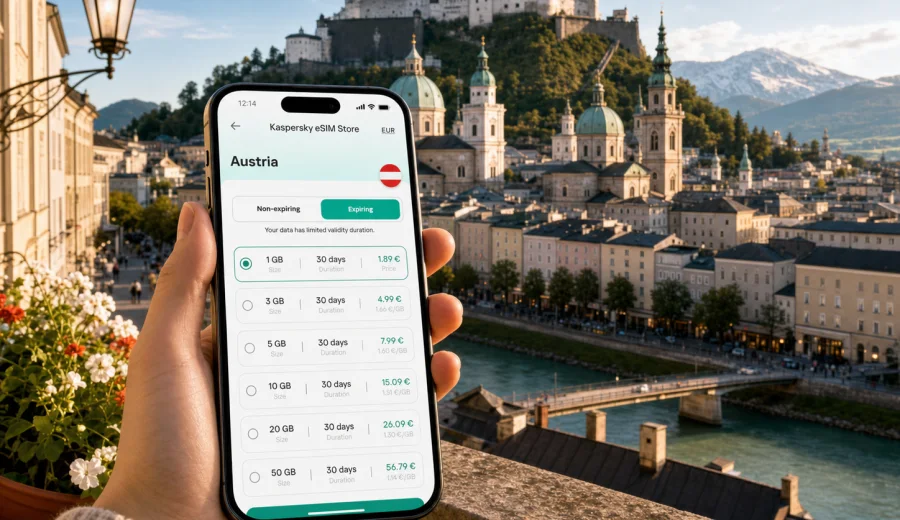
Salzburg eSIM: mobile connection and internet for your trip
Salzburg is compact enough to cross on foot, but a trip here still depends on steady mobile internet. You may land at Salzburg Airport, arrive by rail from Vienna or Munich, walk between both sides of the Salzach, check hotel access codes, book a concert ticket, follow a bus route to Hellbrunn, or confirm a day trip into the Salzkammergut. In each of these moments, an eSIM can help you keep maps, messages, bookings, and travel apps available without looking for a physical SIM card after arrival.
For many visitors, Salzburg is not a single-stop city. It is often part of a route through Austria, Bavaria, the Alps, or Central Europe. That makes mobile data planning more practical than it first appears. You need enough traffic for navigation and reservations, a validity period that fits the full stay, and a device that supports eSIM before you start the trip. Kaspersky eSIM Store is an app and website where you can choose, set up, and activate an eSIM with a suitable data plan for mobile internet during international travel.
This guide focuses on Salzburg itself: arrival, local movement, hotel check-in, old town walking routes, business trips, short stopovers, and trips from the city. Austria matters because it is the country for the eSIM plan, but the main question is local: how do you stay online smoothly while moving around Salzburg?
Why mobile internet matters in Salzburg
Salzburg is a city of short distances and precise timing. A bus from the airport to the center can be simple if you can check the route. A dinner reservation near Linzergasse is easier to find if maps update in real time. A walk from Mirabell Gardens to the cathedral district is more relaxed when you can confirm opening hours, ticket QR codes, and the location of your next stop.
Typical online tasks in Salzburg include:
- navigating from Salzburg Airport to the old town or hotel;
- checking rail platforms at Salzburg Hauptbahnhof;
- using maps in Altstadt, Nonntal, Maxglan, Elisabeth-Vorstadt, and Schallmoos;
- messaging your hotel or apartment host before check-in;
- confirming tickets for concerts, museums, or tours;
- booking taxis, rides, buses, or regional trains;
- sharing photos without waiting for hotel Wi-Fi;
- using translation, banking, and authentication apps;
- working from a hotel, cafe, conference venue, or coworking space.
The old town is walkable, but streets, courtyards, bridges, steps, and river crossings can make a route less obvious than it looks on a paper map. Mobile internet is also useful when plans change during the day.
Arrival scenarios: airport, rail station, and cross-border routes
Salzburg Airport is close to the city, so the first online task often happens quickly. You may want to message your hotel, open a transit app, find the correct bus stop, or check whether a taxi ride is worth it with luggage. If your eSIM is installed before departure, you can switch mobile data to the eSIM profile after arrival and avoid searching for a shop at the airport.
If you arrive by train, the main station is a common transfer point for routes from Vienna, Innsbruck, Munich, Zurich, and other regional cities. Online access helps with platform changes, digital tickets, onward buses, and hotel directions. It is also useful if your trip crosses the Austria-Germany border: confirm that the plan you choose covers the country or region you need, and check the validity period before travel.
For car trips, mobile internet is useful even if your vehicle has navigation. You may still need parking information, hotel messages, EV charging apps, toll or vignette details, restaurant bookings, and route updates for mountain roads. Downloading offline maps helps, but online data gives you live changes when the route, weather, or schedule shifts.
Where eSIM is useful inside the city
Salzburg does not require heavy data use all day, but it rewards reliable access at the right moments. These are the places where an eSIM can make the trip easier:
| City situation | Why mobile data helps |
|---|---|
| Old town walks | Maps help with narrow streets, courtyards, viewpoints, museums, and bridge crossings. |
| Hotel check-in | Many hotels and apartments use messages, codes, portals, or digital confirmations. |
| Public transport | Buses and regional trains are easier when you can check times and route changes. |
| Hohensalzburg Fortress | Tickets, opening hours, funicular details, and weather checks are useful on the move. |
| Mirabell and Neustadt | Navigation helps if you move between gardens, restaurants, and the station area. |
| Business travel | Email, calendar changes, taxis, and document access depend on stable data. |
| Day trips | Routes to Hallstatt, St. Gilgen, Wolfgangsee, Berchtesgaden, or the Alps may change. |
For a short city break, you may only need a moderate data package for maps, messages, and bookings. For a longer route through Austria, a larger package or longer validity period can be more comfortable. The right choice depends on how you travel, not just on the city name.
How to estimate your data needs for Salzburg
Most travelers underestimate background data and overestimate how much they need for basic navigation. Maps, messages, and tickets usually use less traffic than video calls or streaming, but constant photo backup, cloud sync, or hotspot sharing can change the calculation.
Use this practical estimate:
- Light use: maps, messaging, tickets, email, and occasional browsing.
- Medium use: regular maps, social media, restaurant searches, photo sharing, and travel apps.
- Heavy use: video calls, remote work, cloud backup, hotspot use, or streaming.
For a weekend in Salzburg, light or medium use is common. For a week that includes Salzburg, Vienna, Innsbruck, and regional day trips, look at both data size and validity. If you plan to work from the city, treat video calls and hotspot use as separate from ordinary sightseeing data.
Before choosing a plan, write down three details:
1. How many days you will need mobile internet in Austria.
2. Whether your route stays in Austria or crosses into another country.
3. Whether you will use data only on your phone or also share it with another device.
These answers help you avoid choosing a plan that is too short, too small, or not suitable for your route.
Choosing an eSIM plan for Salzburg
For a city article, the country plan is the relevant landing page because Salzburg is in Austria. When you compare options, check the destination, data amount, validity period, price, and activation details. You can view available mobile internet options for Austria and choose a data plan that fits your Salzburg itinerary.
Kaspersky eSIM Store helps you choose and set up an eSIM with a suitable data plan for travel. It is not a mobile network operator and does not replace the local network itself. The practical value is that you can prepare the eSIM process before the trip, see key plan conditions, and reduce your dependence on public Wi-Fi, airport kiosks, or physical SIM cards.
When comparing plans, pay attention to:
- Destination: the plan should include Austria, or a region that includes Austria, if that matches your route.
- Data amount: choose based on navigation, messaging, work, and media habits.
- Validity: match the plan duration to the full travel period, including arrival and departure days.
- Activation rules: check when the validity period starts and whether activation needs mobile network access.
- Device support: confirm your phone or tablet supports eSIM and is not locked to another carrier.
- Hotspot needs: if you plan to share data, check whether tethering is allowed by the selected plan.
A Salzburg stopover may need only a small package. A family holiday in the Alps or a business week with video calls may need more. The goal is not to buy the largest option automatically; it is to choose a plan that matches your actual travel behavior.
Salzburg travel patterns and data planning
Different trips create different mobile internet needs. A weekend visitor may mainly need maps, restaurants, tickets, and messenger apps. A festival or concert visitor should allow extra data for QR codes, group messages, and schedule changes. A business traveler may use more traffic for email, calendar updates, taxi apps, video calls, or hotspot use. If Salzburg is one stop in a longer Austria route, match the validity period to the whole route, not only the nights spent in the city.
If you are visiting during a busy season, mobile internet is useful for more than directions. Restaurant availability, timed museum entries, concert tickets, and weather decisions can change during the day. A prepared eSIM helps keep those decisions on your phone instead of depending on hotel Wi-Fi or public hotspots.
Before you travel: a simple checklist
Prepare the eSIM before the trip if you can. This gives you time to check compatibility, read the plan details, and avoid setting everything up while standing with luggage.
Checklist before leaving for Salzburg:
- Confirm that your phone supports eSIM.
- Check that the device is not carrier-locked.
- Choose a plan that includes Austria.
- Match the validity period to your arrival and departure dates.
- Read when the plan starts counting down.
- Save your hotel address and first route offline as backup.
- Keep your primary SIM available if you need calls or SMS from your home number.
- Make sure mobile data is assigned to the eSIM profile when you want to use it.
If you need to confirm compatibility, use Check your device before choosing a plan. eSIM support depends on the exact device model, region, and carrier lock status, so checking early is better than discovering a limitation at the airport.
How to install and activate eSIM for Salzburg
The installation flow depends on your device, but the travel logic is simple: choose the plan, install the eSIM profile, and then use it for mobile data when appropriate. If your device supports eSIM, you can usually prepare the profile before the trip and activate mobile data after arrival.
General steps:
1. Choose Austria or a suitable regional destination for your route.
2. Select the data amount and validity period.
3. Complete the setup flow in Kaspersky eSIM Store.
4. Install the eSIM profile on your compatible device.
5. When you arrive, set mobile data to the eSIM profile.
6. If required by your device or plan, enable data roaming for the eSIM profile.
7. Keep your regular SIM for calls and SMS if you still need your main number.
For device-specific setup, follow the Android installation guide or the iOS installation guide. Connection can take a few minutes and depends on the device, settings, and local network conditions.
Do not delete the eSIM profile after installation unless you are sure you no longer need it. Some eSIM profiles cannot be transferred or reinstalled after removal, depending on the plan conditions.
Practical Salzburg use cases
First hour after arrival
The first hour is when mobile internet matters most. You may need to open a message from your hotel, check the bus route, call a ride, or find the correct side of the river. If your eSIM is ready, you can turn on mobile data and handle these tasks before you reach the hotel.
For a smooth arrival, keep the following offline as backup: hotel address, booking number, first transport route, and a screenshot of any access code. Use mobile data for live updates and messages, not as your only copy of critical information.
Old town and sightseeing
Salzburg's old town is dense and layered. You can walk from Mirabell Gardens to Getreidegasse, the cathedral, Kapitelplatz, and the fortress area, but the route may include small lanes, steps, covered passages, and busy pedestrian zones. Mobile data helps you adjust the route without stopping at every signboard.
Useful online tasks include checking museum times, opening ticket QR codes, finding a cafe away from the busiest streets, and sharing your location with travel companions. If you use audio guides or stream music while walking, include that in your data estimate.
Hotels and apartments
Salzburg has classic hotels, modern business hotels, guesthouses, and short-stay apartments. Some check-ins are traditional; others use app messages, key boxes, or entry codes. Mobile internet is useful if you arrive outside reception hours or need to coordinate luggage storage.
Hotel Wi-Fi is still useful for larger downloads, backups, and video calls. An eSIM does not mean you should ignore Wi-Fi completely. It simply gives you a more flexible option when you are outside the hotel or when public Wi-Fi is inconvenient.
Business trips and events
For business travelers, Salzburg can combine meetings, conferences, cultural events, and regional transfers. Mobile data supports calendar updates, taxi bookings, document access, authentication apps, and quick calls over messaging services. If you expect video meetings, choose a plan with enough data and test your setup before the meeting day.
Keep a power bank if you will be out all day. Navigation, hotspot use, and video calls use battery as well as data. A good eSIM setup helps with internet access, but device power and backup documents are still part of the travel plan.
Stopovers and short visits
Some travelers visit Salzburg for a few hours between trains or as a stop between Munich, Vienna, and the Alps. In that case, your main data needs are station navigation, locker information, walking routes, and tickets. A short plan can be enough if it covers the right country and dates.
If you cross the border before or after Salzburg, check whether your selected plan remains suitable for the next part of the journey. A country-specific plan may be right for Austria-only travel, while a regional plan may fit better for a route across several countries.
Day trips from Salzburg
Salzburg is a strong base for trips into lakes, mountains, and nearby towns. Mobile internet is useful because regional travel can involve train changes, buses, boat schedules, weather decisions, and route updates.
Common day-trip scenarios:
- Hallstatt or the Salzkammergut: check train and bus connections, weather, and return options.
- St. Gilgen and Wolfgangsee: use maps for lakeside routes and transport changes.
- Werfen and the surrounding mountains: confirm train times and walking routes.
- Berchtesgaden or Bavaria: check whether your plan fits a cross-border route.
- Ski or alpine areas in season: monitor weather, lift information, and transport.
Download key maps before leaving the city if you expect weaker signal in mountain areas. An eSIM data plan helps you stay connected where mobile service is available, but terrain, local network conditions, and device settings can affect connection quality.
What eSIM does and does not replace
An eSIM for travel is mainly about mobile data. It is useful for apps, maps, messaging, email, tickets, and online services. It usually does not include a standard local phone number, voice calls, or SMS unless the specific plan conditions say so.
For many Salzburg trips, that is fine. You can use internet-based messaging and calling apps, keep your primary SIM active for important calls or SMS, and use the travel eSIM for mobile data. If your bank or airline sends verification messages to your main number, keep that in mind before changing SIM settings.
FAQ: eSIM and mobile internet in Salzburg
Is eSIM useful for a short trip to Salzburg?
Yes, especially if you want maps, tickets, hotel messages, and transport apps available from arrival. For a very short visit, choose a plan with a validity period and data amount that match the actual time you will be online.
Should I install eSIM before arriving in Austria?
Installing before travel can be convenient because you can complete setup while you still have stable home internet. Check when the validity period starts before you activate the plan.
Can I use eSIM for calls and SMS in Salzburg?
Travel eSIM plans are usually focused on mobile data. Standard calls, SMS, and a local phone number may not be included unless the selected plan states otherwise. You can often use messaging and calling apps over mobile data.
What if my trip includes Munich or another country?
Check the destination coverage before choosing a plan. If your route crosses borders, a regional option may be more practical than an Austria-only plan, depending on the full itinerary and plan conditions.
Final checklist before choosing your Salzburg eSIM
Before you decide, review the trip in practical terms:
- Arrival point: airport, rail station, car route, or cross-border transfer.
- City use: maps, bookings, messages, tickets, payments, and transport.
- Stay length: one day, weekend, business week, or multi-city route.
- Data habits: light navigation, social sharing, video calls, or hotspot use.
- Device readiness: eSIM support, carrier lock status, battery, and backup access.
- Plan fit: Austria coverage, validity, data amount, activation rules, and conditions.
If the answers are clear, the setup becomes straightforward. Choose a plan that fits Austria and your Salzburg itinerary, install it on a compatible device, and keep your travel apps ready before you need them.
For a smoother arrival and easier movement around the city, you can prepare an eSIM data plan for your trip to Salzburg through Kaspersky eSIM Store. Check your device first, choose a suitable Austria plan, follow the setup instructions, and use the eSIM for mobile internet when you arrive.