Travel connectivity guide
Samsung Galaxy Note 20 Ultra 5G eSIM: compatibility
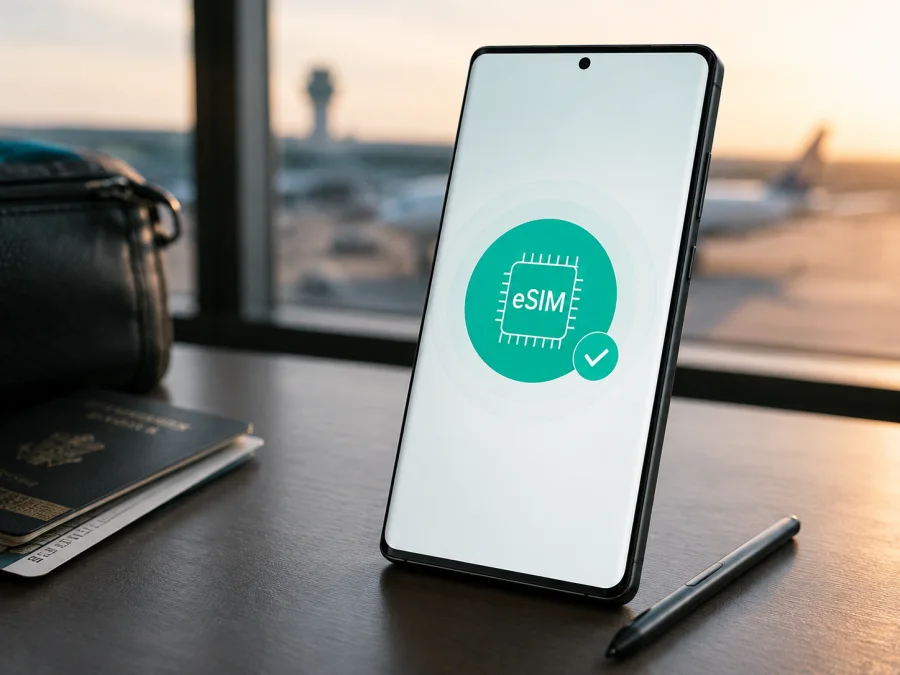
Samsung Galaxy Note 20 Ultra 5G eSIM compatibility and setup
If you want mobile data abroad without replacing your physical SIM card, eSIM can be useful. For the Samsung Galaxy Note 20 Ultra 5G, support differs by regional or carrier version. Samsung’s regional guides and specifications show different SIM configurations, so your exact handset, software, and operator status matter.
Does Samsung Galaxy Note 20 Ultra 5G support eSIM?
The careful answer is: some Samsung Galaxy Note 20 Ultra 5G variants support eSIM, but the name alone does not guarantee it for every market. Samsung documentation for selected regional devices identifies an Embedded SIM, and Samsung lists Note20 / Note20 Ultra among supported Galaxy phones in one regional guide. However, Samsung specifications for the U.S. unlocked Galaxy Note20 Ultra 5G list SIM 1 + MicroSD rather than an embedded SIM. Samsung also notes that eSIM availability can depend on market, software updates, and operator.
Treat the device as conditionally compatible. If it shows an EID and an option such as Add eSIM or Add mobile plan in Settings, it has the eSIM path needed to add a profile. If those entries are absent, do not buy a travel eSIM for that handset until Samsung or the seller confirms the variant. A 5G label, dual-SIM capability, or large storage capacity does not prove eSIM support.
For this phone, the most reliable decision comes from the handset in your hand: check the EID and mobile-network menu, then confirm that it is not carrier-locked.
Why regional versions can differ
The Galaxy Note20 family was sold in multiple markets and model codes. Radio bands, SIM tray, firmware, and carrier provisioning can vary. A physical Nano-SIM and microSD version may not expose an eSIM menu, even if another regional version does. A dual-SIM model may use two physical SIMs or a physical SIM plus eSIM.
Samsung’s own product material explains the caution: one regional specification can describe “Nano-SIM, Embedded SIM,” while another official specification shows “SIM 1 + MicroSD.” Samsung also notes that eSIM use can depend on software updates, market, and operator. These are different version and service conditions, not a universal promise.
The handset needs eSIM hardware, current firmware must expose it, and the phone must be unlocked and accepted by the selected plan. Do not infer the answer from another person’s Note20 Ultra, a listing without a model code, or a generic “5G eSIM” claim.
Key compatibility facts
| Item | What to know for Samsung Galaxy Note 20 Ultra 5G |
|---|---|
| Device covered here | Samsung Galaxy Note 20 Ultra 5G; do not substitute Note20, Note20 Ultra LTE, or another Galaxy model |
| eSIM status | Region- and variant-dependent; some official Samsung materials list Embedded SIM, while other variants do not |
| Physical SIM | Usually a Nano-SIM configuration, but tray and dual-SIM behavior vary by market |
| 5G | Network capability does not prove eSIM availability or 5G access on a travel plan |
| EID | The strongest on-device sign of an eSIM identity; keep it private |
| Carrier lock | A locked phone can reject a travel eSIM even when the hardware supports it |
| Travel use | Confirm destination, data-only terms, activation rules, and validity before purchase |
What eSIM does for a trip
An eSIM is a digital SIM profile stored in the phone. When compatible, it lets you keep the regular physical SIM in the tray while using a separate profile for maps, translation, reservations, messaging, and other mobile data abroad.
Kaspersky eSIM Store is an app and website that helps you choose, arrange, and activate an eSIM with a suitable travel data plan. It is not a mobile operator, network owner, or mobile-internet provider; service conditions come from the selected plan and its underlying local operator arrangements.
Before choosing a plan, check the country or region, data allowance, validity, activation window, and whether it is data-only. Unless the plan says otherwise, it does not provide a new phone number, traditional calls, or SMS. Keep the physical SIM for those functions or use messengers over the travel connection.
Check the EID and eSIM menu before buying
Perform these checks before paying for a travel plan:
- Open Settings. Use the Settings app on the Samsung Galaxy Note 20 Ultra 5G.
- Open Connections. Select the section for Wi-Fi, Bluetooth, mobile networks, and SIMs.
- Open SIM manager. Look for Add eSIM, Add mobile plan, or similar wording. Labels vary by One UI version and region.
- Look for EID. In phone information or SIM status, search for “EID.” It is the identifier associated with the embedded SIM component and differs from the IMEI.
- Check both signs together. An EID plus an Add eSIM control strongly indicates that the handset can accept an eSIM profile. An IMEI alone is not enough.
- Check the lock status. Ask the original operator or seller whether the phone is network-unlocked.
If the option is missing, restart the phone and install any official update offered in Settings, then check again. Do not factory-reset or delete a working profile as a test. If there is still no EID or eSIM control, treat the phone as incompatible until Samsung or the seller confirms the exact model and market.
Compatibility checklist before purchase
Use this checklist for the Samsung Galaxy Note 20 Ultra 5G:
- [ ] The exact device name and model code match the phone you will use.
- [ ] An EID is visible in Settings or device information.
- [ ] Settings contains Add eSIM, Add mobile plan, or an equivalent control.
- [ ] The phone is not locked to a carrier or restricted to one network.
- [ ] Android and One UI are updated through normal device settings.
- [ ] Wi-Fi or another internet connection is available for profile download.
- [ ] The selected plan covers the country, region, or multi-country route.
- [ ] Data volume, validity, activation timing, and refund conditions are understood.
- [ ] You know which SIM will handle calls and which profile will handle mobile data.
Before selecting a plan, Check your device.
How to install an eSIM on Samsung Galaxy Note 20 Ultra 5G
Install the profile before departure on Wi-Fi when possible. Check when the plan starts counting time or data, then follow its terms.
Prepare the phone
- Confirm compatibility. Check the EID, Add eSIM control, and unlocked status.
- Connect to Wi-Fi. Keep the phone online while the profile downloads.
- Keep the QR code ready. Use the code or activation details in your Kaspersky eSIM Store profile.
- Update the phone if needed. Complete a normal Samsung software update before travel.
For platform-specific background, see the Android eSIM installation instructions and the iOS eSIM installation instructions. The iOS page is a general eSIM reference; the Samsung Galaxy Note 20 Ultra 5G uses Android and its own Samsung menu names.
Add the profile
- Open Settings and Connections. Start from the main Settings screen.
- Tap SIM manager. Wait for physical SIMs and eSIM options to appear.
- Tap Add eSIM. Choose the option for adding a mobile plan if the wording differs.
- Scan the QR code. Point the camera at the code while connected to Wi-Fi.
- Confirm the download. Read the plan label and accept the installation.
- Wait and name the profile. Download and registration can take several minutes; use a label such as Travel Data.
If the QR code is displayed on the same phone, use a supplied manual activation code or another screen. Do not share an unused code; it may be sensitive and many profiles are single-installation.
Activate and select mobile data
Adding the profile and using it for data are separate actions.
- Open SIM manager again. Confirm that the new profile appears and is switched on.
- Choose mobile data. Select the travel eSIM as the preferred SIM for data.
- Keep calls on the desired line. If you retain the home SIM, select it for calls or SMS as needed.
- Check data switching. Turn off automatic data switching if it could move traffic back to the home SIM and create roaming charges.
- Enable data roaming for the travel eSIM if required. Use this setting only for the intended profile and follow the plan’s instructions.
- Wait for registration. The phone may need several minutes; timing depends on device, network, and plan.
- Test a simple webpage. Make a small request and verify that the expected profile is using data.
If your home operator charges for roaming, keep data roaming off on the home SIM and verify the selected data SIM before leaving Wi-Fi.
Using eSIM while travelling
Arrival and first connection
If a plan starts on arrival, install it before takeoff but leave the travel line inactive until the appropriate time. After landing, enable it, select it for mobile data, and allow a few minutes for registration. Turn on data roaming for that profile only when required.
Keeping your regular number
The physical SIM can often remain active for incoming calls, SMS, and account verification, subject to your home operator’s rules and fees. Use the travel eSIM for data, disable automatic switching, and review background-data permissions. A regular home-line call can still be billed by the home operator.
Choosing data for your travel style
Maps, translation, text messages, and email use less data than video calls, backups, streaming, or laptop tethering. Turn off automatic backups and app updates when the plan is limited, and check the balance in the relevant account or app. For a multi-country route, confirm that the plan covers every stop and review validity before installation.
Troubleshooting common problems
There is no Add eSIM option
Recheck the exact model code, sales region, and firmware. Look for an EID and compare the SIM configuration with Samsung’s specification. If there is no EID or embedded-SIM setting after an official update, it may be a physical-SIM-only variant.
The QR code will not scan
Increase brightness on the screen showing the code, clean the camera lens, and hold the phone steady. Make sure the code is complete, or use manual activation details. Do not repeatedly scan a single-use code; contact support and keep it private.
The profile will not download
Confirm Wi-Fi, airplane mode, free storage, and any work-management policy. Restart and try again from SIM manager. Failure can result from a used code, a locked phone, or an unsupported variant.
The eSIM is installed but there is no data
Verify that the travel eSIM is enabled and selected for mobile data. Check supplied APN instructions, enable data roaming on the travel profile when required, and turn off Wi-Fi briefly to test cellular data. Check signal strength and allow time for registration; do not change APN values at random.
The home SIM is still using data
Check the preferred mobile-data SIM and automatic switching. Disable roaming data on the home SIM if needed. Both lines can be active while only one is intended for data.
Calls or SMS do not work
Many travel eSIMs are data-only and do not include an ordinary number, voice service, or SMS. Keep the home SIM for those functions if your operator permits it, or use messaging and calling apps over the travel connection. This is a plan feature, not proof that the Samsung Galaxy Note 20 Ultra 5G is incompatible.
The connection is slow or drops
Move to a location with better signal, restart mobile data, and check access to the available local network. 5G may not be available; 4G/LTE can be normal. Speed depends on coverage, congestion, buildings, and network access.
FAQ
Is every Samsung Galaxy Note 20 Ultra 5G eSIM-compatible?
No. Support varies by regional hardware, firmware, and operator provisioning. Check an EID and an Add eSIM control on the exact handset.
Does 5G mean eSIM will work?
No. 5G describes network capability, not the presence of an embedded SIM. A 5G handset can be physical-SIM-only, and an eSIM-capable phone may use 4G when that is what the plan or local network provides.
Do I need an EID?
An EID is the clearest sign that the phone includes an eSIM component. If Settings has no EID and no eSIM menu, stop before purchase and confirm the model with Samsung or the seller. Do not confuse EID with IMEI.
What is Kaspersky eSIM Store?
Kaspersky eSIM Store is an app and website that helps you choose, arrange, and activate an eSIM with a suitable mobile-data plan for an international trip. It is not an operator, network owner, or mobile-internet provider. Availability, coverage, and terms depend on the selected destination and plan.
Final device check and trip eSIM choice
Before selecting a travel plan for the Samsung Galaxy Note 20 Ultra 5G, confirm the exact model code, find an EID, verify Add eSIM in SIM manager, check that the phone is unlocked, and update Android and One UI through official settings. Then choose a plan for the correct country, region, or route and review its data allowance, validity, activation timing, roaming requirement, and data-only limitations.
If all checks pass, Kaspersky eSIM Store can help you choose, arrange, and activate a suitable eSIM travel plan through its app or website before departure or after arrival. Keep the QR code private, select the travel eSIM for mobile data, and monitor the active profile during the trip. If any check fails—especially if there is no EID—pause the purchase and confirm the regional version with Samsung, the seller, or your operator first. That pause is the safest way to avoid buying an eSIM plan for an incompatible Samsung Galaxy Note 20 Ultra 5G.