Travel connectivity guide
Samsung Galaxy S20+ 256GB eSIM Guide
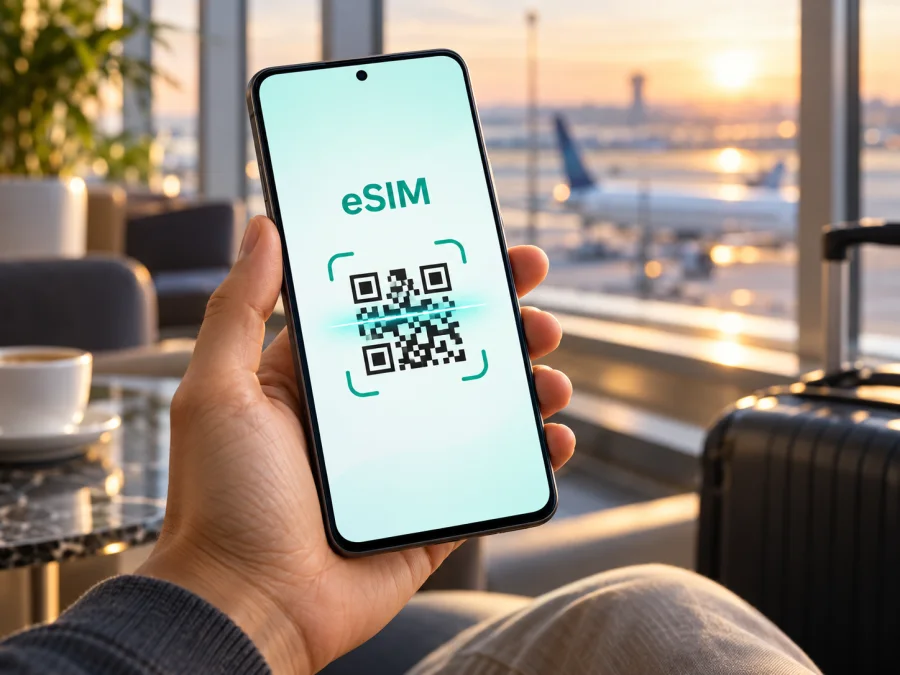
Samsung Galaxy S20+ 256GB eSIM: compatibility and setup guide
Samsung’s published Galaxy eSIM guidance lists the Galaxy S20+ among eSIM-capable models, and Samsung’s S20 SIM specification page marks eSIM as supported for the S20+ 5G. That is a useful starting point for a Samsung Galaxy S20+ 256GB, but it does not guarantee that every phone sold under this storage description has an available eSIM function. The 256GB label identifies internal storage; it does not identify the complete model code, the country variant, the original carrier configuration or the software currently installed.
Practical answer: the Galaxy S20+ family can support eSIM, but confirm your particular handset before choosing or paying for a travel plan. Samsung says eSIM availability can depend on the country of origin, device model and mobile provider. The phone itself must show an EID and an eSIM option in Settings, and it must be unlocked for the network you intend to use. If either check fails, treat the device as not ready for an eSIM until Samsung or the seller confirms otherwise.
At a glance
| Item | What to know about Samsung Galaxy S20+ 256GB |
|---|---|
| Exact topic | Samsung Galaxy S20+ 256GB; the storage variant is retained here as given |
| eSIM family support | Samsung lists Galaxy S20+ among supported Galaxy models; its S20 SIM page specifies S20+ 5G and lists eSIM as supported |
| What 256GB tells you | The phone’s storage capacity; it does not establish regional eSIM availability |
| Final compatibility check | Look for an EID and an “Add eSIM” or “Add mobile plan” control in SIM Manager |
| Network conditions | Provider support, country of origin, firmware and carrier lock can affect activation |
| Typical setup route | Settings → Connections → SIM manager → Add eSIM / Add mobile plan, then scan the provider’s QR code |
| Best time to install | While connected to reliable Wi‑Fi and with the QR code or activation details available |
Samsung’s support pages use slightly different names for the menu across software versions: “SIM manager” and “SIM card manager” may both appear. The visible text and choices can also vary by market, carrier firmware and Android/One UI version. Follow the labels on your phone rather than assuming an online screenshot will match exactly.
Does Samsung Galaxy S20+ 256GB support eSIM?
Samsung UK’s “Galaxy eSIM and supported network carriers” page, reviewed 2 November 2026, includes Galaxy S20, S20+ and S20 Ultra in its eSIM-capable list. Samsung UK’s “What SIM cards can I use with my S20?” page lists eSIM for S20+ 5G and says two SIM connections can operate at once; it also cautions that availability depends on the phone’s country of origin. This supports a conditional “yes” for the S20+ family, not a blanket promise for every individual Samsung Galaxy S20+ 256GB handset sold worldwide.
The supplied name does not include the full model code shown in Settings or on the original box. “256GB” does not tell you whether eSIM is enabled for its market or firmware, or restricted by a carrier. Check the handset before buying a plan.
A missing option is meaningful. If Settings does not show an eSIM entry and the device has no EID, do not infer that eSIM will appear after buying a QR code. First check the model code, software updates, carrier restrictions and the phone’s original sales market with Samsung support or the seller. If the handset still has no eSIM capability, use a physical SIM if appropriate, ask your home carrier about roaming, or use Wi‑Fi where available.
Regional versions, carrier firmware and the operator market
A model name can cover phones sold in different countries and through different carriers, with variations in firmware, SIM configuration and available features. Samsung lists the S20 family as capable but says eSIM may not be supported depending on the country of origin. Carrier firmware or a network lock can also affect activation.
Keep these three questions separate:
- Does this handset contain and expose eSIM capability? Check EID and SIM Manager on the device.
- Is the handset free to use another provider? Check for a carrier lock or an unpaid-device restriction with the original carrier.
- Does the provider for the destination or travel plan support this phone and its eSIM profile? Check the provider’s current compatibility and activation requirements for the relevant market.
An eSIM can be supported by the phone while the intended operator does not support eSIM activation for that device, or while the phone is locked to another network. Conversely, a local provider’s eSIM service in one country does not prove that every international travel plan or every regional S20+ variant will work. Confirm the exact device and the specific provider market that matters to your trip.
The “5G” wording also needs care. Samsung’s S20 specification page identifies the S20+ 5G in its SIM table, but the input name “Samsung Galaxy S20+ 256GB” does not itself state a 5G model code. Do not use a 5G icon, product listing shorthand or storage size as a substitute for the model identifier. eSIM compatibility should be checked independently from 5G availability: they are separate capabilities, and neither guarantees the other in every market.
Check your device before buying an eSIM plan
Do these checks on the phone you will take on the trip, not only on the box or the original product page. A refurbished or second-hand handset may have a different software build or carrier history than expected.
Check for an EID
The EID is the identifier associated with the device’s embedded SIM hardware. On many Samsung versions, open Settings → About phone → Status and look for EID. The exact path may be labelled slightly differently. Samsung also notes that an EID can be printed on the phone’s original packaging. The on-device value is the more useful check for the handset you currently have.
If no EID appears, check the full model code under Settings → About phone, install any available official software update, restart, and look again. If it is still absent, ask Samsung or the seller to verify the model code and regional configuration. Avoid posting the full EID publicly; share it only through a trusted provider process when it is specifically requested.
Check for the add-eSIM control
Open Settings → Connections → SIM manager. Depending on software, the relevant control may read Add eSIM, Add mobile plan or a similar phrase. Finding this entry is a strong practical sign that the phone can accept an eSIM profile, although a plan still needs provider support and an unlocked device. If the option is missing, compare the complete model code with Samsung’s support information and ask the original carrier whether the device firmware or lock status affects the feature.
Use this quick checklist before checkout:
- [ ] The exact phone in your hand is Samsung Galaxy S20+ 256GB, and its full model code is recorded.
- [ ] An EID appears in the phone’s status information or Samsung has confirmed the device configuration.
- [ ] SIM Manager shows an option to add an eSIM or mobile plan.
- [ ] The phone is not locked to a carrier that would block the intended eSIM.
- [ ] The eSIM provider confirms that its plan and activation method are suitable for this device and destination.
- [ ] You have a reliable Wi‑Fi connection for installation and know when the plan’s validity begins.
Check whether your device is compatible before selecting a travel plan. If the device check is uncertain, resolve it first; a successful purchase does not unlock a phone or add missing eSIM hardware.
Prepare the phone and plan
Before installation, update the phone using its normal Settings software-update screen, charge it, and connect to Wi‑Fi. Keep the QR code or activation details accessible on a different screen or on paper, because the phone cannot scan a code that is displayed only on its own screen. If you received the code on the S20+, open it on a laptop or another phone instead.
Review the plan’s destination, supported network, data allowance, validity period, activation conditions and any data-roaming instruction. A plan can start its validity when it is installed, when it first connects in the destination, or under another rule stated by its provider. Do not assume when the clock starts. Keep the QR code private: some eSIM codes can only be used once, and another person who scans it may consume the installation opportunity.
Kaspersky eSIM Store is an app and website where you can select, arrange and activate an eSIM with a suitable mobile-data plan for an international trip. Review the destination and current plan conditions there, then confirm that the S20+ passes the device checks above. Each offer has its own destination and terms, so check the specific details. Browse the Kaspersky eSIM Store to review current destinations and plans.
Install and activate an eSIM on the Galaxy S20+
Samsung’s Galaxy eSIM instructions describe adding a plan with a QR code, an activation code or a pre-assigned plan, when the provider supports the relevant method. On this generation of Galaxy software, the labels may say “SIM card manager” instead of “SIM manager.” The Android steps below describe the usual flow; use the provider’s instructions if its QR process differs.
- Connect to Wi‑Fi. Keep Wi‑Fi available until the profile has downloaded and activation is complete.
- Open SIM Manager. Go to Settings → Connections → SIM manager (or SIM card manager).
- Choose the add option. Tap Add eSIM, Add mobile plan or the matching control shown on your software version.
- Scan the provider’s QR code. Select the QR scanning option and point the camera at the code displayed on another device or printed by the provider.
- Confirm the download. Read the prompt, approve adding the mobile plan and wait while the eSIM profile is downloaded. Keep the Settings screen open if prompted.
- Use manual details only if offered. If the provider supplied an activation code and Samsung shows a manual entry option, enter the details exactly as issued. Do not guess or edit server information.
- Name the profile. Give it a clear label such as “Travel data” so you can distinguish it from your home SIM.
- Choose SIM preferences. Select which SIM is used for mobile data. Keep your home number as the voice/SMS line if that is your preference, and make the travel eSIM the data line when appropriate.
- Activate at the right time. Follow the plan’s validity instructions. If it should begin only on arrival, keep the travel line off until then.
- Test connection. When in the covered destination, enable the eSIM, allow mobile data for that line, and wait several minutes for registration. Follow any provider instruction about data roaming for the travel profile.
For Samsung and other Android devices, see the Android eSIM installation instructions. The iPhone eSIM installation instructions are included for travellers helping another person or comparing a second device; they do not describe the Galaxy’s Android menus.
Use the eSIM for mobile data while travelling
A travel eSIM is useful when you want mobile data for maps, bookings, transport apps, email and messaging without removing your physical SIM. Before departure, check the country or region named in the plan, the supported network or networks, the allowance and the validity rules. A regional plan may cover more than one destination, but that coverage must be stated in the current plan terms. A plan for one country should not be assumed to work across a border.
At your destination, open SIM Manager and make sure the travel profile is enabled. In the mobile network settings, set the travel eSIM as the mobile-data SIM. If the provider instructs you to enable data roaming for its travel profile, enable it for that line only and keep roaming disabled on the home SIM if you want to avoid using the home carrier’s data allowance. Roaming settings are a device control; whether they are required depends on the eSIM provider’s network arrangement and plan instructions.
A few everyday examples help with setup:
- Short city break: install on Wi‑Fi before leaving and enable the profile when its stated validity rules allow.
- Multi-country itinerary: confirm that every stop is included in the plan’s named coverage; check regional options if the route crosses borders.
- Work trip with a home number: keep the home SIM for calls or messages if needed, use the travel eSIM for data, and check home-carrier charges.
- Arrival without airport Wi‑Fi: install in advance, then enable the profile after landing when its activation rules allow.
An eSIM plan intended for mobile data may not include a standard phone number, voice calls or SMS. Check the offer’s terms. Internet-based calling and messaging apps can work over the data connection, subject to the app, network and local conditions. Keep a separate way to receive important verification messages if your home number is unavailable or incurs roaming costs.
Troubleshooting: when setup or data does not work
Start with basic checks and change one setting at a time. Registration after installation or arrival may take several minutes.
“Add eSIM” is missing
Check for an EID and the full model code. Install official updates, restart and revisit Settings → Connections → SIM manager. If the EID or add control is still absent, ask Samsung or the seller to verify the regional configuration; ask the original carrier about a lock or branded firmware restriction.
The QR code will not scan or the profile will not download
Confirm Wi‑Fi is working, show the full QR code on another screen, and check that it has not already been used. If the provider supplied manual activation details and your phone offers manual entry, enter them exactly. For an invalid or used code, contact the provider before deleting or retrying the profile.
The profile is installed but there is no service
Confirm the destination is covered and the plan is valid. Enable the travel line, select it for mobile data, then toggle airplane mode or restart. Check carrier lock status and follow the provider’s specific instructions about data roaming or network selection.
Calls work but data does not
Check that mobile data is assigned to the travel eSIM and switched on. Confirm any required roaming setting, plan validity and remaining allowance. Change APN settings only if the provider gives exact values.
The eSIM was removed or the phone was reset
Do not assume the same QR code can be reused. Check the provider’s reinstallation instructions before deleting a profile or resetting the phone. Removing an eSIM from the handset does not necessarily cancel the plan; ask the provider about account or validity questions.
FAQs
Is eSIM supported on every Samsung Galaxy S20+ 256GB?
Samsung lists the Galaxy S20+ family as eSIM-capable, including the S20+ 5G in its SIM specifications. But “256GB” alone does not identify the country variant or carrier configuration. Confirm the EID and add-eSIM control on your own phone, and verify that the specific provider supports its model and market.
Does the 256GB storage version change eSIM support?
Storage capacity does not by itself confirm or rule out eSIM. The full model code, country of origin, firmware and carrier restrictions are more relevant to practical availability. Check the phone rather than relying on the capacity printed in a shop listing.
Where can I find the EID on a Galaxy S20+?
Look under Settings → About phone → Status information; the exact path can vary. Samsung also says the EID may appear on the original box. If you cannot find it in Settings, confirm the model configuration with Samsung or the seller before buying a travel eSIM plan.
Does a travel eSIM replace my phone number?
A mobile-data travel plan generally does not provide a normal phone number, calls or SMS unless its offer specifically says otherwise. Your home SIM may remain available for those services, subject to your carrier’s international charges and the phone’s SIM settings.
Before you travel: verify, then choose
For Samsung Galaxy S20+ 256GB, Samsung’s published guidance supports eSIM on the S20+ family, but the storage label does not settle compatibility for your individual phone. Confirm the EID, locate the eSIM option in SIM Manager, check carrier-unlock status and match the full model code to the intended provider’s requirements. These checks are especially important for imported, refurbished or carrier-branded devices.
Once the phone passes those checks, select a plan for the actual destination or route and review its data allowance, validity, activation timing and roaming instructions. Kaspersky eSIM Store’s app and website help you choose, arrange and activate an eSIM with a suitable mobile-data plan for an international trip. Confirm the specific offer’s conditions before purchase, install on Wi‑Fi, and choose the correct SIM for mobile data when you arrive. If the handset fails the compatibility check, use a supported alternative such as a physical SIM, home-carrier roaming or Wi‑Fi.


