Travel connectivity guide
Samsung Galaxy S23 Ultra 1TB eSIM Guide
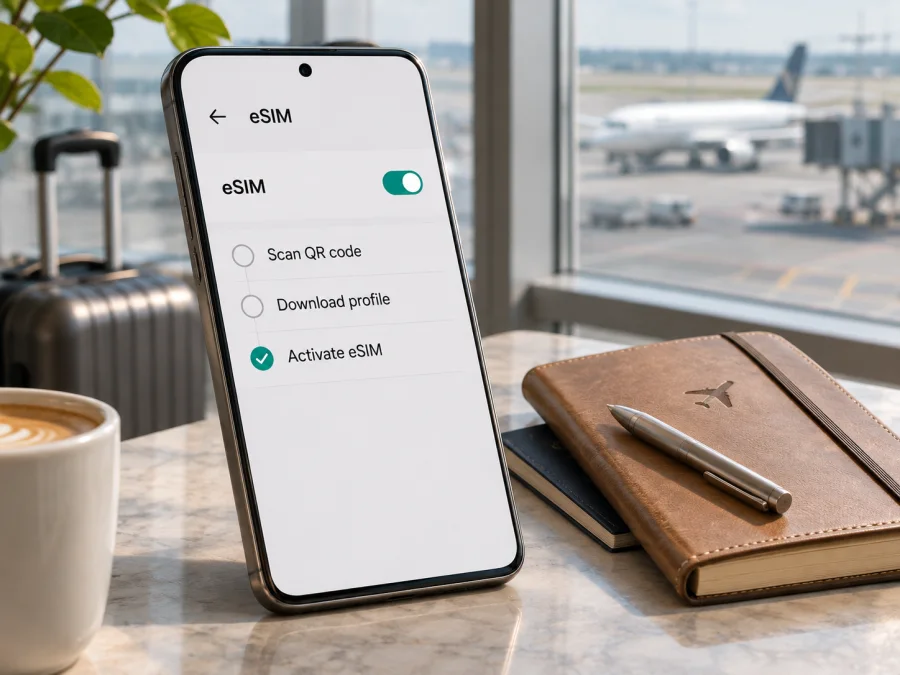
Samsung Galaxy S23 Ultra 1TB eSIM: compatibility and setup
Short answer: Samsung lists Galaxy S23 Ultra among its eSIM-capable phones, and the 1TB configuration is an official storage option. However, the name “Samsung Galaxy S23 Ultra 1TB” does not identify the sales region, exact model code, carrier status, or software build. Samsung notes that eSIM availability can vary by region, carrier, and model. So the practical answer for your particular phone is: eSIM should be available on supported regional versions, but confirm it on the device itself before buying a plan.
The 1TB figure describes internal storage; it does not independently confirm eSIM capability. Check for an EID or the Add eSIM control in Settings, and confirm that the phone is not carrier-locked. If those checks pass, you can add a travel eSIM and use it for mobile data while keeping a physical SIM active where your configuration allows.
Quick reference
| Item | What to know |
|---|---|
| Exact device name | Samsung Galaxy S23 Ultra 1TB |
| Storage variant | Samsung lists a 1TB version; its U.S. comparison lists this storage configuration with 12GB RAM. Regional bundles can differ. |
| eSIM support | Samsung includes Galaxy S23 Ultra in its eSIM-capable Galaxy list. The manual cautions that eSIM may not be available on every region, carrier, or model. |
| How to check | Look for an EID under About phone or Status information, then check Settings → Connections → SIM manager for Add eSIM. Menu wording can vary. |
| Typical use | Add a travel data profile, select it for mobile data, and enable data roaming for that profile if the plan instructions require it. |
| Before purchase | Confirm the exact model code and region, EID/Add eSIM, carrier unlock status, destination coverage, plan validity, and activation conditions. |
Does Samsung Galaxy S23 Ultra 1TB support eSIM?
Samsung’s current Galaxy eSIM support information includes the Galaxy S23 Ultra. Samsung’s product comparison also confirms that the 1TB storage option exists. These are useful model-family facts, but they do not prove that every handset sold under the same retail name has an enabled eSIM profile. Samsung’s user guide explicitly says eSIM may be unavailable depending on region, carrier, or model. The memory capacity does not remove that qualification.
In practical terms, a Samsung Galaxy S23 Ultra 1TB that shows an EID and an Add eSIM option is equipped for eSIM provisioning. If neither appears, do not assume a QR code or a software update will make that particular regional or carrier version compatible. First identify the exact model code and ask the seller or carrier to confirm its eSIM support. If the seller cannot confirm it, treat support as uncertain until you can inspect the phone.
Why regional versions matter
The Galaxy S23 family has different model codes and SIM configurations across markets. Some versions support one physical nano-SIM alongside an eSIM; some markets may sell dual physical-SIM variants. Carrier-branded devices can also have different software menus or restrictions, and an otherwise compatible phone may be locked to its original carrier. The words “1TB” identify capacity, not the radio/SIM configuration or unlock state.
Check the model code in Settings → About phone → Model name / Model number. Write it down exactly, including letters after the model number. Compare that code with the Samsung support information for the country where the phone was originally sold, and ask the seller to verify eSIM on that precise unit. A generic listing for “S23 Ultra 1TB” or the presence of a SIM tray is not enough: physical SIM and eSIM can coexist, and tray design alone does not tell you whether eSIM is enabled.
There are two separate checks before travel. First, the hardware and software must expose eSIM on your unit. Second, the phone must be allowed to use another provider’s profile, and the provider’s eSIM must support the destination and device. An eSIM-capable but carrier-locked phone may refuse a travel profile. A model that supports eSIM in one country also does not guarantee that every mobile operator or data plan in another country will provision it.
Check your phone before choosing a plan
Use this checklist while you have the handset in front of you. The device menus are the most useful evidence for that exact unit; product names and online listings can combine variants.
- [ ] Find an EID. Open Settings → About phone → Status information (the exact submenu may differ), and look for EID. On many Samsung phones, dialing
*#06#in the Phone app also displays device identifiers, including an EID when eSIM is present. You do not need to call the code; close the screen after checking. Keep the EID private and do not post a screenshot publicly. - [ ] Look for Add eSIM. Open Settings → Connections → SIM manager. If you see Add eSIM or an equivalent option, open it only far enough to confirm that setup is offered; you do not need to install a profile yet.
- [ ] Read the model code. In Settings → About phone, note the model number and compare it with the seller’s invoice or box. The retail name and “1TB” do not state the region.
- [ ] Check the lock status. Ask the original carrier or seller to confirm the phone is unlocked for another provider’s eSIM. A working home SIM is not proof that the handset is unlocked.
- [ ] Update and restart. Install available official system updates, restart, and check SIM manager again. An update can change menus or carrier configuration, but it cannot guarantee support for hardware or regional variants without eSIM capability.
- [ ] Confirm the plan details. Check that the destination or every country on your route is included, whether the plan is data-only, when its validity starts, how much data is included, and whether installation needs Wi‑Fi.
If the EID is present but Add eSIM is missing, the phone may have a software, carrier, or regional limitation. Check for a system update, restart, and contact Samsung support or the original carrier with the model code. If Add eSIM is visible but setup reports that the plan is unavailable, check with the eSIM provider as well. You can check your device before selecting a travel data plan.
Before you install a travel eSIM
A few minutes of preparation avoids most setup problems. Keep the phone connected to reliable Wi‑Fi or another internet connection while downloading the profile. If you received a QR code on this phone, display it on a second screen or use the provider’s manual installation details if offered. Most QR activation codes are intended for a single installation, so do not scan repeatedly or delete a profile just to retry. Read the provider’s instructions if activation timing or code reuse is unclear.
Make a note of which SIM you want to use for ordinary calls and messages. A travel data eSIM generally provides mobile data only; it does not automatically replace your number or include voice calls and SMS. You can normally keep your usual line for calls while selecting the travel eSIM for data, subject to your phone’s configuration and home carrier charges. Turn off data switching if you want to prevent the phone from silently using your usual line’s data roaming.
Also distinguish installing a profile from starting a plan. The profile can be downloaded before departure, while a plan may begin its validity at installation, at first connection to a supported network, or at a selected activation time. The terms differ by plan. Check the chosen plan’s activation and validity rules before installation; do not infer them from the QR code or the phone’s confirmation screen.
Kaspersky eSIM Store is an app and website where you can choose, arrange, and activate an eSIM with a suitable mobile-data plan for an international trip. Review the destination, package, and activation terms in the specific plan. The Store does not replace the compatibility checks above.
How to add eSIM on Samsung Galaxy S23 Ultra 1TB
The usual One UI path is shown below; wording varies by software, region, and carrier. Keep internet access available during setup. For more detail, see the Android eSIM installation guide. The iOS installation guide is available for other devices.
- Confirm support and unlock status. Check for the EID and Add eSIM option, then verify that the phone accepts another provider’s eSIM.
- Open SIM manager. Go to Settings → Connections → SIM manager and tap Add eSIM. If it is missing, resolve compatibility before proceeding.
- Scan the activation code. Choose Scan QR code and scan the code supplied with your plan. Use another screen to display it, or follow the provider’s alternate activation instructions.
- Download the profile. Keep the phone online and follow the prompts. Avoid closing Settings while the eSIM is being added.
- Label the line. Use a clear name such as “Travel data” to distinguish it from your regular SIM.
- Choose your default lines. Keep your home SIM for calls or texts if needed. Select the travel eSIM for Mobile data when you are ready to use it.
- Set data roaming for the correct line. Enable it on the travel profile if the plan requires it. Check that mobile data still points to that profile, so the home SIM does not use roaming data unexpectedly.
- Allow time to connect. Network registration can take several minutes and may only work in a supported destination. Follow the plan’s activation timing; do not delete the profile if it does not connect immediately.
Read each setup prompt rather than accepting defaults automatically. Calls, texts, and mobile data can use different lines. A data-only travel eSIM does not provide a new phone number.## Using eSIM for mobile data while travelling
You can often install the profile over Wi‑Fi before departure and leave your usual SIM as the data line until you arrive. Check whether the plan starts at purchase, installation, first connection to a local network, or a scheduled time; these rules vary. Do not assume that installing a profile and starting a plan are the same event.
After landing, open Settings → Connections → SIM manager, turn on the travel profile, select it for Mobile data, and follow its instructions for data roaming. If the phone offers automatic data switching, turn it off when you want to control which line is used. Keep your primary line enabled only if you need calls or messages, and check home-carrier roaming charges.
| Setting | Before departure | At the destination |
|---|---|---|
| Home SIM | Review roaming terms; keep it available if needed. | Keep or disable it based on your needs and carrier charges. |
| Travel eSIM | Install on Wi‑Fi if plan timing allows; label it clearly. | Turn it on and choose it for mobile data. |
| Data roaming | Follow the plan instructions for the travel profile. | Enable it on that profile if required. |
| Data switching | Turn off if you want control over the data line. | Confirm data stays on the travel eSIM. |
Maps, messaging, email, ride booking, and browsing can use a data eSIM without removing a physical SIM. Internet app calls use data; ordinary calls and SMS remain tied to a phone-number plan. Check separately whether your plan includes a number or permits hotspot use.
Choose a plan for the complete route, including border crossings and transit stops. Match its listed data allowance and validity to your expected use: maps and messages need less data than video, large uploads, or hotspot sharing. Review destination coverage and any tethering or fair-use conditions on the selected plan.## Common problems and what to check
“Add eSIM” is missing
Check the EID and model number, install available official updates, restart, and look in SIM manager again. If the option is still absent, ask Samsung or the original seller about eSIM support for that exact regional model. Resetting the phone or scanning a QR code cannot reliably overcome a regional or hardware limitation.
QR code does not scan or is rejected
Increase the brightness of the screen showing the code, clean the camera lens, and keep the phone online. Check whether an eSIM profile is already present. If the code is invalid or already used, stop retrying and ask the plan provider whether it can be reissued; many codes are single-use.
Profile is installed, but there is no service
Confirm the eSIM is turned on and selected for mobile data. Check that the destination is included, the plan’s activation time has arrived, and data roaming is enabled on that eSIM if required. Toggle airplane mode, restart, and verify any APN against the provider’s exact instructions. Do not guess APN values.
The usual SIM is still using data
Check the mobile-data selection in SIM manager and turn off automatic switching. If you are concerned about roaming charges, disable data or roaming on the home SIM according to your carrier’s advice.
Phone says locked or unsupported
Ask the original carrier whether the device is unlocked, then ask the plan provider about your exact model and destination. General eSIM support does not guarantee that a carrier restriction or a particular plan will allow activation.
Connection is intermittent
Move to an area with a stronger signal, check remaining data, and leave network selection automatic unless the provider says otherwise. Coverage and speed depend on the local network and conditions. Avoid deleting the profile while troubleshooting because some activation codes cannot be reused. Contact support with the model code, software version, destination, and error message; do not share passwords, payment data, or a public screenshot of your EID.## Frequently asked questions
Is eSIM supported on every Samsung Galaxy S23 Ultra 1TB?
No universal guarantee can be made from the storage variant alone. Samsung lists Galaxy S23 Ultra as eSIM-capable but warns that availability varies by region, carrier, and model. Check the EID and Add eSIM on your handset and confirm its unlock status.
Does 1TB storage make a phone more likely to support eSIM?
No. Storage capacity and SIM capability are separate characteristics. The 1TB option identifies the storage configuration; use the model code and device settings to check eSIM.
Can I use a physical SIM and eSIM at the same time?
Many Galaxy S23 Ultra configurations support a physical SIM with eSIM, but the exact dual-SIM arrangement depends on the device and region. Check SIM manager and the documentation for your exact model. Your carrier may also restrict simultaneous lines.
Can I keep my regular number?
Usually you can keep a physical SIM profile for your usual number while using a travel eSIM for mobile data, if your handset supports that combination. Your home carrier may charge for roaming calls, texts, or data even when the travel eSIM is installed. Check those terms and select each default line deliberately.
Does a travel eSIM include calls and text messages?
Not necessarily. Travel eSIM plans are often data-only. Check the chosen plan’s terms for voice, SMS, and phone-number availability. Internet messaging and app calls can use data but are not the same as ordinary cellular calls or SMS.
Should I install the eSIM before travelling?
You can install it before departure if you have a reliable internet connection and the plan’s activation terms allow it. Check whether validity begins at installation or at a later event, such as the first connection in the destination. If unclear, ask the provider before scanning the code.
What if Settings shows an EID but Add eSIM does not appear?
Update the software, restart, and check again. If the option remains unavailable, contact Samsung or the original carrier with the model code. An EID is useful evidence, but you should confirm that the device can actually add a profile before arranging a plan.
Final check before your trip
For Samsung Galaxy S23 Ultra 1TB, Samsung’s published information supports a qualified yes: the S23 Ultra family supports eSIM, and Samsung offers a 1TB configuration, but eSIM availability on an individual phone can depend on region, carrier, model code, and software. Confirm the EID, find Add eSIM in SIM manager, and verify that the handset is unlocked. Then check that the selected travel plan covers your destination and that its data allowance, validity, and activation rules fit your itinerary.
Once those checks are complete, you can use Kaspersky eSIM Store’s app or website to choose, arrange, and activate a suitable eSIM data plan for an international trip. For an unspecified destination, start at the Kaspersky eSIM Store and review the current destination and plan details; this is a general starting point, not a country-specific offer. Keep your primary SIM settings and potential roaming charges in mind, and test mobile data after arrival. A careful check before purchase is the easiest way to know whether your exact phone is ready for eSIM.


