Travel connectivity guide
Samsung Galaxy Z TriFold 512GB 5G eSIM
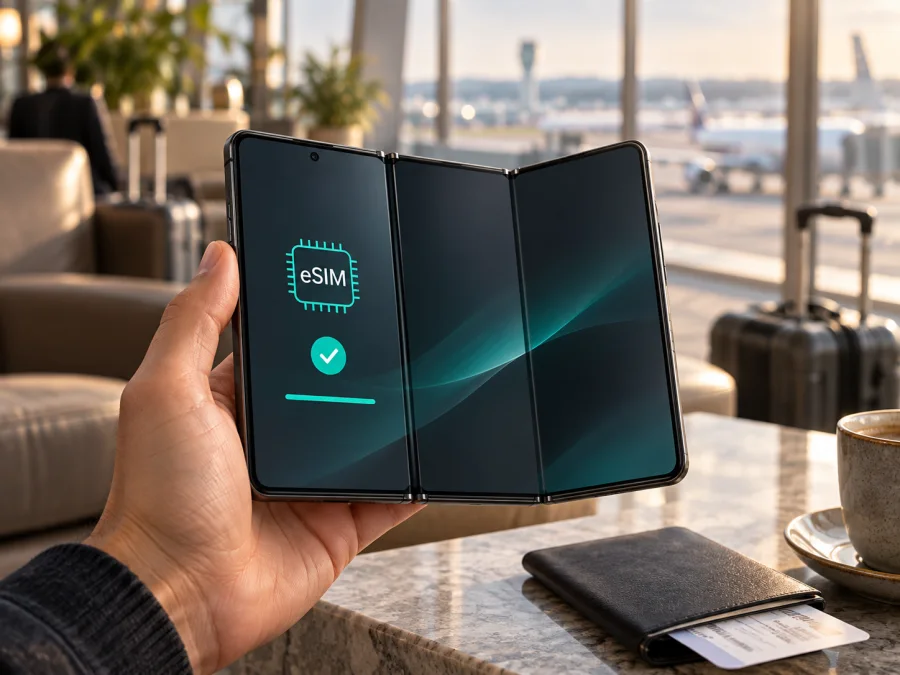
Samsung Galaxy Z TriFold 512GB 5G eSIM: compatibility and setup
The Samsung Galaxy Z TriFold 512GB 5G supports eSIM according to Samsung’s published product information. Samsung lists the TriFold with up to two Nano-SIMs and Multi eSIM; Samsung Korea’s specification for the 512 GB model lists “SIM 1 + eSIM / Dual eSIM.” This confirms eSIM capability for the storage variant covered here. Samsung also cautions that eSIM availability can vary with software version, region, and carrier, so check your own phone before buying a plan.
Regional or carrier-branded units may show different settings, and a locked phone may reject another provider’s profile. The steps below cover device checks, installation, and travel use.
Samsung Galaxy Z TriFold 512GB 5G eSIM at a glance
| Item | Details |
|---|---|
| Exact variant | Samsung Galaxy Z TriFold 512GB 5G |
| Storage | 512 GB |
| Memory listed by Samsung Korea | 16 GB |
| Network | 5G; local service depends on market, bands, and carrier |
| eSIM | Samsung lists Multi eSIM; the Korea 512 GB specification lists SIM 1 + eSIM / Dual eSIM |
| Physical SIM | Up to two Nano-SIMs listed in global product information; configuration varies by market |
| Important caveat | Software version, region, and carrier can affect eSIM availability |
Samsung Korea lists 16 GB of memory alongside 512 GB storage. The 5G label alone does not confirm eSIM; Samsung’s SIM specifications do. 5G access depends on local coverage, supported bands, and the carrier.
Does this exact 512 GB model support eSIM?
Yes. Samsung’s official product information for Galaxy Z TriFold lists “up to two Nano SIM and Multi eSIM.” Samsung’s Korean specifications for the 512 GB model show “SIM 1 + eSIM / Dual eSIM.” These manufacturer details confirm that the Samsung Galaxy Z TriFold 512GB 5G is designed to support eSIM.
Samsung’s caveat is important: eSIM availability may vary by software version, region, and carrier. A unit intended for one market may have different software or SIM options from an imported or carrier-customized unit. A carrier can also restrict the phone to its own network. Ask the seller for the model code, original sales market, and unlock status if the phone is imported or refurbished.
“Multi eSIM” does not guarantee that several lines can be active at once. Stored profiles and active SIM combinations depend on software and region. If you plan to keep a home line on with travel data, check SIM manager and both carriers’ policies.
What to verify on a regional or carrier version
Treat Samsung’s specification as a baseline and verify the phone in hand. Korean, other regional, and carrier-branded units can differ in settings or lock status. A reseller’s “Dual SIM” or “5G” label is not enough; ask the seller or Samsung support if the model code or market is unclear.
Check eSIM compatibility on your phone
Before choosing a plan, confirm each of these points:
- [ ] An EID appears in Settings, indicating eSIM hardware.
- [ ] Settings → Connections → SIM manager includes Add eSIM or a similarly named option.
- [ ] The phone is unlocked, or its original carrier permits another eSIM.
- [ ] The plan supports your exact regional Samsung version and destination.
- [ ] The mobile-data plan covers each country on your route.
- [ ] Wi-Fi is available for installation if the provider requires it.
Device compatibility details before purchase. The EID and Add eSIM option are useful checks, but they do not prove that a phone is unlocked or that a specific provider supports its regional model. If the EID or menu is missing, pause and ask Samsung or the carrier that sold the phone to confirm its configuration.
Find the EID and Add eSIM option
Open Settings and go to Connections → SIM manager. Look for Add eSIM. You can also search Settings for “EID” or “SIM manager.” To check identifiers, try Settings → About phone → Status information and look for EID; the path can vary between software versions. Menu wording may differ by region and One UI release.
The EID identifies the embedded SIM hardware. An EID and Add eSIM control are useful signs that setup is available. If the option is absent, restart, check for an official update, and look again. If it remains missing, ask Samsung or the original carrier about the model code and regional software before buying a plan.
Choose a travel eSIM plan
Compare destination coverage, data allowance, validity, price, and restrictions. A single-country plan may not cover the next stop on your route. Estimate your usage: maps and messaging usually need less data than video calls, streaming, or large uploads. Download maps and documents in advance to reduce usage.
Kaspersky eSIM Store is an app and website where you can choose, arrange, and activate an eSIM with a plan for mobile internet on an overseas trip. Review the conditions shown for your destination, and confirm that your phone is compatible and unlocked before completing an order. The travel plans discussed here are for mobile data; do not assume that they include a separate phone number, standard calls, or SMS unless the selected plan explicitly says so. Internet-based messaging and calls can work over data, subject to app availability and the local network.
To keep your usual number available, check your home carrier’s roaming terms. Charges may apply even if that line is not selected for data. You may be able to use the travel eSIM for data and the home SIM for calls or messages; active-line combinations vary. Consider this if you rely on the home line for verification texts.
Install and activate the eSIM
Before installation, connect to reliable Wi-Fi, have the order details ready, and check the plan’s activation rules. Some providers allow early installation and start validity on first connection; others may start the validity period at installation. Follow the instructions for your specific plan so the active period aligns with your trip.
- Open your eSIM details. Find the QR code or setup instructions in the email, app, or account used for the plan.
- Open SIM manager. On the TriFold, go to Settings → Connections → SIM manager and tap Add eSIM. Labels can vary.
- Choose a method. Select QR-code scanning or manual entry if the provider supplies those details.
- Scan or enter the code. Follow the prompts. Keep the QR code private because it is linked to your eSIM order.
- Wait for the download. Keep the phone online and allow several minutes for the profile to download and register.
- Name the profile. Choose a label such as “Travel data” so it is easy to identify.
- Select your data line. Enable the eSIM and choose it for mobile data when you are ready to use it.
- Set roaming if required. Some travel plans require data roaming on the travel eSIM. Make sure you change the setting for the correct line to avoid unintended home-carrier charges.
- Test in the destination. When the plan should be active and you are in a covered area, turn off Wi-Fi briefly and open a webpage. Confirm that the travel profile is handling data.
See the Android eSIM installation instructions or the iOS eSIM installation instructions. The Samsung Galaxy Z TriFold 512GB 5G runs Android, so use the Android guide for this device; the iOS guide is useful if you are helping another traveler with an Apple phone. If the QR code is on the TriFold’s own screen, it cannot scan itself. Display it on another device or use manual entry if provided.
Install before departure or after arrival?
Installing before departure over stable Wi-Fi can make arrival easier, as long as the plan allows early installation and you understand when its validity begins. If you wait until arrival, you may need airport or hotel Wi-Fi to download the profile. Save the provider’s instructions where you can access them if mobile data is not yet working.
Installation and activation are related but separate. Installing downloads the profile; the eSIM may only connect after it is enabled, selected for data, and within the plan’s coverage area. Some plans also require data roaming or first registration in the destination. Avoid deleting the profile as a troubleshooting step unless support recommends it: a QR code may be single-use, and deleting the profile can make reinstallation difficult.
Use the TriFold during a trip
Before leaving, update the phone over Wi-Fi, make sure the profile appears in SIM manager, and keep activation details accessible. At your destination, enable the travel eSIM and select it for mobile data. Turn on data roaming for that profile only if the plan requires it. Start with automatic network selection; follow the provider’s instructions if manual selection becomes necessary.
The large display is convenient for maps, boarding passes, and travel apps, but eSIM setup is the same as on another compatible Android phone. A 5G label does not guarantee 5G everywhere: service depends on the local network, supported bands, plan, coverage, and congestion.
For a city break, use the eSIM for maps, ride booking, browsing, and messaging, with offline reservations as backup. On a multi-country route, confirm coverage in every destination. For a longer stay, monitor data and validity because either may run out first. Android’s data-usage settings can help identify high-usage apps.
A data-only eSIM generally does not replace your regular number. Internet calls and messages can use its data, while ordinary calls, SMS, and verification codes may still depend on the home SIM. Check whether your carrier charges for incoming calls or texts abroad.
Troubleshooting common problems
Add eSIM is missing
Search Settings for “EID,” then check Connections → SIM manager. Restart and install any official software update, then look again. If neither EID nor Add eSIM appears, the unit may have regional or carrier-specific software, or it may not match the listing. Contact Samsung or the original carrier with the model code and sales market. Do not purchase a plan until the phone’s configuration is clear.
The QR code will not scan or the profile will not download
Use stable Wi-Fi and make sure the QR code is clear and valid. Increase the screen brightness and reduce glare. Use manual entry only if supplied by the provider. If the code appears already used, contact the provider; it may not be reusable.
The profile installed but there is no service
Check that the travel profile is enabled and selected for mobile data. Confirm the plan is valid in your current country and that its activation period has started. Enable data roaming on the travel line if the provider requires it. Toggle airplane mode on for about 30 seconds, turn it off, and wait a few minutes; a restart can also help. Follow the plan’s guidance for network selection.
Data is slow or keeps dropping
Reception, congestion, indoor coverage, local network conditions, and supported bands affect performance. Move to an area with a stronger signal and verify that data is assigned to the travel eSIM. If 5G is unstable, try LTE if the network settings allow it. Check the plan’s remaining data and validity in case the allowance has been exhausted or the plan has expired.
The wrong SIM is using data
Open SIM manager and check which line is selected for mobile data. Confirm that the travel eSIM is enabled and the home SIM is not selected for data if you want to avoid home-network roaming. Check roaming switches line by line; verify the profile name before changing a setting.
The eSIM stopped working after reset or replacement
An eSIM profile can be tied to a device or activation code. A factory reset, profile deletion, or phone replacement may require a new activation. Do not assume the original QR code can be used again. Contact the provider through the account or support channel for the plan.
When requesting help, provide the model code, purchase region, software version, and error message. Do not post your EID, QR code, or activation details publicly. Samsung or the carrier can check device and lock settings; the eSIM provider can check the plan and profile.
Frequently asked questions
Is eSIM supported on the Samsung Galaxy Z TriFold 512GB 5G?
Yes. Samsung lists Multi eSIM for Galaxy Z TriFold, and its Korea specification for the 512 GB model lists SIM 1 + eSIM / Dual eSIM. Availability on an individual phone can still depend on region, software, and carrier.
Does the 512 GB version have 16 GB RAM?
Samsung Korea lists 16 GB memory with 512 GB storage; confirm imported units with the seller.
Can I use a home SIM and a travel eSIM together?
Potentially, depending on the phone’s regional SIM configuration and carrier rules. Select the travel eSIM for data, and check roaming charges before leaving the home line enabled.
Will this phone always connect to 5G with an eSIM?
No. 5G availability depends on the plan, destination network, coverage, bands, and local conditions. The phone may use LTE or another available network instead.
Final device check before your trip
Samsung lists eSIM support for the Samsung Galaxy Z TriFold 512GB 5G, including its 512 GB configuration. Before travelling, find the EID and Add eSIM option, confirm the phone is unlocked, and verify the plan covers its regional version and every destination. Compare data and validity with your itinerary. Kaspersky eSIM Store can help you choose, arrange, and activate a travel eSIM plan for mobile internet abroad. Keep activation details handy and follow the plan’s data-line and roaming instructions.