
Travel connectivity guide
Santa Marta eSIM: Mobile Internet Guide
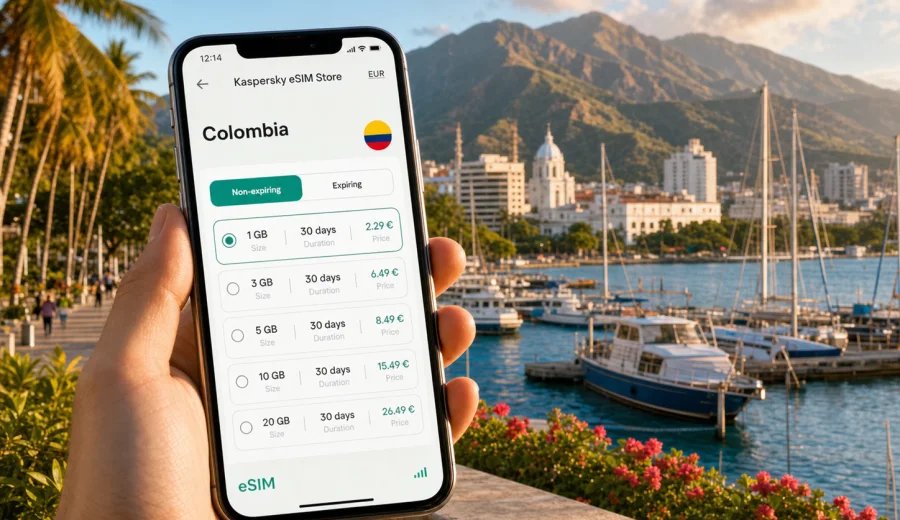
Santa Marta eSIM: mobile connection and internet for your trip
Santa Marta is a practical place to plan mobile internet before you land. The city is compact by Caribbean standards, but the travel pattern around it is not: many visitors move between Simon Bolivar International Airport, Rodadero, the historic center, Taganga, Minca, Tayrona National Natural Park, beach hotels, coworking-friendly cafes, and bus connections toward Barranquilla or Cartagena. An eSIM can help you keep maps, ride apps, hotel messages, banking alerts, and travel documents available without looking for a physical SIM card after arrival.
This guide focuses on Santa Marta as a city trip, not on Colombia in general. It explains where mobile data matters most in local movement, how to estimate traffic needs, when to install an eSIM, and what to check before you choose a tariff for your stay.
Why mobile internet matters in Santa Marta
Santa Marta often combines city errands with nature trips. You might spend the morning in the historic center, take a taxi to Rodadero in the afternoon, then leave early the next day for Minca or the Tayrona area. That rhythm makes mobile connection useful in short bursts: opening a map, checking a pickup point, sending a location to a driver, translating a message, confirming an excursion, or reading a hotel gate code.
Reliable access to mobile internet is especially useful in these Santa Marta scenarios:
| Local situation | Why data helps | What to prepare |
|---|---|---|
| Airport arrival | You may need the hotel address, ride details, and messaging apps before leaving the terminal | Install the eSIM before departure, then activate data when appropriate |
| Rodadero or Bello Horizonte stay | Hotels and apartments can be spread along the coast | Keep maps, booking apps, and ride apps ready |
| Historic center walks | Streets are walkable, but navigation helps with restaurants, museums, and meeting points | Save key locations and keep a small data buffer |
| Trips to Minca | Mountain routes and pickup points may require coordination | Confirm the meeting place before leaving the city |
| Tayrona day trip | Entry logistics, transport timing, and group messages can change | Download documents and keep mobile data for updates |
| Business visit | Calls may move to messengers and video links | Choose a tariff with enough data for work tasks |
An eSIM is not a full replacement for every telecom service. Most travel eSIM tariffs are designed for mobile data. A regular phone number, voice calls, and SMS are not included unless the selected tariff says so. For many Santa Marta travel tasks, that is acceptable because ride coordination, hotel messages, maps, email, and calls through messengers all run over internet data.
Arrival in Santa Marta: the first hour online
The first hour after landing is when travelers often need mobile data the most. Simon Bolivar International Airport is south of the central districts, so most visitors continue by taxi, transfer, rental car, or arranged pickup. If your accommodation is in Rodadero, Bello Horizonte, Pozos Colorados, the historic center, or Taganga, you will usually need to confirm the exact address and route rather than simply follow signs into the city.
A practical arrival checklist:
- Save your hotel name, address, and reservation number offline before the flight.
- Keep your passport details and booking confirmations available in your phone wallet or files.
- Install the eSIM profile while you still have stable internet at home, at the hotel before a side trip, or through airport Wi-Fi if needed.
- After landing, choose the eSIM profile for mobile data if the tariff is ready to use.
- Confirm whether data roaming must be enabled for that eSIM profile according to the setup instructions and tariff conditions.
- Keep your primary SIM active only if you need bank SMS, calls, or another service tied to your regular number.
This preparation reduces the pressure to make technical decisions in the arrivals area. You can focus on luggage, transport, and the first route into Santa Marta.
City movement: where an eSIM is useful
Santa Marta has several areas that feel close on a map but work differently in daily movement. The historic center is good for walking, cafes, restaurants, and short errands. Rodadero is a beach and hotel zone with a different rhythm. Bello Horizonte and Pozos Colorados are common for resort-style stays closer to the airport. Taganga is a nearby coastal area with its own transport and tour pattern. Minca and Tayrona are outside the city center but strongly connected to Santa Marta itineraries.
Mobile internet helps because travel decisions are often local and time-sensitive:
- You can compare routes before choosing whether to walk, take a taxi, or wait for arranged transport.
- You can message a hotel or tour operator if a pickup point is unclear.
- You can check whether a restaurant, coworking spot, or beach club is open before crossing the city.
- You can use translation tools in shops, pharmacies, transport points, and guesthouse reception areas.
- You can keep family or colleagues updated when moving between coastal and mountain routes.
For short city transfers, a small amount of data may be enough. For remote work, cloud files, social media uploads, or video calls, choose a larger data allowance. The right tariff depends less on the city name and more on how you will use the phone each day.
How much data to plan for Santa Marta
Data use varies by device settings and app behavior, but the pattern is predictable. Navigation, messaging, and hotel coordination are light. Video, cloud backup, hotspot use, and large media uploads are heavy. Before choosing an eSIM tariff, review your trip length and decide which apps should be allowed to use mobile data.
| Trip style | Typical data pattern | Practical tariff logic |
|---|---|---|
| Weekend stopover | Maps, messaging, ride coordination, restaurant searches | A smaller data package may be enough if video is avoided |
| Beach hotel stay | Navigation, social media, booking apps, light streaming on Wi-Fi | Choose enough data for movement outside the hotel |
| Tayrona or Minca itinerary | Maps, transport messages, tickets, group coordination | Keep a reserve for updates when away from hotel Wi-Fi |
| Business trip | Email, messengers, video calls, document sharing | Select a larger allowance and manage background sync |
| Family trip | Multiple maps, photos, messaging, shared plans | Consider whether one phone will act as the main online device |
Three settings can make a big difference:
1. Turn off automatic cloud photo backup on mobile data.
2. Download offline maps for Santa Marta, Rodadero, Minca, and any planned route.
3. Restrict app updates and large media downloads to Wi-Fi.
This keeps mobile internet available for tasks that matter during movement, not for background activity you did not intend to run.
Choosing an eSIM tariff for Santa Marta
For a Santa Marta trip, choose the tariff by destination, duration, traffic amount, and route. The city is in Colombia, so a country tariff for Colombia is usually the relevant starting point. If your journey continues through several countries or regions, compare whether a regional or broader tariff better matches the full route.
In Kaspersky eSIM Store, you can review available options for the destination, check data amount and validity, then prepare the eSIM on a compatible device. When you are ready to compare options for this city trip, you can choose an eSIM tariff for travel to Santa Marta in Colombia and match it to your expected use.
Use this decision flow:
1. Confirm the destination. For Santa Marta, look at Colombia coverage and tariff conditions.
2. Match validity to your stay. A tariff should cover arrival day, side trips, and departure day.
3. Estimate data use. Navigation and messaging need less than video calls, uploads, and hotspot use.
4. Check whether top-up or another tariff can be arranged if your plans change.
5. Read the activation notes. Some tariffs start counting validity after activation, others have specific conditions.
6. Keep a backup connection for installation if you have not installed the eSIM before arrival.
Avoid choosing only by the largest data number. A good tariff for Santa Marta is one you understand: where it can be used, how long it lasts, what amount of traffic it includes, and when the validity period starts.
Installing eSIM before the trip or after arrival
The easiest time to install an eSIM is usually before departure, while you still have stable Wi-Fi and time to check settings calmly. After purchase, the eSIM profile is added to your compatible device using the instructions shown by the service, often through an app flow or QR code. Installation and activation are related but not always the same step, so read the instructions for the selected tariff before turning it on.
Before you buy, check your device to confirm that it supports eSIM and is not restricted by an operator lock. Some phones differ by market or model version, so do not rely only on the model name.
For setup guidance, use the official instructions for your device type: Android installation guide or iOS installation guide. Keep another internet connection available during installation because your phone may need to download the eSIM profile before it can use mobile data through that profile.
A calm setup sequence:
1. Check eSIM support and operator lock status.
2. Choose the Colombia tariff that fits the Santa Marta itinerary.
3. Install the eSIM profile while connected to Wi-Fi.
4. Name the line clearly, for example "Travel data".
5. Keep your regular SIM for calls or SMS if you need it.
6. Select the eSIM profile for mobile data when you are ready to use it.
7. Test a basic page or messaging app after activation.
If data does not work immediately, avoid deleting the eSIM profile as a first reaction. Check the selected mobile data line, roaming data setting for the eSIM profile, airplane mode, network selection, and tariff conditions. If the issue remains, contact support with screenshots and device details.
Santa Marta districts and data priorities
Different parts of the city create different mobile internet needs. You do not need a special district tariff, but it helps to know where data will matter.
| Area or route | Common travel task | Mobile data priority |
|---|---|---|
| Historic center | Walking routes, restaurants, museums, meetings | Maps, chat, search, translation |
| Rodadero | Beach hotels, apartments, boat tours, evening plans | Ride apps, bookings, group messages |
| Bello Horizonte | Resort stays, airport transfers, beach days | Transfer coordination and navigation |
| Taganga | Diving, boats, guesthouses, sunset plans | Messaging tour contacts and checking routes |
| Minca route | Mountain day trip, cafes, viewpoints, guesthouses | Pickup coordination and offline maps |
| Tayrona route | Early transfers, entry timing, beach trails | Tickets, group messages, saved documents |
For beach and nature routes, download anything essential before leaving your hotel: maps, booking confirmations, QR codes, passport copies, and the address for your return point. Mobile networks can vary by terrain and local conditions, so offline preparation still matters even when you have an eSIM tariff.
Business trips and remote work in Santa Marta
Santa Marta can be a short business stop, a remote-work base, or a rest point between meetings in the Caribbean region. In these cases, the value of eSIM is not only getting online once. It is having a separate travel data line that you can manage without changing your physical SIM.
For work use, plan more carefully:
- Use hotel or office Wi-Fi for heavy file transfers when it is reliable.
- Keep mobile data for calls in messengers, two-factor prompts, maps, and urgent files.
- Disable automatic system updates on mobile data.
- If you plan to share a hotspot with a laptop, choose a tariff with enough data and check whether tethering is allowed under the tariff conditions.
- Keep your main number available if work tools still depend on SMS or voice verification.
For video meetings, test your connection before the call and have a fallback location. A cafe may be fine for email but noisy for calls. A hotel lobby may have Wi-Fi but weaker privacy. A prepared eSIM profile gives you another option when Wi-Fi is overloaded or inconvenient.
Short stopovers and cruise-style visits
Some travelers pass through Santa Marta quickly: one night before Tayrona, a transfer stop between coastal cities, or a cruise-style visit with limited time. For a short stay, the main goal is not unlimited browsing. It is reducing friction.
A short-stay eSIM setup should cover:
- route from airport, port, bus terminal, or hotel pickup point;
- access to messaging apps for driver and accommodation contact;
- digital copies of booking confirmations;
- translation and search for quick errands;
- enough data for map use if plans change.
If Santa Marta is one stop in a longer Colombia route, consider the full trip rather than the city alone. A tariff that covers the entire Colombia stay can be simpler than arranging connectivity separately for Santa Marta, Cartagena, Barranquilla, Bogota, or Medellin.
Common mistakes to avoid
Many mobile internet issues during a city trip are avoidable. The most common mistakes are not technical failures, but preparation gaps.
Avoid these before traveling to Santa Marta:
- Buying a tariff without checking whether the phone supports eSIM.
- Installing the eSIM only after leaving reliable Wi-Fi.
- Forgetting that many eSIM tariffs are for data, not a local phone number.
- Letting cloud backup consume the data allowance on the first day.
- Assuming hotel Wi-Fi will be strong enough in every room or common area.
- Deleting an installed eSIM profile before checking support guidance.
- Choosing a tariff that ends before your final transfer or departure day.
The safest approach is simple: install early, understand the tariff, keep essential files offline, and use mobile data for the tasks where being online changes the trip.
Quick answers about eSIM in Santa Marta
Is eSIM useful for Santa Marta if my hotel has Wi-Fi?
Yes, because many important moments happen outside the hotel: airport transfer, taxis, beach districts, restaurant searches, tour pickup points, and side trips to Minca or Tayrona.
Can I use eSIM for normal phone calls and SMS?
Most travel eSIM tariffs focus on mobile data. Voice calls, SMS, and a local phone number are not included unless the selected tariff explicitly says so. You can often use messengers over mobile data for calls and messages.
Should I install eSIM before flying to Colombia?
Installing before departure is usually more convenient because you can use stable Wi-Fi and avoid setup pressure after landing. Check the tariff conditions so you understand when validity and data usage begin.
Will eSIM work in every place around Santa Marta?
Coverage and speed depend on local network conditions, terrain, building structure, and the selected tariff. Prepare offline maps and documents for nature routes and remote areas.
Do I need to remove my physical SIM?
No. On compatible devices, eSIM can usually be added as another mobile profile. You can keep your regular SIM for calls or SMS and select the eSIM profile for mobile data.
What should I do if mobile data does not start?
Check that the eSIM profile is selected for mobile data, review whether roaming data should be enabled for that profile, restart the device if needed, and contact support if the issue continues.
Final preparation before you go
Before leaving for Santa Marta, make your phone travel-ready. Save the hotel address, download offline maps, check your booking files, and decide which apps can use mobile data. Then choose a tariff that matches the real itinerary: arrival, city movement, beach districts, work tasks, and any trips from Santa Marta.
Kaspersky eSIM Store helps you choose, arrange, install, and activate an eSIM with a suitable tariff for mobile internet in a foreign trip. For a smoother arrival and fewer connectivity decisions on the road, prepare an eSIM tariff for your Santa Marta trip before you need it at the airport, hotel, or transfer point.