
Travel connectivity guide
Santa Teresa eSIM for Costa Rica Travel
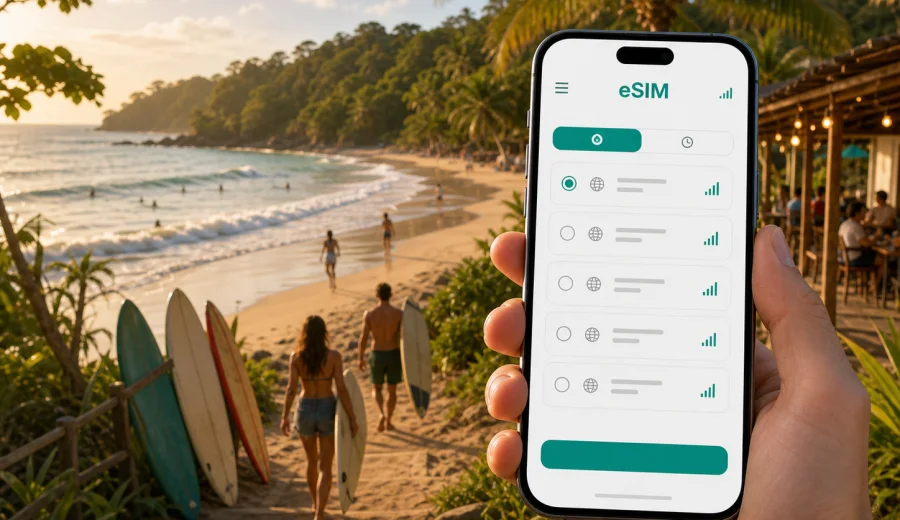
Santa Teresa eSIM: mobile connection and internet for Costa Rica travel
Santa Teresa is a beach town where mobile internet becomes useful before you even see the ocean. You may need it to message a shuttle driver, check the road from Cobano, confirm a hotel gate code, follow a location pin after dark, or tell a surf school that your ferry is running late. Once you arrive, the same connection helps with restaurant bookings, ride coordination, tide checks, online work, maps, and day trips around the Nicoya Peninsula.
An eSIM is practical in Santa Teresa because the town is spread out and informal. Addresses can be descriptive, side roads can be hard to identify, and many plans depend on messages rather than fixed schedules. If your phone is ready for data when you land in Costa Rica, you can handle transfers, navigation, and accommodation details without searching for a local SIM card after a long flight.
This guide focuses on using eSIM mobile connection and internet in Santa Teresa: arrival routes, local transport, beach areas, hotels, remote work, stopovers, and trips from town.
Why mobile internet matters in Santa Teresa
Santa Teresa sits on the western side of the Nicoya Peninsula. It is known for surf, sunsets, yoga, boutique stays, guesthouses, cafes, and a relaxed road that links the beach areas. The atmosphere is easygoing, but logistics can be less formal than in a big city.
Mobile data helps when you need to:
- navigate between Santa Teresa, Playa Carmen, Mal Pais, Playa Hermosa, Manzanillo, Cobano, Montezuma, and Tambor;
- coordinate shared shuttles, taxis, rental cars, ATVs, and hotel transfers;
- check ferry plans if you travel through Puntarenas and Paquera;
- find accommodation that uses landmarks instead of a street address;
- message hosts, surf schools, coworking spaces, and tour operators;
- use translation, banking, maps, and travel apps away from hotel Wi-Fi;
- check tide, weather, and surf conditions before a lesson or beach session.
In Santa Teresa, the internet question is not only about posting photos. It is also about reaching the correct beach entrance, finding a driver, changing a dinner plan, or keeping a work call available when the cafe Wi-Fi slows down.
Arrival routes and first connection needs
Most travelers reach Santa Teresa through Liberia, San Jose, Tambor, or the Puntarenas to Paquera ferry route. Each route benefits from having data before the final transfer.
| Arrival route | Typical use case | Why mobile data helps |
|---|---|---|
| Liberia airport to Santa Teresa | Direct beach transfer from northern Costa Rica | Message the driver, follow the route, update your hotel |
| San Jose airport via Puntarenas and Paquera | Useful when San Jose flights are better timed | Check ferry plans and coordinate the final ride |
| Domestic flight to Tambor | Faster transfer with limited schedule options | Contact the driver at a small airport and confirm pickup |
| Rental car from San Jose or Liberia | Flexible road-trip itinerary | Use maps, fuel stops, route updates, and offline backups |
| Shared shuttle | Common for solo travelers and surf trips | Receive pickup changes and share your location |
Santa Teresa can look close on a map but feel slow in practice. Roads on the peninsula may include curves, dust, rain, gravel sections, and slower night driving. A ready mobile connection makes the last part easier because you can check where the driver is waiting, send a live location, and avoid relying on memory when you are tired.
Local movement around town
Short distances in Santa Teresa are not always simple walks. Heat, dust, rain, surfboards, luggage, and dark roads can make a quick trip feel longer. Visitors often combine walking with taxis, hotel pickups, rental vehicles, ATVs, bikes, or surf-school transport.
Common mobile-data moments include:
- leaving dinner after sunset and sending a location pin to a taxi;
- checking whether you are at Playa Carmen or the main Santa Teresa beach;
- finding the correct turn toward Playa Hermosa or Mal Pais;
- coordinating a surf lesson after the tide or weather changes;
- messaging a hotel when your shuttle reaches Cobano late;
- checking if a cafe, coworking space, or restaurant is open before you go.
This is why a Santa Teresa eSIM plan should match the rhythm of your stay. A two-night surf stop, a two-week remote-work stay, and a family trip with day tours all use data differently.
Key areas near Santa Teresa
Santa Teresa travel planning often includes several nearby names. They are close enough to combine in one stay, but each creates different connection needs.
| Area | Travel context | Mobile internet use |
|---|---|---|
| Playa Carmen | Arrival point, surf, restaurants, shops | Meeting points, taxis, beach access, quick route checks |
| Santa Teresa beach | Surf schools, sunsets, cafes, boutique stays | Tide checks, messages, maps, dinner planning |
| Mal Pais | Quieter coastline and retreat-style stays | Host contact, side-road navigation, evening rides |
| Playa Hermosa | Beach time, villas, surf sessions | Route planning and pickup coordination |
| Manzanillo | Calmer northern beach atmosphere | Maps, weather checks, return transport |
| Cobano | Inland services, fuel, banks, supermarkets | Transfer changes, errands, route decisions |
If you are staying outside the central road, save your accommodation pin offline and keep mobile data available for the first arrival. Some properties are easy to find in daylight but much harder after rain or sunset.
How much data to plan
Data use depends on habits. Messaging, maps, translation, restaurant searches, and ride coordination are usually light. Video calls, hotspot backup, cloud uploads, streaming, and social video are heavier.
| Traveler profile | Likely data use | Planning note |
|---|---|---|
| Weekend visitor | Maps, messages, hotel contact, transfer updates | A smaller package may work if Wi-Fi is reliable |
| Surf traveler | Tide checks, group chats, school messages, photos | Leave daily data for beach coordination |
| Remote worker | Hotspot backup, email, calls, cloud tools | Choose more data and use Wi-Fi for heavy work |
| Family traveler | Maps, activities, translation, shared logistics | Allow extra data for frequent searches and messages |
| Road-trip traveler | Navigation around the peninsula and beyond | Match data to the whole Costa Rica route |
Avoid choosing a package only because it is large. Also avoid assuming Wi-Fi will cover every task. Many Santa Teresa accommodations are comfortable, but Wi-Fi quality can vary by property, room location, weather, and the number of guests online.
Preparing an eSIM before you travel
Before choosing an eSIM tariff for Costa Rica, check your device, route, and expected data use. Your phone must support eSIM and be unlocked for use with another mobile data line. If you are not sure, use Check your device before you buy a tariff.
Think beyond the nights in Santa Teresa. If your itinerary includes Liberia, San Jose, Montezuma, Tambor, Nosara, or a ferry crossing, your mobile data needs continue before and after the beach. Choose a validity period and data allowance that fit the full route.
Install the eSIM while you have stable Wi-Fi, such as at home before departure or at your accommodation before a day out. If you need setup guidance, follow the Android installation guide or the iOS installation guide. Keep your regular SIM active if you still need your usual number for banking messages or calls, and select the eSIM as the mobile data line when appropriate.
Kaspersky eSIM Store is an app and website where you can quickly choose, arrange, and activate an eSIM with a suitable mobile data tariff for an international trip. For Santa Teresa, the useful part is preparation: you can review destination, data volume, validity period, and price before you need data on the road. To prepare mobile internet for the country that includes Santa Teresa, you can choose an eSIM tariff for Costa Rica travel and match it to your stay length and route.
An eSIM data tariff usually does not replace a normal phone number, voice calling, or SMS unless the selected tariff says so. For most travelers, it is mainly for mobile internet: maps, messaging apps, email, transport coordination, web browsing, and online services.
Setup checklist for Santa Teresa
Use this checklist before departure:
- Confirm that your phone supports eSIM and is not operator-locked.
- Choose a Costa Rica package for the whole trip, not only Santa Teresa.
- Install the eSIM profile on reliable Wi-Fi.
- Save installation details according to the product instructions.
- Download offline maps for the Nicoya Peninsula.
- Save hotel, driver, shuttle, and tour contacts.
- Pin your accommodation and key meeting points.
- Decide which SIM line will handle mobile data.
- Check whether data roaming must be enabled for the eSIM line.
- Turn off automatic cloud backups on mobile data if your package is limited.
After arrival, turn on the eSIM line, select it for mobile data, check the relevant roaming setting for the chosen tariff, and open a map or browser to confirm that data is working. Do this before you need to find a shuttle, not while standing at the pickup point.
Hotels, villas, hostels, and retreats
Accommodation style changes data use. At a hotel near the main road, mobile internet may matter mostly outside the property: beach walks, dinner, taxis, and route planning. At a villa on a hill or side road, it may also help with arrival instructions, food messages, driver coordination, and backup connection if house Wi-Fi is unstable.
Retreats and surf camps often share schedule changes through messages: lesson times, yoga sessions, pickup locations, and group dinners. Mobile data keeps you reachable between the beach, studio, room, and cafe. In hostels, shared Wi-Fi may be enough for basic planning, but it can slow down when many travelers are online, so keep mobile data for check-in documents, banking, and transport.
Remote work by the beach
Santa Teresa attracts remote workers because it combines beach life with cafes, villas, coworking options, and slower mornings. Treat mobile data as a backup line, especially if you have client calls, approvals, or two-factor authentication.
For work trips:
- use accommodation or coworking Wi-Fi for long video calls when possible;
- keep eSIM mobile data ready for hotspot backup;
- test the connection before an important call;
- stop automatic photo and video uploads on mobile data;
- carry a power bank if you use maps and hotspot mode often;
- save key files offline before moving between towns.
If you work from several places, choose a data allowance with room for unexpected use. One unstable cafe connection can make a small package feel tight.
Transport scenarios
Transport is one of the strongest reasons to have mobile internet in Santa Teresa.
| Scenario | What can go wrong without data | How an eSIM helps |
|---|---|---|
| Shuttle pickup | Pickup time or point changes | You can message and share location |
| Taxi after dinner | The driver needs a landmark or pin | You can send the exact point |
| ATV rental | You miss a turn toward a beach road | Maps reduce guesswork |
| Rental car | Ferry, fuel, or route plans change | You can adapt without waiting for Wi-Fi |
| Day tour | Weather or meeting time changes | You can receive updates away from the hotel |
Santa Teresa rewards preparation. Save offline maps, keep the accommodation location pinned, and avoid relying only on memory after dark or during heavy rain.
Beach days, surf lessons, and day trips
For surf travelers, mobile data helps before and after the session. You may check tide and weather, message the school, confirm which beach entrance to use, or coordinate a pickup. Ask for the meeting point as a pinned location and save it before leaving your room.
For beach days, use your phone carefully. Salt, sand, heat, and water are hard on devices. Keep the phone shaded, use a waterproof pouch if needed, and download essential information before walking away from the main road.
Santa Teresa is also a base for nearby trips: Montezuma, Cabo Blanco area, Tambor, Cobano, Playa Hermosa, Manzanillo, and onward routes toward Liberia, San Jose, Nosara, or other Pacific stops. Mobile data helps with maps, drivers, restaurant messages, translation, banking, weather checks, and route decisions. Signal can vary with terrain, vegetation, buildings, and local network conditions, so offline backups still matter.
Common mistakes to avoid
The most common connectivity mistakes are easy to prevent:
- buying a package before checking eSIM compatibility;
- installing the eSIM for the first time on a weak connection;
- choosing data only for Santa Teresa, then using it heavily across Costa Rica;
- leaving cloud backup or app updates enabled on mobile data;
- assuming a hotel name is enough for every driver;
- forgetting that many travel eSIM tariffs focus on data, not calls or SMS;
- depending on public Wi-Fi for urgent travel changes;
- using most of the package on streaming before the transfer back to the airport.
The simple approach is better: check compatibility, install early, choose data for the real itinerary, and keep essential locations available offline.
FAQ: eSIM and mobile internet in Santa Teresa
Is an eSIM useful if my hotel has Wi-Fi?
Yes. Much of the trip happens away from the room: transfers, maps, drivers, beach plans, restaurants, and day trips. Hotel Wi-Fi is still useful for heavy tasks such as long video calls or large uploads.
Should I install the eSIM before flying to Costa Rica?
Usually, yes. Installing before departure lets you use stable Wi-Fi and avoid setup pressure at the airport or during a transfer. Activate data according to the conditions of the selected tariff.
Can I use an eSIM for calls and SMS?
Many travel eSIM tariffs are focused on mobile data. They may not include a phone number, voice calls, or SMS unless the tariff conditions say so. Internet-based messaging and calling apps can work through mobile data.
Do I still need offline maps?
Yes. An eSIM improves access to maps and updates, but offline maps are a sensible backup for rural roads, beach areas, and places where signal may vary.
Final preparation before the beach
Santa Teresa is easier when the practical details are ready before you arrive. With mobile internet prepared, you can land in Costa Rica, reach the Nicoya Peninsula, find your accommodation, message drivers, check surf plans, and move between beaches without depending on public Wi-Fi or a last-minute SIM search.
Before you go, check that your device supports eSIM, install the profile on a stable connection, save key locations offline, and choose a data allowance that fits the whole route. To prepare mobile internet for Santa Teresa and the rest of your Costa Rica trip, select an eSIM tariff for Costa Rica through Kaspersky eSIM Store before you travel.