
Travel connectivity guide
Scotts Head eSIM for travel in Dominica
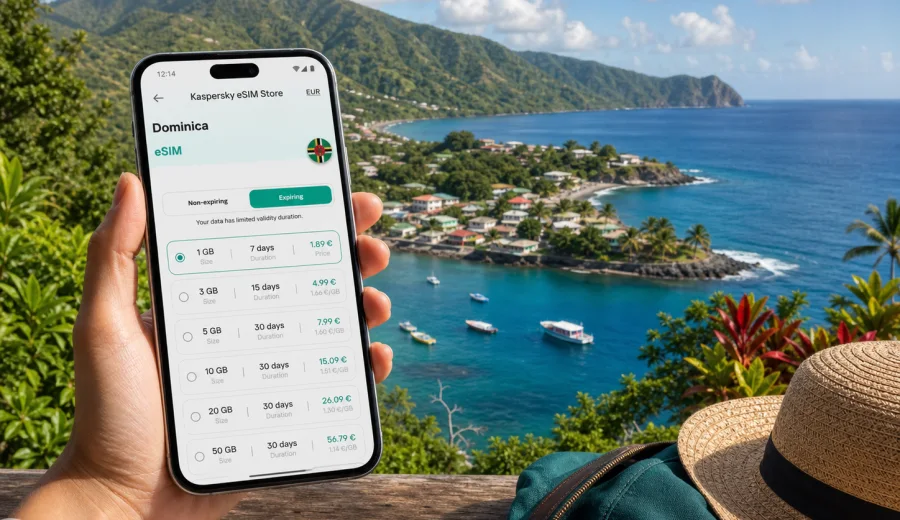
Scotts Head eSIM: mobile connection and internet for a trip to Dominica
Scotts Head is one of the most distinctive places to arrive at in Dominica: a compact village at the island's south-western tip, a narrow headland between blue water and green hills, and a practical base for diving, snorkeling, quiet coastal walks, and short trips toward Soufriere and Roseau. It is not a large city with a metro map or business district. That is exactly why mobile internet matters here. You use it to meet a driver, check the road back from the airport, message your hotel, follow maps around the peninsula, confirm a boat or dive time, and stay in touch when public Wi-Fi is not where you need it.
An eSIM can make that first day simpler. Instead of looking for a physical SIM card after a long transfer, you can prepare mobile internet before the trip and activate it on a compatible phone when the timing is right. For Scotts Head, this is especially useful because the village is small, the main travel services are spread between the coast, Soufriere, and Roseau, and a missed message can mean waiting longer for transport or walking back to ask in person.
This guide is about using an eSIM for Scotts Head specifically: how to plan data for arrival, how mobile connection helps around the waterfront and marine reserve, what to check before you travel, and how to choose a suitable data package for Dominica without turning the trip into a connectivity project.
Why mobile internet matters in Scotts Head
Scotts Head is made for outdoor travel. You may spend the morning near the headland, the afternoon around Soufriere-Scotts Head Marine Reserve, and the evening back at a guesthouse or small hotel. Your phone is not just for photos. It becomes the place where you keep transfer details, weather updates, dive confirmations, offline tickets, restaurant messages, and maps for the winding west-coast roads.
Mobile internet is useful in Scotts Head for practical moments:
- confirming a pickup from Douglas-Charles Airport or Roseau ferry terminal;
- sending your arrival time to a guesthouse, villa, or dive operator;
- checking the route between Scotts Head, Soufriere, Champagne Reef, Roseau, and nearby viewpoints;
- using messaging apps when you do not have a local phone number;
- sharing live location with a driver or travel companion;
- checking weather before a boat, snorkeling, or hiking plan;
- translating short messages or menus if needed;
- keeping payment, booking, and travel documents available when hotel Wi-Fi is weak.
Dominica's geography is part of the planning. Roads can be scenic, steep, and winding. A short distance on the map can still take time. If you are arriving after a flight, meeting a driver, or moving between the airport, Roseau, and Scotts Head, it is better to have mobile data ready before you are standing with luggage and trying to borrow a signal.
Arrival: airport, ferry, and the last part of the journey
Most international visitors reach Dominica through Douglas-Charles Airport on the north-east side of the island. Scotts Head sits far to the south-west, so the transfer crosses a large part of Dominica. Other travelers arrive by ferry in Roseau, which is much closer to Scotts Head and often works better for island-hopping itineraries. In both cases, the final part of the journey usually depends on arranged transport, a rental car, or a local taxi rather than frequent city-style public transport.
This is where an eSIM helps before the trip has properly started. You can keep your driver updated if immigration, baggage, ferry timing, or road conditions change. You can check whether your accommodation expects you at a specific entrance or meeting point. You can also keep maps open while the road follows the coast and hills toward the south.
For an arrival day, mobile data usually supports:
| Travel moment | Why data helps | Practical tip |
|---|---|---|
| Leaving the airport | Transfers can be long and weather can change plans | Save driver details and keep messaging apps ready |
| Arriving by ferry in Roseau | You may need a taxi, cash stop, or route confirmation | Pin your accommodation before leaving the terminal area |
| Reaching Scotts Head after dark | Small roads and guesthouse entrances can be easy to miss | Share live location with your host or driver |
| Checking in | Some properties use messaging for arrival details | Keep booking confirmations available offline too |
You do not need to use mobile data for every minute of the transfer. A better approach is to download offline maps before departure, keep the hotel address saved, and use mobile internet for live details: messages, route changes, weather, and confirmations.
Moving around Scotts Head
Scotts Head is compact, but a trip there often stretches beyond the village. You may walk around the headland, spend time by the bay, join a dive or snorkeling activity, visit nearby Soufriere, continue toward Roseau, or use Scotts Head as a quiet southern base. The value of mobile connection is not that you are staring at your screen. It is that you can solve small logistics quickly and get back to the trip.
Typical local movement looks like this:
- Waterfront and headland: maps, tide or weather checks, photo backup, and messages to travel companions.
- Soufriere: restaurant searches, pickup points, and short route checks between the village and the bay area.
- Marine reserve days: confirmations with dive centers or guides, especially if weather affects timing.
- Trips to Roseau: taxi coordination, ferry planning, grocery stops, banking, and route updates.
- Southern drives: navigation around coastal roads, viewpoints, and small settlements where signs may be limited.
Because Scotts Head is small, you should not assume that every plan can be fixed by walking to a counter or asking at a large front desk. Some services are informal, scheduled by message, or arranged through your host. Mobile internet gives you a practical backup channel.
How much data to plan for Scotts Head
Data use depends on how you travel. A visitor who only checks maps and messages can use a modest package. A traveler who uploads video, works from a laptop, or uses mobile hotspot for several devices needs more. The safest planning method is to separate essential travel tasks from heavy entertainment.
For Scotts Head, estimate your data needs like this:
| Use case | Typical data pressure | Notes for Scotts Head |
|---|---|---|
| Messaging, email, booking apps | Low | Good for arrival, drivers, hotel contact, and dive confirmations |
| Maps and navigation | Low to medium | Download offline maps, then use data for live details |
| Weather, restaurant searches, translation | Low | Useful around the bay and for day plans |
| Photo sharing | Medium | Upload on Wi-Fi when possible if you take many photos |
| Video calls | Medium to high | Better saved for stable accommodation Wi-Fi when available |
| Laptop hotspot | High | Choose a larger package and monitor usage carefully |
For a short stay of two or three nights, a smaller data package can be enough if you use accommodation Wi-Fi for large uploads. For a week in southern Dominica, or if you plan to move between Scotts Head, Roseau, hiking areas, and dive sites, choose more data so you do not have to ration every route check.
Choosing an eSIM for a Scotts Head trip
When you choose an eSIM for Scotts Head, choose for Dominica, not for a separate city plan. City travel still depends on the country destination because the tariff conditions, data allowance, validity period, and activation details are set for the country or region shown in the plan. The city matters for your usage pattern: Scotts Head is coastal, spread out through nearby day trips, and often transport-dependent.
Look at four details before choosing:
1. Destination: the plan should match Dominica or a suitable regional route that includes Dominica.
2. Data volume: choose enough for maps, messages, weather, and booking apps, plus any hotspot needs.
3. Validity period: match it to your full stay, including arrival and departure days.
4. Activation rules: check when validity starts and whether you should install before departure or after arrival.
If Scotts Head is part of a wider Caribbean route, compare a Dominica-specific option with a regional option. A country plan can be practical for a focused Dominica stay. A regional plan may be useful if you are moving between islands, but only if the destinations and validity match your actual itinerary.
For a direct way to prepare before the trip, you can choose a data plan for Dominica in Kaspersky eSIM Store and compare the available data volumes and validity periods before you leave.
Kaspersky eSIM Store is an app and website where you can choose, arrange, and activate an eSIM with a suitable data plan for mobile internet during an international trip. It is not a mobile operator and does not replace the need to check the details of the selected tariff. Before paying, review the destination, data allowance, validity, price, and any activation notes shown for the plan.
Device compatibility before you travel
An eSIM only helps if your phone supports eSIM and is not restricted in a way that prevents adding another mobile plan. Check this before you buy a data package, especially if you use an older phone, a carrier-locked device, or a model bought for a specific market.
Before a Scotts Head trip, run this short compatibility check:
- confirm that your phone or tablet supports eSIM;
- make sure the device is not locked to one carrier;
- update the operating system before departure;
- keep your primary SIM active if you still need bank messages or calls;
- understand which line will use mobile data and which line will handle calls or SMS;
- check your device before choosing the plan.
Most eSIM travel plans are designed for mobile data. They may not include a regular phone number, voice calls, or SMS unless the specific tariff says so. For calls and messages in Scotts Head, many travelers use internet-based apps over mobile data or Wi-Fi. If you need traditional calls, check your home operator's roaming settings separately.
Installation and activation: what to do before arrival
The best setup is usually a mix of preparation and patience. Install the eSIM profile when you have stable internet, then activate mobile data according to the plan's instructions. Some travelers prefer to install before departure and turn on the eSIM after landing. Others wait until they reach Dominica. The right approach depends on the activation rules of the selected plan.
Use this sequence:
1. Choose the Dominica plan that matches your stay and data needs.
2. Read the validity and activation details.
3. Install the eSIM while you have stable Wi-Fi.
4. Keep the QR code or installation details accessible.
5. On arrival, select the eSIM for mobile data when you are ready to use it.
6. If required by the device or plan, enable data roaming for the eSIM line.
7. Test a simple page or message before leaving the airport, ferry terminal, or hotel.
For setup details, use the Android installation guide or the iOS installation guide before your travel day. Do not wait until you are in a taxi with poor signal and low battery to learn where the eSIM settings are.
Practical scenarios in Scotts Head
A quiet beach and snorkeling weekend
You arrive in Roseau by ferry, take a taxi south, and stay near the water in Scotts Head. Your mobile data use is mostly messaging, maps, weather, and restaurant searches. A modest eSIM package can be enough if your accommodation has usable Wi-Fi. Download offline maps before travel and save the location of your hotel, the headland, Soufriere, and your return pickup point.
Diving or marine reserve activities
If your trip is built around diving or snorkeling, connection becomes a scheduling tool. Weather, sea conditions, meeting points, and equipment timing can change. Keep enough data for messages, weather checks, and map searches. Avoid using your entire package on video uploads during the first day. Back up large photos or clips on Wi-Fi when you are back at your accommodation.
Working remotely from southern Dominica
Scotts Head can be a calm base, but it is not a dense business hub. If you need to work, ask your accommodation about Wi-Fi quality and keep eSIM data as a backup for essential tasks. Video meetings, cloud drives, and laptop hotspots use data quickly. Choose a larger package, turn off automatic photo backup on mobile data, and prepare documents offline before the call.
A short stop before moving north
Some travelers visit Scotts Head as part of a wider Dominica route: Roseau, Trafalgar Falls, Champagne Reef, Soufriere, Scotts Head, and then north or east. In that case, eSIM data is valuable for navigation between stops. Keep maps downloaded, but use mobile data for live messages, updated opening times, and changes in pickup location.
Quick checklist before leaving for Scotts Head
Before you fly or board the ferry, download offline maps for Roseau, Soufriere, and Scotts Head; save your hotel address; keep transfer and tour confirmations available offline; and turn off automatic app updates on mobile data. Use eSIM data for live tasks instead: messages, route changes, urgent searches, weather updates, and pickup coordination.
The goal is not to keep your phone in your hand all day. The goal is to make the phone reliable when it matters: arrival, transport, navigation, confirmations, and safety check-ins.
FAQ: eSIM for Scotts Head
Is there a separate Scotts Head eSIM plan?
Usually you choose a plan for Dominica or a regional plan that includes Dominica. Scotts Head is the city focus of your trip, but the eSIM destination should match the country or region shown in the plan.
Can I install the eSIM before I travel?
In many cases, yes, but always read the activation and validity rules of the selected plan. Install when you have stable Wi-Fi and activate mobile data according to the instructions.
Will an eSIM give me a Dominican phone number?
Most travel eSIM data plans focus on mobile internet and may not include a regular phone number, calls, or SMS unless stated in the tariff conditions. Use messaging apps for calls when appropriate.
Do I still need Wi-Fi?
Wi-Fi is useful for large uploads, long calls, and app updates. eSIM data is better for movement: roads, pickup points, maps, and quick messages around Scotts Head and nearby areas.
How much data should I choose for a short Scotts Head stay?
For light use, choose enough for maps, messaging, weather, and booking apps. If you plan to upload videos, use hotspot, or work remotely, choose a larger package and monitor usage.
Prepare your eSIM before Scotts Head
Scotts Head rewards travelers who arrive with the basics handled. Save your maps, confirm your transfer, keep your accommodation details offline, and prepare mobile data before you need it. With a compatible device and a suitable Dominica plan, an eSIM can help you stay connected from arrival through the headland walk, marine-reserve day, and return transfer.
Before you go, compare the available data volumes and validity periods, check your phone compatibility, and prepare an eSIM plan for your trip to Dominica through Kaspersky eSIM Store. Then use mobile internet for the practical parts of the journey: finding your way, confirming plans, and keeping the Scotts Head trip moving smoothly.