Travel connectivity guide
Seiyun eSIM: Mobile Internet in Yemen
Seiyun eSIM: Mobile Connection and Internet in Yemen
Seiyun is a city in Hadramaut, in Yemen’s Wadi Hadramaut. A mobile data plan can be useful for maps, messages, and coordinating a carefully arranged itinerary, but connectivity should never be treated as guaranteed in this region. This guide explains what to check before relying on an eSIM, how to plan around Seiyun’s geography, and why current travel and network information matters more here than a generic coverage claim.
Start with the current travel situation
As of 17 October 2026, the UK Foreign, Commonwealth & Development Office advises against all travel to Yemen because of unpredictable security conditions. The advisory specifically says to minimise movement within cities and towns if you are already there and to monitor local developments. The United States Department of State also maintains a “Do not travel” advisory for Yemen. Conditions can change quickly, and an airport listing or a working mobile signal is not evidence that a journey is safe or that flights are operating.
This page is practical connectivity information, not a recommendation to visit. If you are considering travel, read your own government’s current advice, consult people responsible for your local security arrangements, and check with your airline and insurer directly. Do not plan a route from Seiyun to another town based only on a map, a tourist description, or a phone’s coverage indicator. A route that looks short on screen may involve checkpoints, changing conditions, or movement restrictions that an app cannot assess.
Where Seiyun sits in the Wadi Hadramaut
Seiyun, also written Say’un or Sayun, is an urban centre in Hadramaut Governorate in eastern Yemen. The surrounding Wadi Hadramaut is an inland valley landscape rather than a coastal resort corridor. Seiyun’s central role in the valley makes it a reference point for local administration, services, and carefully planned journeys, but distances between settlements and the reliability of road travel should not be inferred from the city’s position on a map alone.
The city’s most recognisable landmark is Seiyun Palace, a large mud-brick complex completed in the 1920s and formerly used as the residence of the Kathiri sultan. UNESCO reports that the building has housed a museum since 1984 and that a rehabilitation project is under way. That context matters for visitors: opening arrangements, access, and the condition of heritage sites can change, so confirm them locally before setting out. Do not assume a map pin means a site is open to the public.
The Old Walled City of Shibam lies elsewhere in the Wadi Hadramaut, within Seiyun District. UNESCO describes its dense, multi-storey earthen houses, fortified perimeter, and historic urban plan; the site has been on the List of World Heritage in Danger since 2015. Shibam is not a neighbourhood of Seiyun and should not be described as if it were within walking distance. Any excursion there is a separate journey requiring current local advice and transport arrangements.
What mobile data can—and cannot—do for a Seiyun itinerary
A data connection may help you retrieve a saved map, send a message, translate a short phrase, or update a meeting time. It cannot confirm that a road is passable, a venue is open, a driver is available, or an area is safe. Keep the people coordinating your visit informed through a pre-agreed method, and make essential arrangements before leaving a place where you have reliable communications.
| Travel need | What a phone can help with | What you should arrange separately |
|---|---|---|
| Reaching accommodation | Open a saved location or message a contact | Confirm the address, pickup point, and arrival plan with the host |
| Moving around Seiyun | Keep a map and written directions available | Use locally approved transport and confirm the route with a trusted contact |
| Visiting the palace | Save the location and relevant notes | Check access, opening status, and local conditions before departure |
| A longer valley journey | Keep itinerary details accessible offline | Obtain current security and road advice; agree check-ins and alternatives |
| Work or a short stop | Send updates when a connection is available | Share plans in advance and do not rely on a live meeting link as your only contact method |
A useful rule is to prepare for both connected and offline periods. Download or write down information you may need, keep important phone numbers in your contacts and on paper, and tell a trusted person where you expect to be. If you need directions, ask for them before travel rather than expecting a map application to recalculate reliably while moving.
Arrivals: treat the airport as a route to verify
Yemen’s Civil Aviation and Meteorology Authority lists Sayun International Airport. That official listing establishes the airport’s name and location; it does not confirm a current timetable, the availability of a particular route, or that an arrival is operating on the day you need it. Check flight status with the airline or travel organiser close to departure, confirm any transit and entry requirements with the relevant authorities, and arrange ground transport before travelling.
For a planned arrival, keep these details together offline:
- Your full itinerary, booking references, and a contact for the person meeting you.
- The exact pickup point agreed with the driver or host; do not assume the airport has a familiar ride-hailing service.
- The accommodation address in both a map pin and written form that can be shown to a local contact.
- A backup way to reach your host if mobile data does not connect immediately.
- A power bank and a charging plan, especially if onward travel may take longer than expected.
Do not make an essential arrangement that depends on receiving a one-time code or loading a new map after landing. A travel eSIM may need a supported device, a suitable profile, and a network partner that is actually reachable at your destination. Those conditions are separate from the fact that an airport exists.
Streets, landmarks, and practical navigation
Seiyun’s landmarks and local street names may appear under different spellings in English-language maps. Seiyun, Say’un, Sayun, and Sayoun are variants you may encounter for the same city; use the spelling on your booking or local instructions when searching, then confirm that the result points to the intended place. A pin alone can be misleading when a town name is transliterated in more than one way.
For a visit centred on the palace or a meeting in the built-up area, save the exact destination before you leave your accommodation. Ask a local contact to confirm the approach road and an appropriate drop-off point. If you are travelling with a driver, agree whether they will wait, return at a set time, or remain reachable through a phone call or messaging app. A mobile-data plan does not supply a local voice number unless the plan terms explicitly say that it includes one.
For heritage visits, allow your host or guide to confirm access and timing. The palace’s historic mud-brick fabric and ongoing conservation work make current access information more important than a generic attraction listing. For Shibam, Tarim, or another place outside central Seiyun, plan it as a separate journey. Keep the itinerary private from public posts while travelling, and share the necessary details directly with the people coordinating your safety.
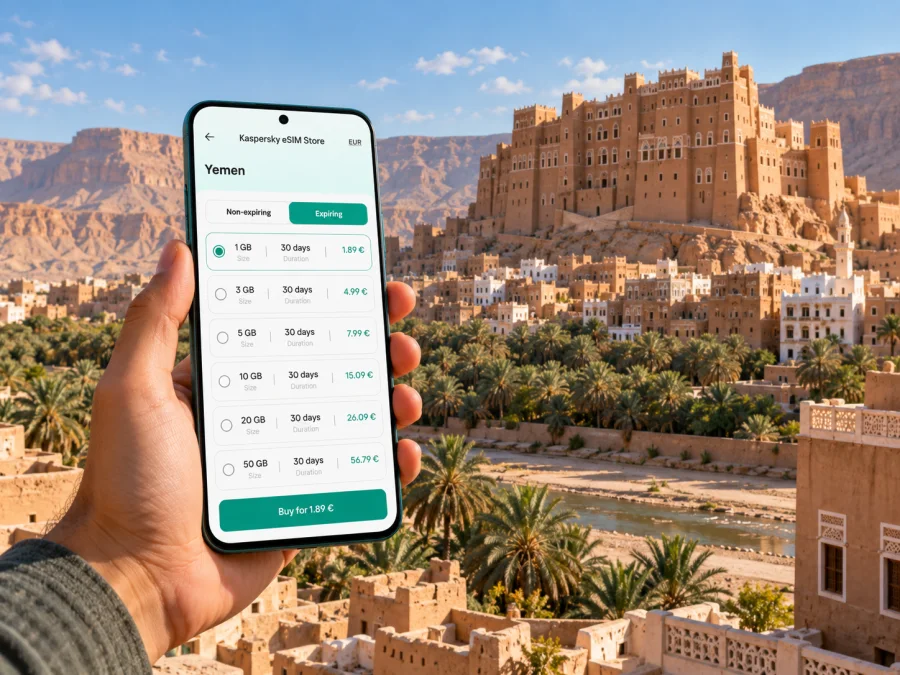
Kaspersky eSIM Store is an app and website where travellers can select, arrange, and activate an eSIM with a suitable data plan for an international trip. It is not the mobile operator and does not itself determine local coverage. You can review the available eSIM options for Yemen and check the current plan details before making a decision. Availability and terms can change; a country page by itself should not be taken as confirmation of signal in Seiyun.
What current local network information tells us
Telecom service in Yemen is not one uniform national footprint. Operators, technologies, access arrangements, and practical availability can differ by area. Yemen Mobile’s official 4G information page describes the operator’s 4G service and names cities and districts where it is available. Seiyun is not named in that published list. This does not prove that no mobile service exists in Seiyun, nor does it establish the coverage of other operators; it means that the cited page cannot be used as confirmation of Yemen Mobile 4G availability in the city.
Yemen Mobile’s 2023 annual report also mentions provision of an eSIM system. That historical company statement is not enough to confirm that a foreign visitor can obtain or activate a Yemen Mobile eSIM today, that a particular handset variant is accepted, or that the service works in Seiyun. A local operator’s eSIM system and an international travel eSIM are different offerings. A travel eSIM can connect only through the network and roaming arrangements stated for its own plan; do not assume that it uses Yemen Mobile or any named local network unless the current plan details explicitly identify it.
This is why plan labels should be read carefully. “Yemen” as a destination describes the plan’s market, not a promise that every town, road, building, or local operator is covered. Before relying on a travel eSIM in Seiyun, check the live plan terms for supported network, data allowance, validity, activation rules, and any restrictions. If the provider does not clearly identify a network or cannot confirm service for your exact itinerary, treat coverage as unverified and arrange a separate communications fallback.
Choosing a plan for this city
Start by matching the plan to your real itinerary and the amount of time you expect to be online, rather than choosing only by a displayed data total. Consider whether you need messaging and maps, whether you will upload large files, and whether your accommodation or workplace has another connection. A brief city visit with mostly offline navigation has a different data pattern from frequent video calls or cloud backups.
Check these items on the plan page before you proceed:
- Network information: Is the local partner named? Does the current information cover the exact destination, or only the country generally?
- Data amount and validity: How much data is included, when does validity begin, and what happens when the allowance is used?
- Service type: Is the eSIM data-only? Unless the terms say otherwise, do not expect a local phone number, standard voice calls, or SMS.
- Activation conditions: Does the profile install before travel, and does the plan start on installation, first connection, or another stated event?
- Tethering and device limits: Confirm whether sharing data with another device is allowed and whether the eSIM can be moved after installation.
- Refund and support terms: Read the current conditions before purchase and save the support details somewhere accessible offline.
If any material detail is unclear, ask the plan provider before relying on it for an essential journey. Do not treat a price or data allowance as a proxy for local signal quality. The practical question is whether the named service can connect where you will be, under the specific plan terms in force at the time.
Device variants and eSIM readiness
An eSIM-capable product name does not guarantee that every regional version of a phone supports eSIM. Manufacturers can sell different hardware or software variants under a similar model name, and a device may also be locked to a home carrier. Before choosing a plan, check the exact model number and region variant in your phone settings or manufacturer documentation, confirm that the handset is unlocked, and make sure it can add an eSIM profile. Check whether your device is compatible before purchase.
If you carry two SIMs, decide in advance which line will handle mobile data and whether data switching should be disabled. Keep your home SIM active only if you need it for calls or verification messages and understand its roaming charges. A data-only travel eSIM generally does not replace a phone number. Messaging and internet calls may work through apps when the data connection is available, but they are not a substitute for a dependable emergency contact arrangement.
Install before the journey; activate with care
When the plan instructions allow, install the eSIM while you have stable internet access and enough time to complete setup. Installation and activation are not always the same step: follow the instructions shown for the selected plan, and do not delete a profile just because it has not connected yet. Some eSIM profiles cannot be installed again after removal. Keep the QR code or setup details secure and available until the profile is working.
For device-specific steps, use the Android eSIM installation instructions or the iOS eSIM installation instructions. The exact menus vary by system version and handset manufacturer, so follow the instructions for your device rather than relying on a generic sequence of taps.
Once you arrive, follow the plan’s activation steps and check whether the device registers on a supported network. If it does not, avoid repeatedly deleting or reinstalling the profile. Check the selected data line, roaming setting, plan status, and the provider’s troubleshooting instructions. If service remains unavailable, contact support through a channel you can access and use your prearranged alternative for essential communications.
Common questions
Is Seiyun in Yemen or in a separate region?
Seiyun is a city in Hadramaut Governorate in Yemen. The Wadi Hadramaut is the broader inland valley region. Shibam is a separate historic town within Seiyun District, not a district of Seiyun’s urban centre.
Does the airport authority listing mean flights are operating?
No. The civil aviation authority lists Sayun International Airport, but that listing is not a live flight schedule. Confirm your specific itinerary with the airline or organiser close to departure and recheck for disruptions.
Is Yemen Mobile 4G confirmed in Seiyun?
The operator’s published 4G coverage page lists multiple areas but does not name Seiyun. That source therefore does not confirm Yemen Mobile 4G service in the city. It also does not establish what other networks may provide there, so ask for current local information rather than extrapolating from another operator’s footprint.
Does the mention of eSIM in an operator report mean visitors can use it?
No. Yemen Mobile’s 2023 annual report refers to an eSIM system, but that statement alone does not confirm current visitor access, handset eligibility, or Seiyun coverage. Check current terms with the operator if considering its local service.
Will a travel eSIM include calls and SMS?
Only if the specific plan says so. Many travel eSIM plans are data-focused. Check the plan description and use internet messaging only as an additional option when data service is available.
Can I rely on an eSIM to navigate outside the city?
Do not rely on it as your only navigation or safety resource. Download information in advance, obtain current route advice locally, and arrange check-ins with a trusted person. Network access and road conditions can both change.
Prepare connectivity around the real itinerary
For Seiyun, a sound connectivity plan has three parts: verify that the exact handset variant can use eSIM, read the live plan terms and network details, and prepare offline information with a separate way to coordinate essential travel. Local operator information is not interchangeable with a travel eSIM’s network arrangements, and a country-level listing does not establish service at a specific address or along a road.
Before making any travel decision, review current official advice and confirm transport and local arrangements with qualified contacts. If you are proceeding with a trip, use the Kaspersky eSIM Store website or app to choose an eSIM plan for Yemen, then follow the plan’s installation and activation conditions. Keep a backup communication plan ready and never depend on a mobile data connection as your only source of directions or assistance.


