
Travel connectivity guide
Setif eSIM for mobile internet in Algeria
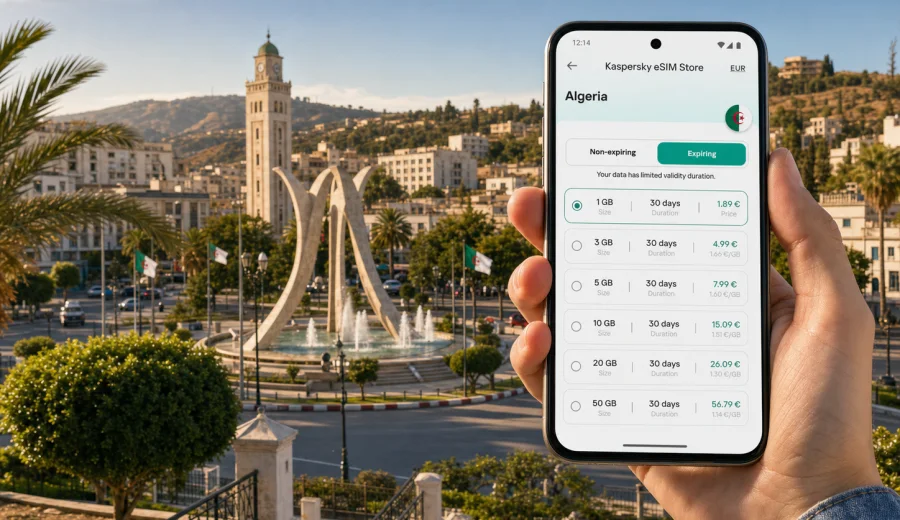
Setif eSIM: mobile connection and internet for your trip
Setif is a practical city for travelers who need reliable mobile routines from the first hour of arrival. It sits on Algeria's High Plateaus, works as a regional business and transport hub, and is often used as a base for meetings, family visits, university trips, shopping, or short routes toward Djemila, Constantine, Bejaia, Batna, and Algiers. In this kind of trip, mobile internet is not a luxury detail. It is what keeps maps, hotel messages, taxi coordination, train or bus plans, and everyday communication under control.
An eSIM can make that preparation simpler because you do not need to look for a physical SIM card after landing or after reaching the city. With a compatible device, you can choose a prepaid data plan for Algeria, install the eSIM profile, and use mobile data for navigation, messaging, bookings, email, and travel apps. Kaspersky eSIM Store is an app and website where you can quickly choose, arrange, and activate an eSIM with a suitable data plan for mobile internet during an international trip.
This guide focuses on Setif city scenarios: arrival, local movement, hotels, business days, short stopovers, and trips from Setif to other parts of Algeria.
Why mobile internet matters in Setif
Setif is easy to underestimate if you look only at a map. It is not just a point between larger Algerian cities. Travelers use it as a working base, a family destination, a shopping stop, and a route gateway across the eastern and central parts of the country. That means your connection needs can change during the same day: one moment you are checking an address near the city center, and the next you are coordinating a driver for a road trip outside town.
Mobile internet is useful in Setif for several everyday tasks:
- finding your hotel or apartment after arrival;
- checking routes between the airport, city center, bus station, university areas, and business locations;
- using maps when street names, local landmarks, and spoken directions need to be matched quickly;
- messaging hosts, colleagues, relatives, or drivers;
- confirming bookings and payment details;
- translating short phrases, menus, and address notes;
- sharing documents during a business trip;
- keeping children, older relatives, or travel companions reachable.
Public Wi-Fi can help in some hotels, cafes, or offices, but it is not a complete travel plan. You may need internet before you reach the hotel, while moving across town, or when you are between meetings. A prepared eSIM can reduce your dependence on finding Wi-Fi at the exact moment you need directions or a confirmation code.
Arrival in Setif: the first hour online
If Setif is your first stop in Algeria, the first hour is when mobile data is often most useful. You may need to check the address in your booking, message a driver, compare transport options, or tell someone that you have arrived. If you enter Algeria through another city and continue to Setif by road, rail, or domestic flight, the same logic applies when you reach the final part of the route.
A simple arrival checklist helps:
- save your hotel address and booking reference offline before departure;
- install the eSIM profile while you still have stable Wi-Fi;
- check whether your phone supports eSIM and is not locked to one carrier;
- keep your primary SIM active if you need calls or SMS on your usual number;
- set the eSIM as the mobile data line when you are ready to use the travel data plan;
- keep key contacts in a messenger that works over mobile data.
For travelers arriving through Setif 8 May 1945 Airport, mobile internet can be useful before you leave the terminal area. For travelers arriving by bus, car, or train from Algiers, Constantine, Bejaia, or Batna, it helps with the final transfer and with confirming where to meet a host or driver.
The main point is not speed for its own sake. It is control. If you can open maps, contact your hotel, and check your route without searching for a SIM shop, the first part of the trip becomes calmer.
Where eSIM helps inside the city
Setif trips often involve short movements rather than one long tourist circuit. You may go from a hotel to a meeting, from the center to a restaurant, from a family address to a shopping area, or from Setif to a nearby archaeological or mountain route. In those situations, a data plan is useful because the trip is made of small decisions.
| City situation | Why mobile data helps | Practical tip |
|---|---|---|
| Hotel check-in | You can message reception, open the booking, and share arrival time | Keep the booking PDF available offline too |
| Taxi or arranged transfer | You can share location and confirm pickup points | Save the driver's number before moving |
| Business meetings | You can open email, calendar, files, and maps | Use Wi-Fi for large uploads when available |
| Family visits | You can coordinate addresses and timing in messengers | Pin important locations in your map app |
| Shopping or errands | You can compare locations, opening times, and routes | Avoid relying only on public Wi-Fi |
| Day trip from Setif | You can keep maps and messages active outside the center | Check data balance before leaving town |
Setif is also a city where local references matter. Directions may include a square, a cafe, a university building, a mall, a road junction, or a neighborhood name. Mobile internet makes it easier to match those spoken references with a map and to adjust if the driver or host gives you a more precise point.
Choosing data for a Setif trip
The right amount of data depends on your style of travel. A person visiting relatives and using home Wi-Fi most evenings may need less mobile data than a business traveler who joins video calls, sends files, and moves between sites during the day. A traveler who uses Setif as a base for trips around the region may need more data than someone staying mostly in one hotel.
Think about your trip in three layers:
1. Essential use: maps, messenger, email, booking confirmations, ride coordination, and translation.
2. Comfort use: browsing, restaurant searches, cloud documents, short social media updates, and photo sharing.
3. Heavy use: video calls, streaming, hotspot use, large downloads, and frequent cloud backups.
For most city trips, essential use is the priority. If you expect to work remotely, share a hotspot with a laptop, or travel outside Setif several times, choose a plan with more data and a validity period that covers the full stay. Before buying, check the plan conditions carefully: data allowance, validity, destination, price, and whether top-up options are available.
Do not choose a plan only by the number of gigabytes. A smaller plan with the right validity period can be better for a short stay, while a longer trip may need a plan that gives you enough days even if the daily data use is moderate.
A practical way to prepare before departure
You can prepare mobile internet for Setif before the trip without turning it into a technical project. The most reliable approach is to handle the setup while you still have stable Wi-Fi at home, in the office, or at your hotel before the next leg of the journey.
Use this sequence:
1. Check that your phone supports eSIM.
2. Confirm that the device is not carrier-locked.
3. Choose Algeria as the destination for your trip to Setif.
4. Compare data allowance, validity period, and price.
5. Install the eSIM profile while connected to Wi-Fi.
6. Keep your regular SIM for calls and SMS if you need your usual number.
7. When you arrive or when the plan should start, select the eSIM for mobile data.
8. Monitor data use during the trip.
If you are planning a city-focused stay, you can choose a data plan for your trip to Setif in Algeria through Kaspersky eSIM Store and then follow the setup steps for your device. The store helps you select and arrange an eSIM with a suitable data plan for mobile internet in a foreign trip; the final conditions depend on the specific plan you choose.
Before purchasing, also use this quick check: check your device. Compatibility matters because eSIM support depends on the phone model, regional version, and carrier lock status. A modern phone may still be locked by a carrier, and some devices have different eSIM capabilities depending on where they were sold.
Installing an eSIM for Setif
Installation is usually straightforward, but it is worth doing it carefully. You need an internet connection to install the eSIM profile, so use reliable Wi-Fi before the trip or at a place where you are not rushed. After the eSIM is installed, you can choose when to use it for mobile data according to the plan instructions.
For device-specific steps, use the official setup guides: Android installation instructions and iOS installation instructions. Follow the guide that matches your phone, and keep the purchase confirmation available until the eSIM is active.
Important setup details:
- give the eSIM a clear label, such as "Algeria data" or "Travel data";
- keep your primary number selected for calls and SMS if you still need it;
- set the eSIM as the mobile data line when you are ready to use the plan;
- enable data roaming for the eSIM if the instructions or device settings require it;
- avoid deleting the eSIM profile unless you are sure the plan allows reinstallation.
An eSIM for travel data usually does not replace your usual phone number. Calls and SMS are not included unless the selected plan explicitly says so. For calls, travelers commonly use messaging apps over mobile data, hotel Wi-Fi, or their regular SIM depending on their needs.
Setif travel scenarios and data planning
Different trips to Setif create different internet needs. A one-night stopover may need only maps, messages, and booking access. A business visit may need more data for calendar updates, document sharing, and calls. A family visit may involve frequent location sharing and changes of plan. A regional route from Setif toward Djemila, Constantine, Bejaia, Batna, or Algiers needs enough data and validity for movement outside the city center.
The exact amount depends on apps, phone settings, and habits, but this comparison can help you choose more realistically:
| Use pattern in Setif | Typical activities | Data approach |
|---|---|---|
| Light | Maps, text messages, email checks, hotel coordination | Choose a smaller plan with enough validity |
| Standard | Maps, browsing, translation, social updates, regular messaging | Choose a balanced plan for the full stay |
| Work-focused | Email, documents, calls, hotspot for laptop | Choose more data and monitor usage daily |
| Route-heavy | Setif plus nearby cities or day trips | Choose enough data for navigation and messages outside the center |
| Media-heavy | Streaming, cloud backup, large uploads | Use Wi-Fi where possible and choose a larger plan |
You can reduce data use by downloading offline maps, disabling automatic cloud photo backup on mobile data, updating apps before departure, and using hotel Wi-Fi for large files.
Local movement: maps, taxis, hotels, and districts
Setif travel usually includes short, practical movements between the center, hotels, residential areas, university sites, shopping areas, restaurants, offices, and transport points. Data helps because these movements are often time-sensitive.
When you move around Setif, keep these habits:
- pin your hotel and the nearest main road on your map app;
- take a screenshot of the address in Arabic, French, or the spelling used by your host if available;
- keep your driver's contact in a messenger before leaving Wi-Fi;
- share your live location only with people you trust;
- keep your phone charged before longer rides;
- check your data balance before leaving the city for a day trip.
For hotels, mobile data is useful even when Wi-Fi is included. Hotel Wi-Fi may be better for large downloads, while eSIM mobile data is better for movement, maps, and quick messages outside the building. If you plan trips from Setif, download offline map areas, confirm the return plan, and keep enough data for route changes.
What to check before buying
Before you arrange an eSIM for Setif, check a few practical details. These checks prevent most avoidable problems.
- Device support: your phone must support eSIM.
- Carrier lock: a locked device may not accept another mobile data profile.
- Destination: the selected plan should cover Algeria for a trip to Setif.
- Validity: the plan should cover your full stay, including arrival and departure days.
- Data allowance: choose enough for maps, messaging, work, and route changes.
- Activation rules: check when validity starts and what steps are required.
- Calls and SMS: assume a travel data eSIM is for mobile internet unless the plan says otherwise.
- Reinstallation: do not delete the eSIM profile unless the plan conditions allow it.
These points are especially important if you are traveling with multiple devices or helping someone else prepare their phone. Each traveler should check the device that will actually be used in Setif.
Quick checklist for Setif
Use this checklist before you leave for Setif or before you travel from another Algerian city toward Setif.
- My phone supports eSIM.
- My phone is not carrier-locked.
- I have selected Algeria as the destination.
- The plan validity covers my full Setif stay.
- The data allowance matches my use: maps, messages, work, routes, or hotspot.
- I installed the eSIM profile while connected to Wi-Fi.
- I know which line is used for mobile data.
- I saved my hotel address and key contacts offline.
- I know where to find the Android or iOS installation guide if I need it.
- I will monitor data use during the trip.
FAQ about eSIM and mobile internet in Setif
Can I use an eSIM for mobile internet in Setif?
Yes, if your device supports eSIM, is not carrier-locked, and the selected plan covers Algeria. Check the plan conditions before buying and install the eSIM while you have a stable internet connection.
Should I install the eSIM before arriving in Setif?
It is usually better to install the eSIM profile before you need it, while you have reliable Wi-Fi. Then you can set it as the mobile data line when you are ready to use the travel data plan.
Will an eSIM give me a local phone number in Algeria?
Travel eSIM plans are usually focused on mobile data. Calls and SMS are not included unless the selected plan explicitly says so. You can use messaging apps over mobile data for many everyday communication needs.
Is an eSIM useful if my hotel has Wi-Fi?
Yes. Hotel Wi-Fi helps inside the building, but mobile data is useful for arrival, maps, taxis, restaurants, meetings, and day trips from Setif. The two options can complement each other.
Can I use the same plan outside Setif?
If the plan covers Algeria and remains valid, it can support travel beyond Setif within the plan conditions. Check the destination and validity details before relying on it for a wider route.
Choose mobile internet for your Setif trip
Setif is a city where mobile internet helps with the practical parts of travel: arrival, directions, hotel coordination, business schedules, family visits, and regional routes. Preparing an eSIM before you need it can make those moments easier because you are not dependent on finding a SIM shop or public Wi-Fi at the right time.
Before you go, check device compatibility, choose the data allowance and validity period that match your route, install the eSIM carefully, and keep your usual number available if you still need calls or SMS. Kaspersky eSIM Store helps you choose, arrange, and activate an eSIM with a suitable data plan for mobile internet during your international trip.
When your itinerary is ready, prepare an eSIM data plan for Setif and Algeria so maps, messages, bookings, and travel details are easier to manage from the first day.