
Travel connectivity guide
Shanghai eSIM: Mobile Internet for Your Trip
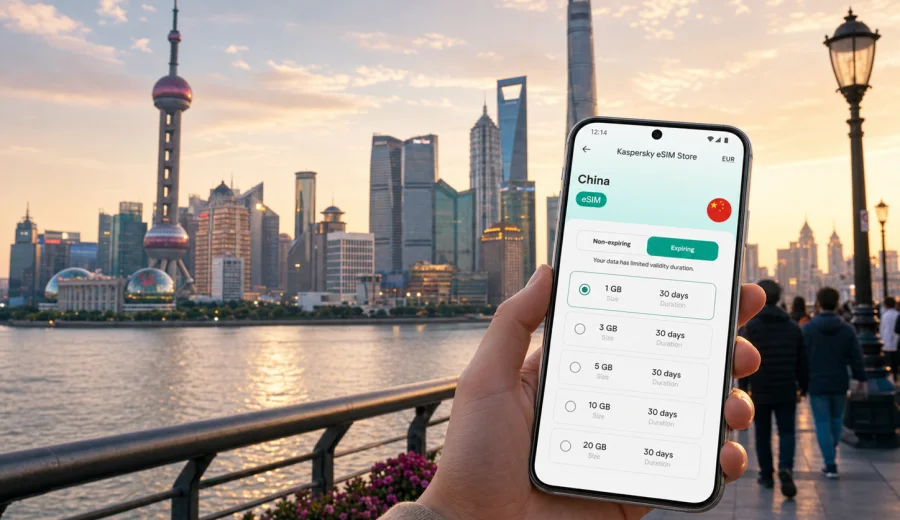
Shanghai eSIM guide: mobile connection and internet for your trip
Shanghai is a city where mobile internet becomes useful in the first minutes of a trip. You may need a map at Pudong airport, a translation app at a metro ticket machine, ride-hailing near Hongqiao, a hotel confirmation on the Bund, or a messenger call after a late business dinner in Lujiazui. An eSIM helps you prepare mobile data before you travel, without looking for a physical SIM card counter after a long flight.
This guide focuses on practical connectivity in Shanghai: arrival, local movement, districts, hotels, business trips, stopovers, and short routes from the city. It also explains how to choose an eSIM tariff for China and what to check before buying.
Why mobile internet matters in Shanghai
Shanghai is large, fast-moving, and dense. The city is easy to navigate when you have mobile data, but it can feel slow if you depend only on airport, hotel, or cafe Wi-Fi. A data plan helps with the small moments that shape the trip: finding the right metro exit, checking a taxi pickup point, translating a menu, updating a meeting time, or confirming a high-speed train platform.
The most common city scenarios are simple:
- You land at Pudong and need directions to a hotel in People's Square, Jing'an, Xintiandi, or Lujiazui.
- You transfer through Hongqiao and need to move between terminal, railway station, metro, and taxi area.
- You use maps to choose between walking along the Bund, taking Line 2, or crossing to Pudong.
- You attend meetings in office towers where visitor registration, QR codes, and messenger updates may be part of the day.
- You take a day trip to Suzhou, Hangzhou, or a nearby water town and want data outside the hotel Wi-Fi zone.
An eSIM is useful because it can be prepared before departure, then activated on a compatible phone when the trip begins according to the selected tariff conditions. It is mainly a mobile data solution. Voice calls and SMS are not included unless the conditions of a specific tariff say so. For calls, many travelers use internet-based messengers while keeping their regular SIM for banking messages or important incoming calls.
Arrival in Shanghai: when data helps first
Shanghai has two major passenger airports. Pudong is the main long-haul international gateway. Hongqiao is important for domestic flights and high-speed rail connections. In both places, mobile internet helps with early decisions: airport transfer, metro route, Maglev connection, pickup point, hotel check-in details, and translation.
At Hongqiao, the challenge is often complexity. The airport, railway station, metro lines, taxi areas, and indoor passages are connected in one transport hub. A data connection helps you check platform changes, message a colleague, or find the correct pickup zone.
For a stopover, mobile data can be even more important. If you have only six to ten hours, you do not want to spend time looking for a local SIM counter or guessing train schedules offline. With an eSIM-ready phone, you can leave luggage, ride into the city, see one district, and return with enough time for boarding.
Choosing an eSIM tariff for a Shanghai trip
For a city article, the tariff choice is still country-based: Shanghai is in China, so you need a tariff that covers China or a broader regional tariff that includes China if your route requires it. Check the destination, traffic allowance, validity period, activation rules, and whether the plan can be topped up.
Use this practical method:
1. List the exact travel dates, including arrival and departure days.
2. Decide where you will go beyond Shanghai: Suzhou, Hangzhou, Nanjing, or another country.
3. Estimate the heaviest data tasks: navigation, translation, ride-hailing, cloud files, video calls, hotspot use.
4. Choose a prepaid tariff with a validity period that covers the whole stay.
5. Check whether your device supports eSIM and is not locked to one carrier.
6. Install the eSIM before travel if the tariff conditions allow it, then activate mobile data when appropriate.
Light users may mainly need maps, messages, email, and translation. Moderate users add ticket management, photo backup on Wi-Fi, and occasional calls. Heavy users may need cloud documents, hotspot sharing, long video meetings, or frequent navigation. The right choice depends on behavior, not only on the destination name.
Shanghai districts and connectivity scenarios
Shanghai is not one travel pattern. Around the Bund and People's Square, mobile internet helps with walking routes, restaurant locations, museum reservations, and ride pickup points. In Lujiazui and Pudong business areas, it helps with visitor instructions, building entrances, and last-minute meeting updates. In Jing'an, Xintiandi, and the Former French Concession, maps and translation make short movements easier on small streets. Around Hongqiao, data is useful for flight, train, metro, and taxi changes. For Disney Resort and Pudong family routes, one phone with working data often becomes the coordination point.
When to prepare the eSIM
For most travelers, a practical time to prepare an eSIM is before departure, while you still have reliable home internet and time to check the device. Installation and activation are separate ideas. Depending on the selected tariff, you may install the eSIM profile before the trip and turn on mobile data when you arrive, or follow the tariff instructions at the correct moment.
Before you travel to Shanghai, check three things:
- Your phone supports eSIM.
- Your phone is not locked to one mobile carrier.
- You know which SIM profile will be used for mobile data after arrival.
If you are unsure about device support, use the compatibility check before purchase: check your device. This is especially important if you use an older phone, a carrier-bought device, or a dual-SIM setup where your physical SIM remains active for calls and SMS.
How Kaspersky eSIM Store fits into the trip
Kaspersky eSIM Store is an app and website where you can choose, arrange, and activate an eSIM with a suitable tariff for mobile internet during an international trip. For Shanghai, the relevant destination is China. You can review conditions, compare data volume and validity, and prepare the eSIM before you need it in the city.
If your itinerary is centered on Shanghai but includes nearby trips inside China, choose a tariff that covers the whole route. If the itinerary continues to another country, compare whether a country tariff or a broader regional option better matches your dates. When you are ready to plan mobile data for the trip, you can choose an eSIM tariff for China and check the available options for the destination.
Coverage, speed, activation details, and availability depend on the selected tariff, device settings, local networks, and the conditions shown before purchase.
Installing and activating eSIM for Shanghai
The basic process is straightforward, but it is worth doing carefully. Keep your regular SIM active if you need calls or SMS, and use the eSIM profile for mobile data if that is your plan. After purchase, follow the installation instructions for your device.
Typical setup steps:
1. Connect to reliable Wi-Fi before installation.
2. Open the eSIM details in the app, website profile, or purchase email.
3. Follow the device setup flow and add the eSIM profile.
4. Set mobile data to the eSIM profile when you want to use the plan.
5. Check whether data roaming must be enabled for the eSIM profile.
For device-specific setup, use the official installation pages: Android installation guide and iOS installation guide. Screen names can differ by phone model and operating system version, so follow your device prompts as well as the eSIM instructions.
Do not delete an installed eSIM profile unless you are sure you no longer need it. Reinstall and transfer rules depend on the plan conditions.
Data planning by traveler type
Different Shanghai trips need different data habits. Use the table below as a planning guide rather than a fixed rule.
| Traveler type | Typical data use in Shanghai | Planning tip |
|---|---|---|
| Stopover traveler | Maps, metro routes, messages, translation, boarding updates | Choose enough data for a compact but active day outside the airport. |
| Business traveler | Email, calendars, messenger calls, document review, taxi apps | Leave a margin for meeting changes and hotspot backup. |
| First-time visitor | Navigation, attraction routes, restaurant search, photo sharing | Use Wi-Fi for large uploads and keep mobile data for movement. |
| Family trip | Group messaging, tickets, maps, translation, ride coordination | Make one phone the main data device and keep a battery pack ready. |
| Regional route | Shanghai plus Suzhou, Hangzhou, Nanjing, or another city | Confirm the tariff covers all planned locations in China. |
If you use cloud backup, set it to Wi-Fi only. If you use maps heavily, download offline areas where the app supports it, then use mobile data for live updates. For video meetings, choose a larger data allowance or use hotel Wi-Fi for long calls and keep the eSIM as a backup.
Transport in Shanghai: where mobile data saves time
Shanghai's metro is often the most predictable way to cross the city. Mobile data helps you check line combinations, station exits, service changes, and walking routes after you leave the station.
For taxis, ride-hailing, and high-speed rail, data helps with pickup points, driver messages, booking confirmations, train numbers, and hotel addresses.
Hotels, apartments, and workspaces
Hotel Wi-Fi is useful, but it should not be your only plan. You may need mobile data before check-in, after checkout, in a taxi, at a client office, or in a lobby where guest Wi-Fi requires room details you do not have yet. For business trips, save meeting addresses offline, use mobile data for route changes and urgent messages, keep a charger in your work bag, and know which SIM profile is active before leaving the hotel. For apartment stays, keep data ready for door codes, building photos, host messages, or map pins.
Short trips from Shanghai
Many visitors use Shanghai as a base for nearby trips. Suzhou, Hangzhou, Nanjing, and several water towns are common choices, and each day can include station navigation, train tickets, local maps, return times, and messages with hotels or tour contacts. Before leaving the city, confirm that the eSIM tariff covers the destination inside China, save return details, charge the phone, and use Wi-Fi for large uploads after you return. If your route continues beyond China, check whether a regional or global tariff better matches the next destination and validity period.
Common mistakes to avoid
The most common eSIM problems are avoidable with a short check: confirm eSIM support before buying, install the profile on the right device, remember that most travel eSIM tariffs focus on data rather than a phone number, set the eSIM as the mobile data line after arrival, and choose a plan that covers the last travel day. Also check app access and account logins before travel. An eSIM helps with mobile internet access for the trip, but it is not a VPN, anonymity tool, or tool for changing service availability.
Quick checklist before flying to Shanghai
Use this checklist the day before departure:
- Passport, hotel address, and flight details are saved offline.
- eSIM compatibility has been checked.
- The China tariff conditions, data volume, and validity period are clear.
- Data roaming settings for the eSIM profile are checked according to instructions.
- Offline maps or key addresses are saved as a backup.
- A charger or power bank is packed for long city days.
FAQ: eSIM and mobile internet in Shanghai
Can I use an eSIM for a trip to Shanghai?
Yes, if your device supports eSIM, is not carrier-locked, and you choose a tariff that covers China. Shanghai does not require a separate city tariff.
Should I install the eSIM before I leave or after I land?
Many travelers install it before departure while they have reliable Wi-Fi. Activation timing depends on the tariff conditions.
Will an eSIM give me a local phone number in Shanghai?
Usually, travel eSIM tariffs are focused on mobile data. Voice calls and SMS are not included unless the selected tariff specifically says otherwise.
How much data do I need for Shanghai?
It depends on your habits. Maps, messaging, translation, and transport apps use moderate amounts. Video calls, hotspot sharing, and cloud uploads need more.
Prepare mobile internet for Shanghai before the trip
Shanghai rewards travelers who can move quickly, confirm details, and adapt plans on the way. An eSIM can make those daily decisions easier: from Pudong arrival to a Lujiazui meeting, from a Bund evening walk to a Hongqiao train, from a hotel check-in to a day trip outside the city.
Before you go, check device compatibility, choose a tariff that covers China, read the validity and activation conditions, and install the eSIM while you still have time to troubleshoot. Kaspersky eSIM Store helps you choose, arrange, and activate an eSIM with a suitable mobile internet tariff for an international trip. To prepare data for your Shanghai itinerary, review eSIM tariff options for China and choose the plan that matches your dates, route, and data needs.