
Travel connectivity guide
Shenzhen eSIM for Mobile Internet Travel
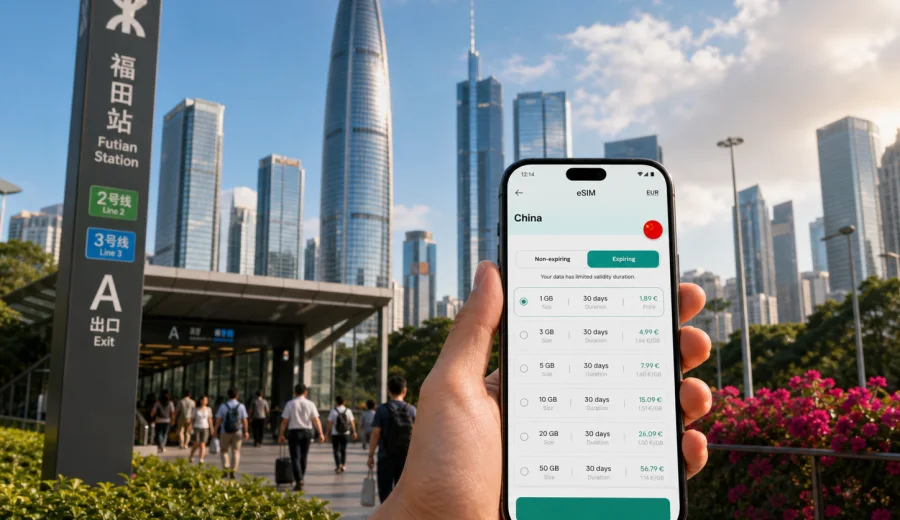
Shenzhen eSIM: mobile connection and internet for your trip
Shenzhen is a city where travel plans often depend on a working phone. You may land at Shenzhen Bao'an International Airport, cross the border from Hong Kong, arrive by high-speed train, or come for a short business visit between meetings in Guangzhou, Dongguan, and the Greater Bay Area. In every scenario, mobile internet matters from the first hour: maps, ride-hailing, hotel check-in messages, translation, mobile payments, train tickets, and contact with colleagues all sit on the same small screen.
An eSIM helps you prepare mobile data before the trip without searching for a physical SIM card after arrival. With Kaspersky eSIM Store, you can use the app or website to choose, arrange, install, and activate an eSIM with a suitable data plan for international travel. The key is to match the plan to your Shenzhen itinerary: a stopover needs less data than a week of meetings, factory visits, navigation, and video calls.
This guide focuses on Shenzhen itself: arrival, transport, districts, hotels, work trips, short stays, and routes from the city. China is the country context for choosing the correct destination plan, but the practical problem is local: how to stay online while moving through a fast, dense, multilingual city.
Why mobile internet is important in Shenzhen
Shenzhen is designed for speed. Metro lines connect the airport, Futian, Luohu, Nanshan, Qianhai, and other business areas. High-speed rail links Shenzhen with Guangzhou, Hong Kong, and cities across Guangdong. Hotels, office towers, malls, and exhibition venues may be easy to find on a map, but they are not always easy to manage offline if you do not read Chinese or if your arrival plan changes.
Mobile data is useful for:
- checking the route from the airport or railway station to your hotel;
- using translation tools at reception, in taxis, or in restaurants;
- coordinating with a driver, host, colleague, or exhibition contact;
- confirming train times and gate details;
- navigating large malls, business parks, and metro interchanges;
- checking hotel messages and booking details;
- using messengers and internet calls when a voice number is not included in your data plan.
An eSIM does not replace every travel tool. It normally gives mobile internet rather than a local phone number, and voice calls or SMS are not included unless the selected plan states otherwise. For many travelers, though, data is the most important part: it keeps maps, messages, email, and booking apps available when public Wi-Fi is inconvenient or requires extra steps.
Arrival scenarios: airport, rail, and border crossings
Shenzhen Bao'an International Airport sits west of the main downtown districts. If you arrive there, your first online tasks are usually simple but time-sensitive: check the address in Chinese, see the best route, tell your hotel when you will arrive, and compare taxi or metro options. Airport Wi-Fi can help, but relying on it for the entire arrival process is fragile. A prepared eSIM lets you move from baggage claim to transport with less friction.
High-speed rail arrivals are different. Shenzhen North Railway Station and Futian Railway Station can be busy, and platforms, exits, metro transfers, and taxi areas may require quick decisions. A working data connection helps you keep the hotel address, train ticket information, and map route visible while you move through the station.
Some travelers reach Shenzhen from Hong Kong. In that case, mobile data planning becomes even more important because your phone may move between different connectivity contexts during the same day. Check whether your selected eSIM plan is for China, a wider regional route, or a separate destination. If your itinerary includes both Shenzhen and Hong Kong, compare plan coverage carefully before purchase.
District guide: where an eSIM helps most
Shenzhen is not a single compact tourist center. It is a chain of districts with different travel patterns.
| Area | Typical reason to visit | Why mobile data helps |
|---|---|---|
| Futian | Business meetings, government offices, high-speed rail, shopping | Fast route changes, ride-hailing, calendar updates, hotel communication |
| Luohu | Border crossing, older commercial areas, shopping, rail links | Navigation in dense streets, translation, station transfers |
| Nanshan | Tech offices, Shenzhen Bay, universities, Sea World area | Meeting coordination, map routing across large business zones |
| Qianhai | Finance, modern offices, new development areas | Taxi pickup points, office tower access, traffic checks |
| Bao'an | Airport area, factories, hotels near terminals | Arrival planning, flight updates, last-mile transport |
| Yantian and Dameisha | Coastal trips, leisure, port-related visits | Map use on longer rides, weather checks, return planning |
For a short city break, you may only use a map and messaging. For a work trip, data demand can be higher: email, calendar attachments, video previews, document checks, hotspot use for a laptop, and constant route coordination between offices. This is why the same destination can require very different data packages.
Choosing an eSIM data plan for Shenzhen
Start with your route and not with the largest number on the screen. A plan should fit the number of days, the amount of data you expect to use, and whether Shenzhen is your only destination.
For a one-day stopover, a small data package may be enough if you mostly need maps, messages, and transport. For a three- to five-day business trip, allow more room for email, document downloads, translation, and occasional hotspot use. For a longer stay, think about your daily habits: cloud backups, video streaming, social media uploads, and video calls can use data quickly.
Before you travel, you can open Kaspersky eSIM Store and choose a mobile data option for China that matches your Shenzhen itinerary. Review the destination, data amount, validity period, and activation conditions before payment. Kaspersky eSIM Store helps you choose, arrange, install, and activate an eSIM with a suitable plan; it is not a mobile network operator, and the exact conditions depend on the selected plan.
Use this quick estimate when comparing options:
- Light use: maps, messaging, email headers, check-in details, and translation.
- Medium use: regular map navigation, email attachments, web browsing, ride-hailing, and photo sharing.
- Heavy use: video meetings, hotspot for a laptop, cloud documents, large downloads, or frequent media uploads.
If you will travel from Shenzhen to Guangzhou, Dongguan, Zhuhai, or other cities in mainland China, choose based on the country or regional coverage shown in the plan. If you also cross to Hong Kong or Macao, do not assume the same plan covers every stop. Read the destination list in the plan details before you buy.
Before you buy: compatibility and phone settings
Not every phone supports eSIM, and some devices may be locked to a mobile operator. Check this before purchase, especially if you bought the phone through a carrier or use a dual-SIM setup. You can use the internal compatibility check here: check your device.
Also review these points before departure:
- Make sure your phone supports eSIM and is not operator-locked.
- Keep your primary SIM active if you need banking SMS or calls on your usual number.
- Save hotel addresses in English and Chinese where possible.
- Keep a screenshot of your booking details in case you briefly lose connectivity.
- Check whether data roaming needs to be enabled for the eSIM profile according to the installation instructions.
An eSIM profile is usually installed on one device. Do not assume it can be moved freely after activation. If you travel with two phones or a phone and tablet, decide in advance which device should carry the travel data plan.
How to install and activate an eSIM for Shenzhen
The exact steps depend on your device and the selected eSIM profile, but the general flow is simple: choose the destination, select a plan, install the eSIM profile, then activate it according to the plan instructions. If you need device-specific guidance, use the Android installation instructions or the iOS installation instructions.
A practical installation sequence:
1. Choose China or the appropriate regional destination in Kaspersky eSIM Store.
2. Compare data amount, validity period, and plan conditions.
3. Complete the purchase and open the installation details.
4. Install the eSIM while you have a stable internet connection.
5. Label the eSIM clearly, for example “China travel”.
6. Keep your home SIM selected for calls if you still need your regular number.
7. On arrival, switch mobile data to the travel eSIM and follow the plan activation guidance.
Installing before departure can be convenient because airport arrivals are busy. Activation, however, may depend on the plan conditions, so read when the validity period starts. Some travelers prefer to install the profile at home, then activate mobile data after landing.
Shenzhen transport: where data saves time
Shenzhen's metro system is usually the easiest way to move between major districts. It can also be crowded and involves large stations with many exits. Mobile internet helps you check the correct exit for your hotel, office tower, mall, or railway transfer.
Taxis and ride-hailing can be useful late at night, with luggage, or when visiting industrial parks and offices far from metro stations. A data connection helps you send your location, confirm pickup points, translate addresses, and track the route. For airport rides, keep the hotel name and address saved offline as a backup, but expect mobile data to make the process easier.
If you plan to visit coastal areas, factories, or nearby cities, data becomes more than a convenience. You may need to compare travel times, check train schedules, share live location, or update colleagues if traffic changes.
Business trips and trade visits
Shenzhen is a practical business city: meetings may happen in office towers, coworking spaces, technology parks, exhibition centers, hotels, and manufacturing areas. Many visitors move between Futian, Nanshan, Bao'an, Longgang, and nearby cities during the same trip.
For business travel, choose an eSIM plan with enough headroom. The most common data-heavy moments are not always obvious:
- opening map links from a meeting invitation;
- downloading a presentation right before a meeting;
- using a messenger call when a phone number is not available;
- sharing a hotspot with a laptop in a taxi or hotel lobby;
- uploading product photos, receipts, or signed documents;
- coordinating with a driver or supplier in real time.
If you will attend a trade show or visit several factories, prepare addresses in advance and keep contact names easy to find. Large venues and industrial zones can have multiple gates.
Hotels, apartments, and public Wi-Fi
Hotel Wi-Fi is useful, but it does not solve the whole trip. You need data before check-in, during transport, in restaurants, in shopping malls, at stations, and while walking between buildings. Public Wi-Fi may require registration, may be slow, or may not be available where you stand.
An eSIM is especially useful when:
- you arrive before check-in time and need to leave luggage;
- your hotel is inside a large mixed-use complex;
- the apartment host sends instructions through a messenger;
- you need translation at reception;
- you want to check a map before stepping out of the metro;
- your laptop needs a short hotspot session outside the hotel.
Keep in mind that eSIM data plans are usually for mobile internet. If you need local voice calling, check the plan details because many travel eSIM options focus on data only.
Stopovers and short stays
For a short Shenzhen stop, the goal is not to build a complex connectivity setup. You need enough data for the essentials: airport or station navigation, hotel or luggage storage messages, maps, translation, and transport. A smaller plan may work if you avoid streaming and large uploads.
Useful short-stay checklist:
- Install the eSIM before departure if your plan allows it.
- Save your hotel or meeting address in English and Chinese.
- Keep the QR code or installation information accessible.
- Turn off automatic cloud backup on mobile data.
- Download offline maps for the broad area as a backup.
- Keep a power bank if you will navigate for several hours.
The main risk on a stopover is not high data use; it is losing time. Preparing data in advance makes the short visit more predictable.
Trips from Shenzhen to nearby cities
Shenzhen is often part of a wider itinerary. You might visit Guangzhou for meetings, Dongguan for manufacturing contacts, Huizhou for a side trip, or Hong Kong before or after your mainland China stay. For mainland China routes, check that the selected destination plan covers the country area you need. For cross-border routes, check each destination separately.
When planning trips from Shenzhen, mobile data helps with:
- high-speed rail station navigation;
- train time checks and platform updates;
- map routing from the arrival station to a meeting place;
- messaging a host when trains are delayed;
- comparing taxi, metro, and rail options.
If you expect to use hotspot mode for work during intercity travel, check whether hotspot use is allowed in the plan and monitor data consumption. Video calls on trains or in cars can use data quickly and may not be stable throughout the route.
Data-saving tips for Shenzhen
You do not need to treat mobile data as fragile, but a few settings can make the plan last longer.
| Setting | Why it helps |
|---|---|
| Disable automatic photo and video backup on mobile data | Prevents large background uploads |
| Download offline map areas before travel | Reduces repeated map loading |
| Update apps over Wi-Fi only | Avoids unexpected data use |
| Limit video quality in streaming apps | Keeps leisure use under control |
| Monitor hotspot sessions | Laptops can consume data much faster than phones |
| Close unused navigation routes | Continuous GPS and map refreshes can add up |
For work trips, separate essential data from optional data. Maps, messaging, email, and translation should come first. Large cloud sync and software updates can wait until hotel Wi-Fi.
Common mistakes to avoid
The most common eSIM mistakes are simple and preventable.
- Buying before checking whether the phone supports eSIM.
- Choosing a plan for the wrong destination or a route that does not match the trip.
- Forgetting when the validity period starts.
- Installing the eSIM on the wrong device.
- Leaving mobile data on the home SIM and using roaming by accident.
- Assuming the eSIM includes a local phone number, voice calls, or SMS.
- Using a laptop hotspot for long sessions without checking data use.
Before boarding your flight or train to Shenzhen, open your phone settings and confirm which SIM is used for mobile data. After arrival, check that the travel eSIM is selected for data and that the profile follows the plan instructions.
FAQ: eSIM and mobile internet in Shenzhen
Can I use an eSIM for mobile internet in Shenzhen?
Yes, if your device supports eSIM, is not operator-locked, and you choose a plan that includes China or the relevant travel destination. Check the plan details before purchase.
Do I get a Chinese phone number with an eSIM data plan?
Usually, travel eSIM plans focus on mobile data. A phone number, voice calls, and SMS are not included unless the selected plan says so. You can often use internet-based messaging and calling apps over mobile data.
Should I install the eSIM before flying to Shenzhen?
Installing before departure is often convenient because you can use a stable connection at home. Activation timing depends on the selected plan, so read when validity begins.
Is an eSIM useful if my hotel has Wi-Fi?
Yes. Hotel Wi-Fi helps inside the property, but you still need internet at the airport, railway station, in taxis, on the metro, and while walking between meetings or attractions.
How much data do I need for Shenzhen?
For light navigation and messaging, a smaller plan may be enough. For business travel, hotspot use, video calls, or frequent uploads, choose more data and monitor usage.
Prepare your Shenzhen eSIM before you travel
Shenzhen rewards travelers who can make quick decisions: which station exit to use, which route is faster, where the taxi should stop, and how to message a hotel or meeting contact. A prepared eSIM gives you mobile internet for these everyday moments without looking for a physical SIM card after arrival.
Before your trip, check device compatibility, compare data amount and validity, install the eSIM profile on the right phone, and save key addresses. When you are ready, you can prepare an eSIM data plan for your trip to Shenzhen through Kaspersky eSIM Store and keep your mobile connection ready for arrival, local movement, business meetings, and trips from the city.