Travel connectivity guide
eSIM Slovenia: mobile internet for your trip
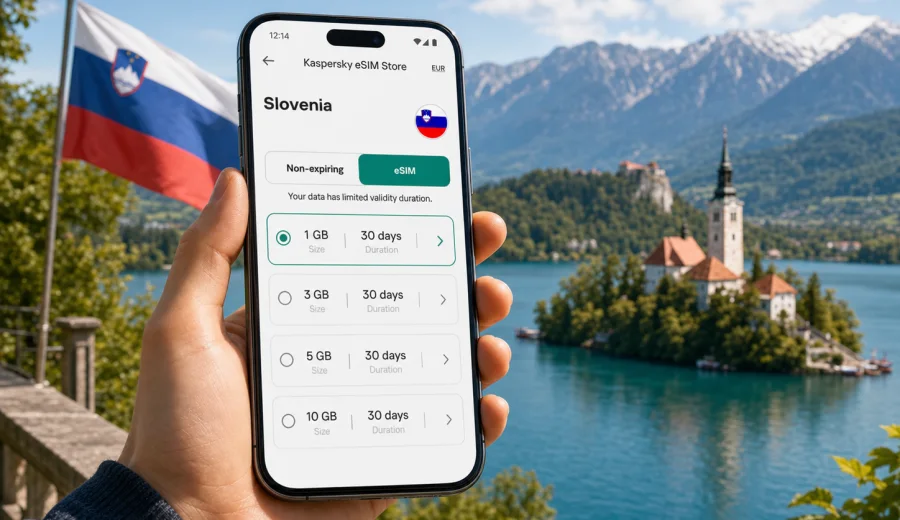
eSIM in Slovenia: mobile connection and internet for your trip
Slovenia is compact enough for a short break and varied enough for a full route: Ljubljana for cafés and museums, Lake Bled for alpine views, the Soča Valley for outdoor travel, Postojna Cave for a half-day stop, and the Adriatic coast around Piran for a slower finish. That variety is exactly why mobile internet matters. You may move between city streets, rural roads, mountain valleys and border areas in one journey, often using maps, tickets, weather apps, messaging and reservations several times a day.
An eSIM helps you prepare mobile data before the trip without looking for a physical SIM card after arrival. Instead of replacing your main SIM, you install a digital SIM profile on a compatible phone and use it for travel data. Your usual number can remain in the device for banking messages or calls, while the eSIM handles internet access for navigation, transport, translation and everyday travel tasks.
This guide explains how to plan an eSIM for Slovenia, how much data different travelers may need, what to check before buying, and how Kaspersky eSIM Store can help you choose, set up and activate an eSIM tariff for mobile internet abroad.
Why mobile internet is useful in Slovenia
Slovenia is easy to explore, but many travel decisions happen on the move. A train time changes, a mountain road takes longer than expected, a restaurant uses online booking, or you need to confirm a hotel check-in code. Public Wi-Fi can help in hotels and cafés, but it is not a reliable base for a full trip.
Mobile data is especially useful for:
- navigation between Ljubljana, Bled, Bohinj, Maribor, Piran and the Soča Valley;
- checking public transport times and ride details;
- using translation apps in smaller towns or local restaurants;
- keeping boarding passes, accommodation details and car rental documents accessible;
- sharing trip updates through messengers;
- checking weather before hiking, cycling or visiting mountain areas;
- using mobile payments and banking apps when needed;
- searching opening hours, parking information and local services.
For many travelers, the main benefit of eSIM is not only convenience. It is predictability. You can see the traffic allowance, validity period and destination before the trip, then install the profile on a compatible device and avoid a last-minute search for a local SIM counter.
What an eSIM gives you during a Slovenia trip
An eSIM is a digital SIM profile installed directly on your phone. For a trip to Slovenia, it usually serves one practical purpose: mobile internet. It normally does not include a regular local phone number, voice calls or SMS unless this is clearly stated in the conditions of a specific tariff. For calls and messages, you can use internet-based apps over mobile data.
The typical travel setup looks like this:
| Travel need | How eSIM helps |
|---|---|
| Maps and routes | Use navigation without depending on hotel Wi-Fi |
| Messaging | Stay reachable through internet-based apps |
| Tickets and bookings | Open confirmations and QR codes while moving |
| Translation | Translate menus, signs and short conversations |
| Work tasks | Check email or join light calls when the connection is suitable |
| Backup access | Keep mobile data available when public Wi-Fi is weak or unavailable |
An eSIM is not a guarantee of identical performance in every location. Speeds, coverage and network quality depend on the selected tariff, local network conditions, the device and the exact place where you are using data. In a city center, the experience may differ from a remote valley or a mountain road. That is normal for mobile networks, so it is better to plan data use realistically.
Slovenia routes where eSIM is especially convenient
Slovenia rewards flexible travel. Distances are short, but routes often combine urban sightseeing with nature. An eSIM is useful because the same data plan can support many small decisions throughout the day.
Ljubljana and day trips
In Ljubljana, mobile internet helps with walking routes, restaurant reservations, taxi apps, museum times and public transport details. If you use Ljubljana as a base for day trips to Bled, Postojna Cave or Predjama Castle, data also helps with train and bus schedules, map changes and return planning.
Lake Bled, Bohinj and alpine travel
Bled and Bohinj are popular for viewpoints, lake walks and mountain access. Mobile data is useful for weather checks, route planning, accommodation messages and navigation between smaller villages. If you plan hikes, download offline maps as a backup and use mobile data for updates, not as the only safety tool.
Soča Valley and road trips
The Soča Valley is known for outdoor travel, mountain roads and scenic stops. Mobile internet helps with route adjustments, fuel stops, accommodation communication and weather changes. If you drive, an eSIM can reduce dependence on public Wi-Fi and make the route easier to manage.
Piran and the coast
On the coast, mobile data is useful for parking, restaurant searches, ferry or bus details, beach weather and photo sharing. In busy periods, having your own mobile data can be more practical than relying on crowded café networks.
How much data do you need for Slovenia?
Data needs depend on how you travel. A person who mainly uses maps and messages will need much less than someone who uploads video, works remotely or uses cloud services every day.
| Travel style | Typical data use | Practical suggestion |
|---|---|---|
| Light city break | Messaging, maps, tickets, occasional search | 1-3 GB may be enough for a short trip |
| Standard sightseeing | Maps, photos, social apps, bookings, transport | 3-5 GB gives more breathing room |
| Road trip or active route | Navigation, weather, route checks, frequent searches | 5-10 GB is often more comfortable |
| Remote work add-on | Email, documents, calls, hotspot use | Consider a larger allowance and monitor usage |
| Heavy media use | Video, cloud backup, streaming | Choose more data or use Wi-Fi for large transfers |
These figures are planning ranges, not promises. App settings matter. Video autoplay, cloud photo backup and system updates can consume data quickly. Before departure, disable automatic downloads on mobile data and set messaging apps to avoid large media downloads unless you need them.
Device compatibility: check before you buy
Before choosing any eSIM tariff, confirm that your phone or tablet supports eSIM and is not locked to one mobile operator. This is an important step because not every device model supports eSIM, and some devices sold in different markets may have different SIM capabilities.
Use this short checklist:
- Your device supports eSIM.
- The device is unlocked for mobile networks.
- You have a stable internet connection during installation.
- You can access the email or account where installation details are sent.
- You understand when the tariff validity starts.
- You know which SIM will be used for mobile data after activation.
If you are unsure, check your device before buying a tariff. It is better to spend one minute checking compatibility than to discover the issue at the airport or in a hotel lobby.
When to install and activate your eSIM
You can usually prepare an eSIM before departure, but the right timing depends on the instructions and the tariff conditions. Installation and activation are not always the same thing. Installation adds the eSIM profile to your device. Activation starts using the profile or begins the validity period according to the tariff rules.
A practical approach is:
1. Check device compatibility before purchase.
2. Choose Slovenia as the destination and compare available data amounts and validity periods.
3. Install the eSIM while you have stable Wi-Fi, such as at home or in a hotel.
4. Keep your primary SIM active if you need your usual number.
5. When you arrive, select the eSIM for mobile data and check data roaming settings if required by the instructions.
6. Monitor usage during the trip and top up or choose another tariff if the product flow allows it.
For detailed setup steps, use the Android installation guide or the iOS installation guide. Follow the on-screen instructions for your exact device, because menu names may differ between Android models and iPhone versions.
How to choose an eSIM tariff for Slovenia
A good eSIM choice is not only about the largest data number. It should match your trip length, route and habits. A weekend in Ljubljana has different requirements from a two-week itinerary that includes Bled, Bohinj, the Soča Valley, caves, vineyards and the coast.
Use these questions before choosing:
- How many days will you be in Slovenia?
- Will you stay mostly in cities or travel through rural and mountain areas?
- Do you need mobile data only for yourself or also for a laptop through hotspot?
- Will you use maps online all day, or download offline maps in advance?
- Do you upload many photos and videos from mobile data?
- Do you need a regional option because your route also includes Italy, Austria, Croatia or Hungary?
If Slovenia is your main destination, you can prepare an eSIM tariff for your Slovenia trip in Kaspersky eSIM Store and compare available options by data amount, validity and destination. The goal is to choose a tariff that fits the way you actually travel, not to overbuy or run short on the second day.
Practical data-saving settings
Small settings can make a modest data package last much longer. They are worth checking before travel, especially if you plan to use maps and messaging every day.
| Setting | Why it matters |
|---|---|
| Disable cloud photo backup on mobile data | Photo and video uploads can consume gigabytes |
| Turn off video autoplay | Social apps can use data even when you scroll briefly |
| Download offline maps | Navigation becomes lighter and more reliable |
| Update apps before the trip | Avoid large downloads while roaming |
| Limit background app refresh | Stops apps from syncing unnecessarily |
| Use Wi-Fi for streaming | Saves mobile data for travel tasks |
| Track data usage daily | Helps you adjust before the allowance runs low |
For Slovenia, offline maps are particularly useful if you plan to drive or hike. Mobile data can then be reserved for live traffic, weather, messages and booking changes.
eSIM, roaming and local SIM: quick comparison
Travelers usually compare three options: standard roaming from a home operator, a local physical SIM card, and an eSIM tariff for travel. Each can work, but they solve different problems.
| Option | Best for | Things to consider |
|---|---|---|
| Home roaming | Keeping everything on your existing SIM | Conditions and costs depend on your home plan |
| Local physical SIM | Longer stays with local-store setup | You may need to find a shop and replace or add a SIM |
| Travel eSIM | Preparing data before or during a trip | Requires eSIM support and is usually focused on mobile internet |
For a short or medium Slovenia trip, eSIM can reduce setup friction because you do not need to remove your physical SIM and can keep your main number available.
Quick checklist before departure
Use this list the day before your flight or train:
- Confirm your phone supports eSIM and is unlocked.
- Choose the data amount and validity period for your Slovenia route.
- Install the eSIM on stable Wi-Fi if the instructions allow pre-trip installation.
- Save installation details somewhere accessible.
- Download offline maps for Ljubljana, Bled, Bohinj, Piran and any driving route.
- Turn off mobile data backups for photos and videos.
- Update travel, banking and messaging apps before departure.
- Check which SIM is assigned to mobile data.
- Keep your primary SIM available if you need calls or SMS.
- Read the tariff conditions so you know when validity starts.
FAQ
Can I use eSIM in Slovenia for normal phone calls?
Most travel eSIM tariffs are intended for mobile internet. They usually do not include a regular phone number, voice calls or SMS unless this is stated in the tariff details. You can use internet-based calling apps over mobile data.
Will eSIM work in the mountains?
Mobile coverage can vary in alpine valleys, remote areas and on mountain roads. Download offline maps and essential documents before leaving cities, then use mobile data for updates where service is available.
Can I keep my usual SIM card active?
On many compatible phones, yes. You can keep your main SIM for your regular number and select the eSIM for mobile data.
Is public Wi-Fi enough for Slovenia?
Public Wi-Fi can help in hotels and cafés, but it is not always available when you need maps, tickets, parking, weather updates or messages.
Choose mobile internet for Slovenia before you travel
An eSIM is a practical way to prepare mobile connection and internet for Slovenia without waiting to buy a physical SIM after arrival. It is especially useful if your trip includes several regions, day trips, mountain routes or neighboring countries.
Before you choose, check device compatibility, compare the data amount and validity period, and read the activation conditions. Then install the eSIM using the correct Android or iOS instructions and set it as your mobile data line when you are ready to use it.
Kaspersky eSIM Store is an app and website where you can quickly choose, set up and activate an eSIM with a suitable tariff for mobile internet during an international trip. If Slovenia is your destination, choose an eSIM tariff for your Slovenia trip and prepare your travel data before you need it on the road.