
Travel connectivity guide
Strasbourg eSIM Guide for Mobile Internet
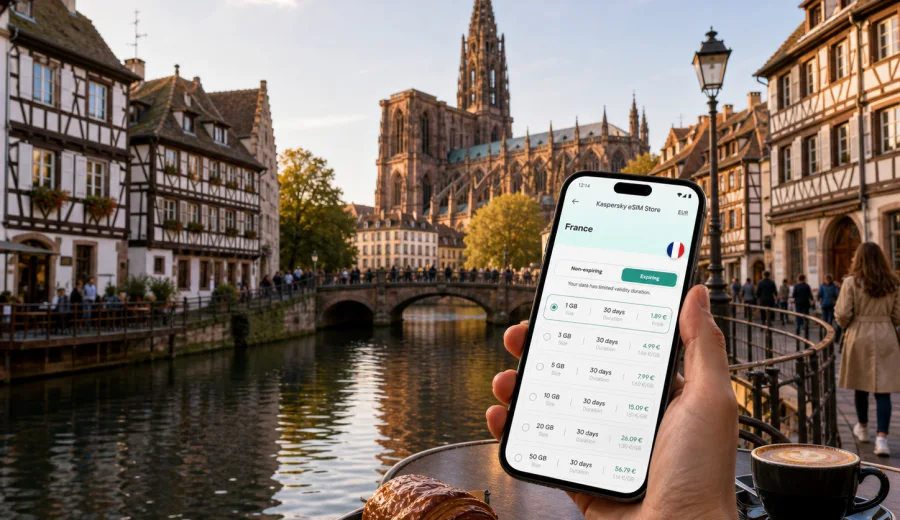
Strasbourg eSIM: mobile connection and internet for a calmer city trip
Strasbourg rewards travelers who move with a plan. The city is compact enough for long walks, but it also asks you to make quick decisions: which tram line gets you from the station to the hotel, whether the next train to Colmar is worth taking, where the river boat leaves from, and how to reach the European Quarter without losing time. A reliable mobile connection and practical internet access help you handle those decisions without turning every corner into a Wi-Fi search.
An eSIM is useful in Strasbourg because many trip moments happen between fixed places: at Strasbourg Airport, on the TER train into the city, beside the canals of Petite France, on the tram to Robertsau, or while crossing into Germany for a short visit to Kehl. With an eSIM-ready phone, you can prepare mobile internet before you travel, keep your main SIM in place, and use data for maps, bookings, messages, translation, and ride planning.
This guide focuses on Strasbourg itself: arrival routes, local movement, districts, hotels, business trips, stopovers, Christmas market visits, and day trips from the city. France matters because the data plan must match the country of travel, but the practical question is simpler: how do you stay online while moving through Strasbourg without relying on hotel Wi-Fi or last-minute SIM shopping?
Why mobile internet matters in Strasbourg
Strasbourg is easy to enjoy when you can check details on the move. The historic center sits on the Grande Ile, the canals around Petite France can be confusing at first, and the tram network is efficient but not always obvious to a first-time visitor. Mobile internet helps with small decisions that save time:
- walking from Strasbourg-Ville station to your hotel without overshooting narrow streets;
- checking tram platforms and transfer points before you enter a station;
- finding the right entrance to the cathedral area when streets are busy;
- confirming restaurant bookings around Place Gutenberg, Krutenau, or Neustadt;
- opening hotel messages when reception instructions arrive late;
- translating short notices, menus, or transport updates;
- keeping business calls, messaging apps, and navigation available during the day.
The city also has seasonal pressure points. During the Strasbourg Christmas market, central streets get crowded and some routes change. During European Parliament sessions, hotels and taxis can be busier around the European Quarter. On summer weekends, riverfront walks and nearby train routes attract day visitors. In each case, mobile data gives you flexibility: you can adjust a route, share a location, or check a reservation without waiting for a stable public hotspot.
Where an eSIM helps from the moment you arrive
Most visitors reach Strasbourg through one of four routes. Each route has its own internet moments.
| Arrival route | What you usually need data for | Practical eSIM use |
|---|---|---|
| Strasbourg Airport | Train times, hotel directions, messaging your host | Turn on data after landing and check the TER connection before leaving the terminal |
| Strasbourg-Ville station | Walking route, tram line, ride coordination | Use maps as soon as you exit the station square |
| Paris or Frankfurt connection | Train changes, delay updates, platform checks | Keep data available between rail apps, messages, and maps |
| Road trip from Alsace or Germany | Parking, low-emission zone checks, hotel access | Navigate to car parks near the center, then continue on foot or by tram |
Strasbourg Airport is close to the city, but travelers still need to coordinate the short rail transfer and the final leg to the hotel. At Strasbourg-Ville, the station is central, yet the first ten minutes can be busy: luggage, tram stops, taxis, and the walk toward Grande Ile all compete for attention. If your eSIM is already installed, you can activate data when appropriate and handle these steps without searching for a shop first.
For rail travelers, eSIM is especially convenient. Many Strasbourg trips start elsewhere in France, Switzerland, Germany, Belgium, or Luxembourg. You may pass through several stations before reaching the city, and public Wi-Fi quality can vary. A prepared data plan lets you keep tickets, maps, and messages available during the whole travel day, subject to the terms and coverage of the selected plan.
Strasbourg districts where data is especially useful
Grande Ile is the obvious starting point. It includes the cathedral, shopping streets, museums, restaurants, and many hotels. The streets are walkable, but they curve around canals and small squares. Mobile maps help you avoid circling the same block when you are heading to the cathedral, Place Kleber, or the riverfront.
Petite France is more scenic and more maze-like. Wooden houses, bridges, locks, and narrow lanes create beautiful detours, so data is useful for live location sharing, restaurant checks, and photo backup. Neustadt is broader and more formal; if you are moving between Place de la Republique, the university area, and cultural venues, online maps help you decide when walking still makes sense and when the tram is faster.
Krutenau works well for cafes, evening plans, and smaller hotels. The European Quarter is where online access matters most for business travelers: meetings may be spread between institutional buildings, hotels, and tram stops. An eSIM data plan does not replace proper corporate security practices, but it can reduce dependence on open Wi-Fi for routine navigation and messaging during a working day.
How much data to plan for a Strasbourg trip
Data needs depend less on the city and more on your behavior. A traveler who uses offline maps, hotel Wi-Fi, and light messaging may need far less than someone who streams video, uploads large files, or works from a laptop hotspot.
| Trip style | Typical online tasks | Data planning note |
|---|---|---|
| Weekend city break | Maps, messaging, restaurant searches, tickets | A modest package may be enough if you use hotel Wi-Fi for heavy tasks |
| Christmas market visit | Maps, photos, group chats, opening hours | Allow extra data for navigation and media sharing in crowded areas |
| Business trip | Email, calendars, calls, document access | Choose more data and check whether tethering is allowed in the tariff terms |
| Family trip | Several devices, ride planning, tickets, translation | Consider who needs data and whether one phone will act as the main navigator |
| Alsace day trips | Train apps, maps, photo uploads, route changes | Plan beyond the city if you visit Colmar, Obernai, or other towns |
Separate essential data from optional data. Essential data includes maps, transport checks, messaging, authentication, booking confirmations, and urgent web searches. Optional data includes streaming, large photo uploads, cloud backups, and long video calls.
Choosing an eSIM for Strasbourg
For a city article, the correct plan destination is the country that includes the city. For Strasbourg, that means France. A city-specific package is usually not needed; what matters is that the selected eSIM tariff supports your travel area, validity period, and expected data use.
When you compare options, look at four practical details:
- data volume, because maps and messaging use much less data than video and hotspot work;
- validity period, because a three-day city break and a two-week route through Alsace need different timing;
- destination coverage, because your plan should match France and any wider route you intend to use;
- activation rules, because some plans start counting validity at installation while others start when they connect.
Kaspersky eSIM Store is an app and website where you can quickly choose, order, and activate an eSIM with a suitable data tariff for mobile internet during an international trip. If Strasbourg is your destination, you can prepare an eSIM tariff for travel in France before you leave or when you are ready to set up your phone.
Avoid choosing only by the largest data number. A larger package is useful for video calls, frequent hotspot use, or long days outside the hotel. A smaller package can be enough for navigation, messages, tickets, and restaurant searches.
Device compatibility before you buy
Not every phone supports eSIM, and some devices may be locked to a mobile operator. Before preparing an eSIM for Strasbourg, check your device model, regional variant, and settings.
Use the compatibility check before purchase: check your device. Many travelers keep their main number active for banking codes, messengers, and important contacts, while the eSIM handles travel data.
Travel data eSIM tariffs usually do not include a regular local phone number, voice calls, or SMS unless the specific tariff says otherwise. For calls and messages, you can use internet-based apps over mobile data.
Installing an eSIM before the trip
Installing the eSIM before departure can make arrival smoother. You can complete the setup on a stable connection, keep the eSIM turned off until the right moment, and avoid rushing through phone settings after landing. Follow the instructions for your operating system: Android installation guide and iOS installation guide.
A practical setup sequence looks like this:
1. Check that your phone supports eSIM and is not locked in a way that prevents adding one.
2. Choose a tariff for France or for the wider route you will actually travel.
3. Install the eSIM while you still have reliable Wi-Fi.
4. Name the eSIM clearly, for example "France data" or "Travel data".
5. Keep your main SIM as the default line for calls if that is your preference.
6. Set the eSIM as the mobile data line when you are ready to use it.
7. Check whether data roaming must be enabled for the eSIM according to the tariff instructions.
Do not delete the eSIM profile casually after installation. Reinstalling or moving it to another device may depend on the conditions of the specific plan.
Using mobile data on Strasbourg transport
Strasbourg has one of France's most practical tram networks. For travelers, the tram is useful for the station, the city center edges, university areas, the European Quarter, and connections toward the German border. Mobile data helps when you need to check direction, transfers, or whether walking is faster than waiting.
In the historic center, walking is often the best option. Data still helps because bridges, canals, and pedestrian streets can create small delays.
For trips beyond the center, mobile internet becomes more important. You may use it to:
- compare tram and walking times to the European Parliament area;
- check train departures for Colmar, Obernai, Selestat, or Basel connections;
- navigate to park-and-ride locations if you arrive by car;
- coordinate a taxi or ride pickup after dinner;
- open digital tickets or booking confirmations without relying on station Wi-Fi.
If you plan to cross into Kehl, remember that you are moving from France into Germany. Check the destination list and terms before assuming that a France-only plan is suitable for cross-border use.
Hotels, apartments, and remote work
Hotel Wi-Fi is useful for heavy tasks, but it is not a complete travel internet plan. Check-in messages, door codes, late arrival instructions, and map searches often happen before you reach your room. An eSIM can cover the gap between station, tram, street, and reception.
Apartment stays make this even more relevant. Many Strasbourg apartments use self-check-in instructions, and mobile data helps you open lockbox details, message the host, translate instructions, and share your arrival time.
For remote work, treat mobile data as a backup and mobility tool. It can support email, chat, calendar updates, maps, and short calls, but large software updates or long video meetings can use data quickly. If you plan to tether a laptop, check whether hotspot use is allowed.
A practical data checklist for Strasbourg
Before you leave:
- install offline map areas for Strasbourg and nearby towns you may visit;
- save your hotel address in English and French if useful;
- keep train, flight, and hotel confirmations available offline;
- check eSIM compatibility and installation steps;
- choose a data tariff that matches France and your travel dates;
- understand when the plan validity starts;
- decide whether your main SIM or eSIM will handle mobile data.
On arrival:
- enable the eSIM for mobile data when you are ready to use it;
- check that the phone selected the correct data line;
- test maps and messaging before leaving the airport or station area;
- keep data-heavy uploads paused until you are on hotel Wi-Fi;
- watch your remaining data if your plan has a fixed allowance.
During the trip:
- use mobile data for movement, tickets, messages, and urgent searches;
- use trusted Wi-Fi for large uploads and streaming when possible;
- keep your phone charged before long market visits or day trips;
- review plan conditions before crossing into another country;
- contact support through the available product channels if setup questions appear.
Common Strasbourg scenarios
For a weekend trip, the main value is navigation and convenience: station arrival, Petite France, restaurant bookings, the cathedral, and a late return to the hotel. For the Christmas market, expect heavier map and messaging use because meeting points and walking routes can change quickly.
For a business trip, focus on calendar changes, secure messaging, route planning, and fast responses. For a family visit, one phone often becomes the main navigation device, so that phone needs enough data and battery for the whole day. For day trips to Colmar, Obernai, or the Alsace Wine Route, data helps with train checks and route changes.
Quick answers about eSIM in Strasbourg
Do I need a Strasbourg-specific eSIM?
Usually no. Strasbourg is in France, so the practical choice is a tariff that covers France or a broader route that includes France.
Can I install the eSIM before arriving?
Yes, if your device supports eSIM and the tariff instructions allow that setup. Check when plan validity begins.
Will an eSIM give me a French phone number?
Travel data eSIM tariffs usually focus on mobile internet and do not normally include a regular local phone number, voice calls, or SMS unless the specific tariff says so.
Is eSIM useful if my hotel has Wi-Fi?
Yes. Hotel Wi-Fi helps inside the property, while mobile data helps between the station, tram stops, restaurants, museums, meetings, and day trips.
Should I keep my main SIM active?
Many travelers do. Your main SIM can remain available for calls, SMS, or verification codes according to your home operator's terms.
What if I visit Germany from Strasbourg?
Check the tariff's destination coverage before crossing the border. Kehl is very close, but it is in Germany, so a France-only data plan may not match that part of your route.
Choose an eSIM tariff for your Strasbourg trip
Strasbourg is a city where good mobile internet quietly improves the whole journey. It helps at arrival, on the tram, around the canals, in the European Quarter, during market crowds, and on day trips through Alsace. The best setup is simple: check device compatibility, choose a tariff for France or your wider route, install the eSIM in advance when possible, and keep mobile data for the moments when you are moving.
With Kaspersky eSIM Store, you can use the app or website to choose, order, and activate an eSIM with a suitable data tariff for travel. Before your trip, review mobile internet options for France and pick the package that fits your Strasbourg dates, data habits, and route.