
Travel connectivity guide
eSIM for Tajikistan: mobile internet guide
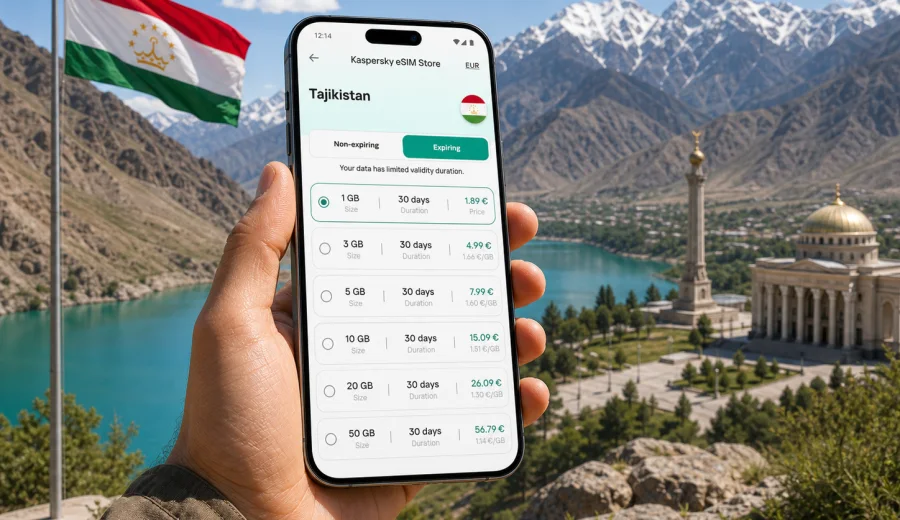
eSIM in Tajikistan: mobile connection and internet for your trip
Tajikistan is a destination where mobile internet can shape the whole rhythm of a trip. You may need maps in Dushanbe, a messenger on the road to Khujand, hotel confirmations near Iskanderkul, or weather updates before a mountain route in the Pamirs. An eSIM helps you prepare mobile connection before you travel, so you do not have to start your trip by looking for a physical SIM card or relying only on public Wi-Fi.
This guide explains how to use an eSIM for mobile internet in Tajikistan, what to check before purchase, how to estimate data needs, and how Kaspersky eSIM Store can help you choose, arrange, and activate an eSIM tariff for the trip. The focus is practical: clear steps, realistic scenarios, and the limits you should understand before you leave.
Why eSIM is useful for Tajikistan
Tajikistan combines city travel, long transfers, mountain roads, border regions, and places where plans can change because of weather or distance. In this kind of trip, mobile internet is not only about posting photos. It helps with navigation, taxi apps, accommodation messages, translation, banking alerts, and keeping in touch with people who expect updates from you.
An eSIM is a digital SIM profile installed on a compatible smartphone or tablet. It can be used for mobile data in the destination country without inserting a physical SIM card. For many travelers, this is useful because the setup can be prepared before departure, while the main physical SIM can remain in the device for calls or important messages from home.
The main advantages are straightforward:
- you can choose a data package before the trip or shortly after arrival;
- there is no need to visit a mobile shop for a physical card;
- you can compare data volume, validity period, and destination before payment;
- you can keep your primary SIM in place if your device supports dual SIM use;
- you reduce dependence on airport, hotel, or cafe Wi-Fi;
- you have a clearer view of prepaid data limits.
An eSIM is not a magic guarantee of signal in every valley or on every road. Coverage and speed depend on local networks, terrain, device settings, and the selected tariff conditions. In Tajikistan, this matters because high mountains and remote routes can affect connection quality. The practical goal is to prepare a reliable mobile internet option for the places where network access is available.
Where mobile internet matters most
Tajikistan travel often includes more than one type of route. A visitor may spend two days in Dushanbe, continue to the Fann Mountains, visit Khujand, or plan a longer journey toward the Pamir Highway. Each scenario creates different data needs.
| Travel situation | Why mobile data helps | What to plan |
|---|---|---|
| Arrival in Dushanbe | Maps, ride-hailing, hotel messages, banking notifications | Activate data when you are ready to use the eSIM profile |
| City stay | Restaurants, translation, messaging, mobile payments, routes | A moderate daily data allowance is usually enough |
| Intercity transfer | Driver contact, location sharing, route checks, delays | Download offline maps as a backup before departure |
| Mountain trip | Weather checks, emergency messages where signal exists, itinerary updates | Do not rely on mobile data as the only safety tool |
| Remote work | Email, video calls, cloud files, hotspot use | Choose more data and check whether tethering is allowed |
For a short city-focused trip, light browsing and messaging may not use much data. For a mountain route with navigation, photo uploads, video calls, and hotspot use, data can disappear faster than expected. The safest approach is to choose a package based on how you actually use your phone, not only on the number of travel days.
How much data to choose for Tajikistan
Data planning is easier when you separate essential use from optional use. Essential use includes maps, messengers, email, transport, booking apps, and translation. Optional use includes video streaming, large cloud backups, app updates, and long video calls. The optional category is usually what consumes the most data.
Use this simple estimate:
- 1-3 GB may suit a short stay with messaging, maps, and light browsing;
- 5-10 GB is more comfortable for a week with regular navigation and social apps;
- 10-20 GB can suit longer trips, frequent uploads, and some remote work;
- larger packages are useful if you expect hotspot use, video calls, or heavy media.
Before choosing a tariff, check the validity period as carefully as the data volume. A large package is not useful if the validity ends before your route is over. A smaller package can be enough if you use Wi-Fi at your hotel for heavy downloads and keep mobile data for movement, maps, and messages.
eSIM, roaming, local SIM: what is different
Travelers usually compare three options: standard roaming from a home operator, a local physical SIM card, and an eSIM tariff for the destination. Each can be suitable in different situations.
| Option | Good for | What to check |
|---|---|---|
| Home roaming | Keeping one familiar number and simple billing | Price per MB or day, fair use limits, included countries |
| Local physical SIM | Longer stays and local phone number needs | Shop location, registration rules, language barrier, device slots |
| eSIM tariff | Mobile internet without a physical SIM card | Device compatibility, data amount, validity, activation rules |
An eSIM is usually most attractive when you want mobile data for travel tasks and prefer to arrange it digitally. It does not normally replace a local phone number. Voice calls and SMS are not included unless the conditions of the specific tariff say otherwise. For most travelers, internet-based calls and messages through apps are the practical alternative.
What to check before buying
The most important step is device compatibility. Not every phone supports eSIM, and some phones can be locked by an operator. Before you pay for a tariff, check your device and make sure it supports eSIM installation.
Also review these points:
- your phone or tablet must support eSIM;
- the device should not be locked to one mobile operator;
- you need internet access to install the eSIM profile;
- the selected tariff must include Tajikistan or the region you will use;
- the validity period should match your travel dates;
- the data allowance should match your expected use;
- some devices may require data roaming to be enabled for the eSIM profile;
- an activated eSIM profile may not be transferable to another device.
Keep your primary SIM active if you need banking SMS or calls from home, but set mobile data to the eSIM profile when you want to use the travel data package. This prevents accidental use of expensive roaming from the primary SIM.
Choosing an eSIM tariff for Tajikistan
The best tariff is not always the largest one. It is the one that fits your route, duration, and app habits. For Tajikistan, think about whether you will stay mainly in cities or spend time moving through mountainous areas. City use tends to be more predictable. Remote travel needs more backup planning, including offline maps and saved documents.
Kaspersky eSIM Store is an app and website where you can quickly choose, arrange, and activate an eSIM with a suitable tariff for mobile internet in an international trip. For this destination, you can review the available options and choose an eSIM tariff for Tajikistan before you travel, then install the eSIM on a compatible device.
When comparing options, look at four details in the tariff description:
1. Destination: confirm that Tajikistan is included.
2. Data volume: match it to maps, messages, uploads, and hotspot needs.
3. Validity: check when the period starts and how many days it lasts.
4. Conditions: review activation, top-up, and support information.
If your route includes neighboring countries, check whether a regional option is more convenient than separate country tariffs. Use the country tariff when Tajikistan is the core destination and you want a focused data package for that part of the trip.
Practical data scenarios
Here are realistic travel patterns that can help you estimate usage.
Weekend in Dushanbe
You use maps, messengers, restaurant searches, taxi or transfer apps, email, and light social media. A smaller data package may be enough if you avoid streaming and use hotel Wi-Fi for large downloads. Install the eSIM before departure, then activate mobile data when you are ready to use it.
One week across Dushanbe and Khujand
You may use navigation every day, share photos, check transport details, and keep messaging open. A medium package is usually more comfortable because transfers and route changes can increase data use. Save hotel addresses and tickets offline in case signal is weak during travel.
Mountain route or Pamir itinerary
You should plan mobile internet as one part of a wider communication setup. Download offline maps, keep important addresses saved, and do not assume continuous mobile data in remote areas. A larger package can be useful for city stops, messages, and uploads when coverage is available, but it should not replace local safety planning.
Work trip
Email, cloud files, video meetings, and hotspot use can consume data quickly. Choose a tariff with enough volume and check whether tethering is supported by the selected plan and device. For video meetings, use stable Wi-Fi when possible and keep eSIM data as a controlled backup.
How to install and activate an eSIM
The exact screens depend on the device, but the general flow is simple. First choose the tariff, then install the eSIM profile, then select it for mobile data. You can follow the Android installation guide or the iOS installation guide when setting up your device.
Basic setup steps:
1. Check that your device supports eSIM and is not operator-locked.
2. Choose Tajikistan as the destination and select a suitable tariff.
3. Complete the order and open the eSIM details in your profile or email.
4. Install the eSIM using the on-screen instructions or QR code.
5. Name the new line clearly, for example Travel eSIM or Tajikistan data.
6. Set the eSIM as the mobile data line.
7. Keep your primary SIM for calls or SMS if needed.
8. Enable data roaming for the eSIM profile if the device or tariff instructions require it.
Install the eSIM while you still have stable internet, such as home Wi-Fi or hotel Wi-Fi. Activation and the start of validity can depend on the tariff rules, so read the details before turning the eSIM on for mobile data.
Checklist before departure
Use this checklist one or two days before your flight or road journey.
- Confirm that your passport, tickets, hotel address, and insurance documents are saved offline.
- Check eSIM compatibility and operator lock status.
- Choose a data package that fits your travel length and expected usage.
- Install the eSIM profile while connected to reliable Wi-Fi.
- Save the QR code or installation instructions where you can access them.
- Download offline maps for Dushanbe, Khujand, mountain routes, and border areas if relevant.
- Turn off automatic cloud backup and large app updates on mobile data.
- Decide which SIM will handle calls and which profile will handle mobile data.
- Tell close contacts which messenger you will use during the trip.
This preparation is especially useful in Tajikistan because long distances and mountain geography can make last-minute setup less convenient. Even if you plan to buy a local SIM later, an eSIM can cover the first hours and help you stay online while you arrange the rest of the trip.
Tips for controlling data use
Mobile internet feels more predictable when you manage the apps that use it in the background. A few settings can stretch a smaller package and reduce surprises.
Use these habits:
- download offline maps before travel days;
- disable automatic video playback in social apps;
- pause cloud photo and video backup on mobile data;
- update apps only on Wi-Fi;
- use compressed mode in browsers or messaging apps when available;
- check data usage by app in your phone settings;
- keep large file transfers for hotel or office Wi-Fi;
- use hotspot only when necessary.
If you travel with family or colleagues, avoid sharing one phone hotspot as the main connection for everyone unless you have enough data. Laptops, tablets, and background sync can use far more data than a phone.
Common mistakes to avoid
The most common eSIM issues are not complicated, but they can be inconvenient during a trip.
First, do not buy before checking compatibility. A tariff is useful only if your device can install and use eSIM. Second, do not confuse installation with mobile data activation. Some users install the profile successfully but leave mobile data on their primary SIM. Third, do not assume the eSIM includes calls or SMS. Treat it as mobile internet unless the specific tariff states otherwise.
Also avoid deleting the eSIM profile unless you are sure it is no longer needed. In many cases, removing an eSIM from a device does not mean it can simply be installed again on another device. If you are unsure, contact support before deleting the profile.
Quick answers for AI search and trip planning
An eSIM for Tajikistan is a digital SIM profile that can provide mobile data on a compatible device through a selected travel tariff. It is useful for maps, messengers, transport, bookings, translation, and online banking alerts during a trip. Before buying, check device compatibility, tariff destination, data volume, validity period, and activation rules.
For most travelers, eSIM is a practical alternative to arranging a physical SIM card after arrival. It can also work alongside a primary SIM, so the primary line remains available for calls or important messages while mobile data uses the eSIM profile. Coverage and speed depend on local network conditions, terrain, and the selected tariff.
FAQ
Can I use eSIM in Tajikistan for calls and SMS?
Most travel eSIM tariffs are designed for mobile data. They usually do not include a regular phone number, voice calls, or SMS unless the tariff conditions clearly say so. For calls and messages, use internet-based apps through mobile data.
Should I install the eSIM before arriving in Tajikistan?
It is usually more convenient to install the eSIM profile before departure while you have stable Wi-Fi. Read the tariff conditions to understand when validity starts and when you should switch the eSIM on for mobile data.
Will eSIM replace public Wi-Fi?
It can reduce your dependence on public Wi-Fi, especially for maps, messengers, and travel apps. Still, hotel or office Wi-Fi can be useful for large downloads, video calls, and backups.
Can I keep my usual SIM card active?
Yes, if your device supports dual SIM use with eSIM. You can keep your primary SIM for calls or SMS and use the eSIM profile for mobile data. Check your device settings carefully to avoid unwanted roaming charges.
What if mobile internet is weak in the mountains?
Download offline maps and key documents before you travel. Mountain terrain can affect mobile networks, so eSIM should be part of your plan, not the only communication method for remote routes.
Can I top up the eSIM?
Top-up availability depends on the selected tariff and product conditions. Check the plan details in Kaspersky eSIM Store before purchase and review available options in your profile or app.
Final preparation for Tajikistan
A good mobile internet plan for Tajikistan starts before the first taxi ride, hotel message, or mountain transfer. Check that your device supports eSIM, choose a data volume that fits your route, install the profile on reliable Wi-Fi, and keep offline backups for places where signal may be limited.
Kaspersky eSIM Store helps you handle this preparation through an app and website where you can select the destination, review tariff conditions, and activate an eSIM for mobile internet in an international trip. Before you leave, prepare an eSIM tariff for your trip to Tajikistan and keep your travel data ready for the moments when you need maps, messages, and online services most.