
Travel connectivity guide
Tallinn eSIM: mobile internet for Estonia trips
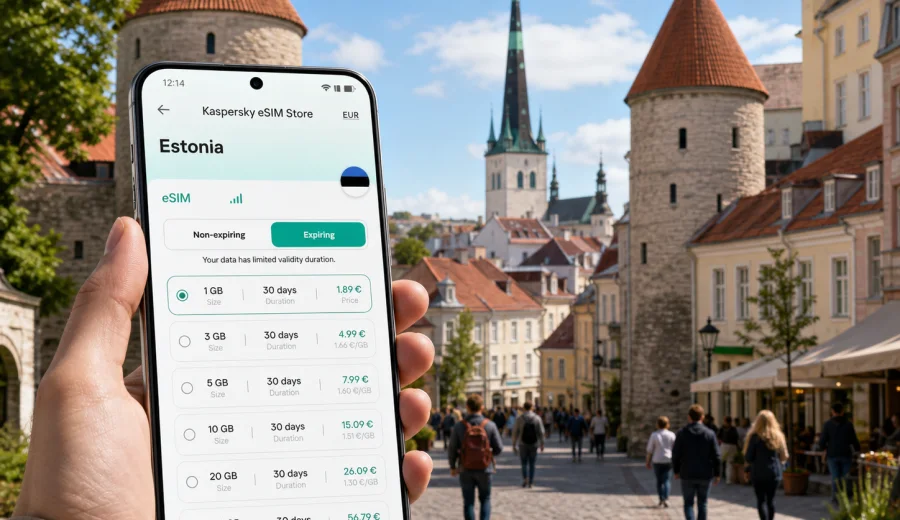
Tallinn eSIM: mobile connection and internet for your trip to Estonia
Tallinn is compact, walkable, and easier to enjoy when your phone is already online. A typical day can include landing at Tallinn Airport, checking a tram route, finding a hotel in the Old Town, joining a work call near Rotermann Quarter, and sending photos from a viewpoint above the red rooftops.
An eSIM can make that first day simpler because you do not need to look for a physical SIM card after arrival. You choose a suitable eSIM tariff for Estonia before the trip or once you have Wi-Fi, install it on a compatible device, and use mobile data for maps, messaging, bookings, translation, and transport apps. Kaspersky eSIM Store is an app and website where you can choose, order, install, and activate an eSIM with a suitable data tariff for travel abroad.
This guide focuses on Tallinn, not Estonia in general. It explains where mobile connection matters in the city, how to estimate data, what to check before ordering an eSIM, and how to prepare your phone before arrival.
Why mobile internet matters in Tallinn
Tallinn is not difficult to navigate, but the practical details are easier with mobile data. The important decisions often happen during the first hour: which exit to use, which tram or bus goes nearest to your accommodation, whether your booking address is inside the pedestrian Old Town, and how to contact a host if check-in instructions change.
Mobile data is especially useful in these Tallinn scenarios:
- arrival at Tallinn Airport and route planning to the center;
- hotel check-in in the Old Town, Kalamaja, Rotermann Quarter, Maakri, or near the ferry terminals;
- navigation across cobblestone streets where walking routes can be more useful than car routes;
- transport app checks for trams, buses, tickets, taxis, and ride-hailing;
- messaging with colleagues, family, property owners, guides, and restaurants;
- translation of notices, menus, signs, and self-service screens;
- remote work from a hotel, coworking space, cafe, or conference venue;
- short trips from Tallinn to Kadriorg, Pirita, Rocca al Mare, or other parts of Estonia.
Public Wi-Fi can help in some places, but it is less predictable than having your own mobile data profile ready on the phone when you move from a hotel lobby to Viru Gate, Toompea, Telliskivi, or the seaplane harbor.
Arrival: from airport, ferry, or bus station
Tallinn has three common arrival patterns, and each one benefits from having mobile internet ready.
| Arrival point | What you may need mobile data for | Practical note |
|---|---|---|
| Tallinn Airport | route to the center, ride-hailing, hotel messages, flight updates | The airport is close to the city, so you may start using maps almost immediately. |
| Ferry terminals | walking route, taxi pickup point, onward tickets, messaging | Terminals can be busy when ferries arrive, so a working connection helps you avoid searching for Wi-Fi. |
| Bus station | public transport route, local address check, translation | If you arrive from another Baltic city, your next step may be a tram, bus, taxi, or walk. |
If you install an eSIM before departure, keep your main SIM active for calls and SMS if you need it, and use the eSIM profile for mobile data after arrival. If you install it in Tallinn, connect to trusted Wi-Fi first, complete the setup, and then switch mobile data to the eSIM profile according to your phone settings and tariff conditions.
For travelers with a tight schedule, the advantage is control: you can confirm an address, check the next tram, open a booking voucher, and message the person waiting for you without queueing for a physical SIM card.
Tallinn areas where eSIM is useful
Tallinn is small enough to explore on foot, but your data needs may change by district.
The Old Town is the place where navigation matters most. Streets are narrow, slopes can be steep, and a direct-looking route may lead to stairs, a wall, or a pedestrian-only lane. A map with mobile data helps you choose better walking routes between Town Hall Square, St. Olaf's Church, Toompea, viewing platforms, museums, restaurants, and your hotel.
Rotermann Quarter and the city center are practical for business trips, shopping, restaurants, and hotels. Here mobile internet is useful for calendar updates, taxi apps, QR reservations, meeting locations, and quick file access.
Kalamaja and Telliskivi are popular for cafes, creative spaces, markets, and evening plans. You may use data for route changes, restaurant searches, digital menus, payment confirmations, and ride-hailing after public transport is less convenient.
Kadriorg, Pirita, and the ferry terminal area involve longer movement from the center. Mobile data helps with transport timing, walking routes, boarding details, and coordination if Tallinn is part of a Baltic Sea route.
How much data do you need for Tallinn?
There is no universal number because data use depends on your habits, hotel Wi-Fi, and whether you stream video. Still, you can estimate more accurately by thinking in trip scenarios.
| Trip style | Typical Tallinn use | Data planning idea |
|---|---|---|
| Weekend city break | maps, messaging, bookings, restaurant searches, photos on Wi-Fi | A smaller package may be enough if you avoid video streaming on mobile data. |
| Business trip | maps, email, calendar, calls in messaging apps, documents | Choose a larger package if you may tether a laptop or join calls away from Wi-Fi. |
| Remote work stay | daily work apps, navigation, backup connection | Consider a tariff with more data and a validity period that covers the full stay. |
| Baltic route | Tallinn plus other Estonian cities or nearby countries | Check whether a country, regional, or wider travel tariff fits the whole route. |
| Stopover | airport, ferry, hotel, short walk, messaging | A modest package can be practical if the stay is less than a day. |
Maps and messaging usually consume less data than video, large cloud backups, or hotspot use. The safest approach is to download offline maps, disable automatic media downloads in messengers, postpone system updates until Wi-Fi, and choose a tariff that matches your real schedule rather than the longest possible trip.
Choosing an eSIM tariff for Tallinn
For a Tallinn trip, the destination to check is Estonia. The city itself does not usually require a separate city-specific tariff. What matters is whether the selected eSIM tariff covers Estonia, how much data it includes, how long it remains valid, and when validity starts.
Before choosing, answer five questions:
1. How many days will you spend in Tallinn?
2. Will you leave the city for day trips in Estonia?
3. Will you use mobile data only on the phone, or also as a hotspot?
4. Do you need mobile internet for work calls and document access?
5. Will the same trip include Finland, Latvia, Lithuania, Sweden, or another country?
If your route stays in Tallinn and nearby places in Estonia, a country tariff for Estonia may be the cleanest option. If Tallinn is part of a wider European route, compare regional options. Always check the coverage area, data allowance, validity, price, and activation rules before ordering.
Once you know your dates and expected data use, you can choose an eSIM tariff for your trip to Tallinn in Kaspersky eSIM Store and review the available options for Estonia. This is best done before departure, while you still have stable home internet and time to check device compatibility.
What to check before you order
The most important step is device compatibility. eSIM works only on devices that support eSIM and are not restricted by a carrier lock that prevents adding another mobile profile. Before you choose a tariff, check your device and confirm that your phone or tablet can add an eSIM profile.
Use this checklist before payment:
- your device supports eSIM;
- the device is not locked to one mobile carrier;
- you have a stable internet connection for installation;
- you know whether you will install before departure or after arrival;
- the tariff covers Estonia for your Tallinn trip;
- the data amount fits your expected usage;
- the validity period covers all travel days;
- you understand whether voice calls and SMS are included, if they are mentioned at all;
- you know which SIM profile will handle mobile data after activation;
- you have saved installation instructions in case airport Wi-Fi is inconvenient.
Most travel eSIM tariffs are focused on mobile data. They may not include a regular phone number, voice calls, or SMS unless the specific tariff says so. For calls and messages, many travelers use internet-based apps. If you still need your home number for bank codes or work calls, keep your main SIM active and configure data separately.
How to install eSIM before Tallinn
Installing eSIM is usually easiest before the trip, but activation timing depends on the selected tariff. Read the conditions carefully so you understand when the validity period starts and whether you should activate immediately or wait until arrival.
The basic flow is simple:
1. Check that your phone supports eSIM and is not carrier-locked.
2. Choose Estonia as the travel destination or select a suitable regional option.
3. Review the data volume, validity period, price, and tariff conditions.
4. Complete the order in Kaspersky eSIM Store.
5. Install the eSIM by following the instructions on your device.
6. When ready to use it, select the eSIM profile for mobile data.
7. If required by your device or tariff conditions, enable data roaming for that eSIM profile.
For device-specific setup, use the Android installation guide or the iOS installation guide. Keep these pages available before travel if you expect to install the eSIM while moving between airport, ferry terminal, hotel, or meeting location.
Do not delete the eSIM profile after installation unless you are sure you no longer need it. In many cases, an eSIM profile cannot simply be moved to another device after activation. If something does not work as expected, check device settings first and contact support before removing the profile.
Transport, hotels, and daily scenarios
Tallinn's center rewards walking, but transport still matters. Trams and buses connect the airport, city center, Kadriorg, Kopli, and other districts. Taxis and ride-hailing can be more convenient for late arrivals, luggage, heavy rain, or hotels outside the Old Town walls. Mobile data helps you decide between walking, public transport, taxi, ferry transfer, or an onward coach or train without waiting for the next Wi-Fi point.
Hotels, apartments, cafes, and offices often provide Wi-Fi, but travel days create gaps. You may need a connection before check-in, after checkout, while waiting for a ferry, or while walking between meetings. In apartment stays, data can help with self-check-in messages, door codes, building entrances, and communication with the host.
Match the tariff to the trip type:
| Scenario | What mobile data supports |
|---|---|
| Weekend traveler | maps, restaurant searches, bookings, photo sharing, ride-hailing |
| Business traveler | calendar updates, meeting addresses, email, messaging, backup hotspot |
| Family trip | shared navigation, translation, museum details, transport changes |
| Stopover | boarding information, luggage storage search, a short Old Town route |
| Wider route | Tallinn plus Tartu, Lahemaa, Helsinki, Riga, or Stockholm planning |
Avoid three common mistakes: checking eSIM compatibility only at the airport, choosing data volume by trip length instead of actual usage, and deleting an installed eSIM profile during troubleshooting. If data does not work immediately, check the active data line, data roaming setting for the eSIM profile, airplane mode, and restart options first.
FAQ
Is eSIM useful for a short trip to Tallinn?
Yes, it can be useful even for a short trip if you need maps, transport updates, ride-hailing, messaging, bookings, and translation outside Wi-Fi. For a stopover or weekend, choose data volume according to realistic use rather than buying more than you need.
Should I install eSIM before arriving in Estonia?
You can usually install it before departure if your device is compatible and you have a stable connection. Check the tariff conditions to understand when validity starts. Some travelers install before travel and switch mobile data to the eSIM profile after arrival.
Can I use eSIM for calls in Tallinn?
Many travel eSIM tariffs are designed for mobile internet. A regular phone number, voice calls, and SMS may not be included unless the tariff conditions say so. You can use internet-based messaging and calling apps over mobile data.
What should I do if mobile data does not work immediately?
Check that the eSIM profile is installed, selected for mobile data, and allowed to use data roaming if required. Restart the device if needed. Do not delete the profile unless support or the instructions clearly tell you to do so.
Choose eSIM for your Tallinn trip
A Tallinn trip is easier when mobile internet is ready before you need it. With eSIM, you can move from the airport or ferry terminal to the Old Town, manage transport, open booking details, use maps, and keep messages flowing.
Kaspersky eSIM Store helps you choose, order, install, and activate an eSIM with a suitable data tariff for travel abroad. Before your trip, check device compatibility, estimate your data use, review the tariff conditions, and prepare mobile internet for Estonia so your first hours in Tallinn are focused on the city, not on finding a connection.