
Travel connectivity guide
Tamarindo eSIM for mobile internet in Costa Rica
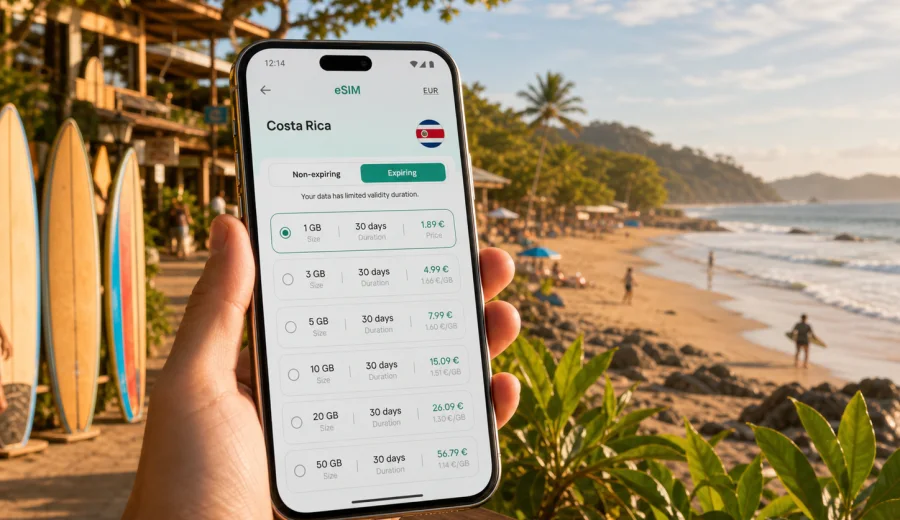
Tamarindo eSIM: mobile connection and internet for a Costa Rica beach trip
Tamarindo is one of the easiest beach towns in Costa Rica to enjoy, but mobile internet can make the trip smoother. You may land in Liberia, arrange a shuttle, check into a hotel, book a surf lesson, find a sunset restaurant, or plan a day trip to Playa Conchal, Las Baulas National Marine Park, or Rincon de la Vieja. In those moments, a working data connection matters.
An eSIM helps you prepare mobile internet before you start moving around Tamarindo. Instead of looking for a physical SIM card after arrival, you can choose a suitable data package, install the eSIM on a compatible device, and use mobile data for maps, chats, rides, reservations, banking confirmations, and travel updates.
This guide focuses on Tamarindo itself: arrival routes, local movement, hotels, beaches, work trips, stopovers, nearby excursions, and mobile connection use cases.
Why mobile internet matters in Tamarindo
Tamarindo is compact, but travel days around it are not always simple. Many visitors arrive through Liberia airport, then continue by shuttle, rental car, private transfer, or bus. Mobile data is useful for tracking the route, confirming pickup details, checking the hotel address, and messaging your host if arrival time changes.
Inside town, you can walk between the beach, restaurants, surf schools, shops, coworking spots, and nearby hotels. Still, accommodation may be in quieter areas above the center or near Playa Langosta, where a map and messaging app help. Wi-Fi may be available in hotels and cafes, but it does not cover the road, the beach, a moving shuttle, or the moment you need to confirm a booking outside a lobby.
Tamarindo travel scenarios where eSIM is useful
The value of eSIM in Tamarindo is less about one dramatic feature and more about small travel moments that add up.
| Situation in Tamarindo | Why mobile data helps | Practical note |
|---|---|---|
| Arrival from Liberia airport | Follow the route, contact a driver, and check hotel details | Install the eSIM before leaving airport Wi-Fi |
| Beach and surf days | Message a surf school and coordinate with friends | Keep the phone protected from sand and water |
| Restaurant planning | Check opening hours, menus, and directions | Some places sit on side streets |
| Hotel check-in | Contact the property if the entrance is not obvious | Useful for apartments, villas, and self check-in stays |
| Day trips from Tamarindo | Share location, view maps, and contact tour operators | Download offline maps as a backup |
For many travelers, Tamarindo starts a longer Costa Rica route, surf week, family holiday, business retreat, or short stay before another province. A country data plan helps you avoid setup changes.
Arrival: what to prepare before you reach town
If you fly into Liberia, the first travel question is usually how to get to Tamarindo comfortably. Transfers are common, rental cars are popular, and buses can be an option for budget travelers. Mobile internet is useful from the first hour because you may need a driver message, rental pickup instructions, or directions to your accommodation.
Before departure, prepare a simple arrival setup:
1. Save your hotel or rental address in your map app.
2. Keep transfer details available offline.
3. Save the phone number or messaging contact for your accommodation.
4. Install the eSIM while you still have reliable Wi-Fi.
5. Keep your primary SIM active for bank confirmations if you need SMS from home.
6. Download offline maps for Tamarindo and the road from Liberia as a fallback.
If your trip starts with a late arrival, mobile data becomes even more useful. Street lighting and signage can vary outside the main commercial areas, so route checks and property messages make the final part of the day easier.
Getting around Tamarindo with mobile connection
Tamarindo is walkable near the main beach, but transport depends on where you stay. Central hotels are close to restaurants and surf schools, while villas above town, stays near Playa Langosta, and quieter roads may require taxis, rental cars, golf carts, or arranged rides.
Mobile internet supports everyday movement in several ways:
- checking whether a destination is walkable in the heat;
- sending a live location to friends or a driver;
- confirming pickup points for tours;
- comparing the route to Playa Langosta, Playa Grande, or Brasilito;
- using translation if you need to clarify a price or address;
- finding an ATM, pharmacy, grocery store, clinic, or coworking space.
For rental cars, data is helpful, but it should not be your only navigation layer. Some Guanacaste roads can be dusty or less clearly marked than major highways. Download maps before longer drives and keep your destination saved offline.
Districts, hotels, and beach areas: where data is most useful
Most visitors think of Tamarindo as one beach town, but your daily connection needs vary by area.
Central Tamarindo is best for restaurants, surf schools, nightlife, shops, and quick walks. Mobile data helps with reservations, maps, and split plans.
Beachfront hotels and apartments are convenient, but you may still use mobile internet on the sand, at pickup points, or between beach entrances.
Playa Langosta is quieter and often chosen for villas and a more residential feel. Data helps when arranging taxis or coordinating evening plans back in Tamarindo center.
Hillside and road-access rentals can be beautiful, but addresses may be less obvious. A working connection helps with arrival instructions and ride coordination.
Nearby beach routes toward Grande, Conchal, Flamingo, Brasilito, and Avellanas are common day plans. Mobile data helps with maps and messages, but offline preparation remains sensible because coverage conditions can change outside town.
If you want to prepare before you fly, you can choose a mobile internet option for Costa Rica through Kaspersky eSIM Store, then install and activate the eSIM according to the selected plan conditions. This keeps the buying and setup step separate from the busy arrival moment at the airport or accommodation.
How much data to consider for Tamarindo
There is no single perfect data allowance for every traveler. The right choice depends on trip length, Wi-Fi quality, the number of day trips, and whether you work during the trip.
| Traveler type | Typical data use in Tamarindo | What to consider |
|---|---|---|
| Weekend or stopover visitor | Maps, messages, check-in details, restaurant searches | A smaller package may be enough if hotel Wi-Fi is reliable |
| Beach holiday traveler | Daily maps, photos, messaging, bookings, light browsing | Choose a package that covers the full stay rather than only arrival |
| Surf or activity-focused traveler | Messaging instructors, location sharing, weather checks, videos | Video uploads can use data quickly |
| Remote worker | Messaging, hotspot fallback, cloud documents, occasional calls | Avoid relying on mobile data for long video meetings unless the package is sized for it |
| Family or group planner | Directions, reservations, shared locations, transport coordination | The organizer usually uses more data than others |
Estimate your real habits. Navigation and messaging are usually modest. Video calls, cloud backups, streaming, social media uploads, and hotspot use can consume a package much faster. If your hotel has strong Wi-Fi, use it for heavy uploads and updates, then reserve mobile data for movement around town.
Choosing an eSIM setup for a Tamarindo trip
When you prepare mobile internet for Tamarindo, the destination should be Costa Rica, not a separate city product. The package needs to match the country where the device will connect, which also helps if your route continues to Liberia, La Fortuna, Monteverde, San Jose, Nosara, or other parts of Costa Rica.
Think about three practical factors:
- Duration: choose a validity period that covers arrival, the stay in Tamarindo, and the return transfer.
- Data volume: choose enough data for maps, messaging, booking changes, and any planned work or uploads.
- Device readiness: make sure your phone supports eSIM and is not restricted by a carrier lock.
Device compatibility and installation
Before buying any travel eSIM, confirm that your phone or tablet can use eSIM. Some models support it only in specific regions, and carrier-locked devices may have limits. You can check your device before choosing a package.
Installation is usually easiest on stable Wi-Fi, before you need mobile data outside. If you need detailed steps, use the Android installation guide or the iOS installation guide.
A practical installation flow looks like this:
1. Confirm eSIM support and carrier unlock status.
2. Select Costa Rica as the trip destination.
3. Choose a package by size and validity period.
4. Install the eSIM profile on the device.
5. Set the eSIM for mobile data when you are ready to use it.
6. Keep your usual SIM for calls or SMS if you still need it.
Travel eSIM packages are mainly for mobile data. They may not include a local phone number, voice calls, or SMS unless the conditions of a specific plan say so.
Beach days, work trips, and short stays
Tamarindo is a beach-first destination, so protect the phone from sand, heat, glare, and water. Download the surf lesson meeting point before leaving the hotel, share a location before your group separates, and use Wi-Fi for large photo or video uploads.
For retreats, freelance work, or longer stays, treat mobile data as a backup layer. Confirm Wi-Fi quality with the hotel, villa, or coworking space, save meeting links offline, and use hotspot only when needed.
For a stopover or one-night surf break, mobile internet is mostly about transfer coordination, self check-in details, restaurant decisions, and navigation to the next destination.
Trips from Tamarindo: plan data before leaving town
Tamarindo is a base for beaches and nature trips across Guanacaste. Mobile internet helps, but road conditions, distance, and coverage can vary outside the main tourist corridor.
Popular directions include:
- Playa Grande and Las Baulas: nature-focused plans and quieter beach time.
- Playa Conchal and Brasilito: day trips and beach hopping.
- Flamingo and Potrero: marina, dining, and coastal drives.
- Avellanas: surf-focused beach time.
- Rincon de la Vieja area: a longer inland day with volcanic landscapes and adventure activities.
Before you leave Tamarindo, save the route, check return timing, charge the phone, and confirm any pickup point.
Practical checklist before you go online in Tamarindo
Use this checklist before relying on your travel eSIM in town:
- Your device supports eSIM and is not carrier-locked.
- The eSIM profile is installed before you leave stable Wi-Fi.
- The selected package covers Costa Rica and your travel period.
- Mobile data is assigned to the eSIM when you are ready to use it.
- Data roaming is enabled if the setup instructions require it.
- Your primary SIM remains available if you need home-bank SMS or calls.
- Offline maps are downloaded for Tamarindo and planned day trips.
- Automatic app updates and cloud backups are restricted on mobile data.
- Hotel details and transfer information are saved offline.
The goal is not to stay online every second of the trip. It is to have connection when it supports navigation, coordination, payments, and safety.
Common mistakes to avoid
- Do not wait until you are in a taxi with weak Wi-Fi or low battery to install the eSIM.
- Do not choose data only for beach days; include arrival, departure, and day trips.
- Do not use mobile data for every large upload when hotel Wi-Fi can handle backups and videos.
- Do not assume a travel eSIM includes voice and SMS unless the selected plan says so.
- Do not rely only on live maps; offline maps are still useful around Guanacaste.
FAQ: eSIM and mobile internet in Tamarindo
Is eSIM useful if my hotel in Tamarindo has Wi-Fi?
Yes. Wi-Fi helps at the property, while mobile data helps between the airport, beach, restaurants, tours, taxis, and day trips.
Should I choose a Tamarindo eSIM or a Costa Rica eSIM option?
Choose the country destination that covers Costa Rica. Tamarindo is the city focus, but the data package should match the country where you travel.
Can I install eSIM before I travel?
In many cases, yes. Install it on Wi-Fi and follow the activation conditions of the selected package.
Will eSIM replace my usual phone number?
Usually no. A travel eSIM is mainly for mobile internet. Keep your primary SIM active if you need calls, SMS, or banking messages.
How much data do I need for one week in Tamarindo?
Light users may need only maps, chats, and booking checks. Travelers who upload videos, use hotspot, or work remotely need more margin.
Prepare mobile internet before your Tamarindo trip
Tamarindo rewards flexible travel: an early surf lesson, a late sunset plan, a quick restaurant change, a nearby beach day, or a transfer that shifts by 20 minutes. Mobile internet supports those small decisions. With an eSIM, you can prepare data access before arrival and keep essential trip tools available when Wi-Fi is not enough.
Before you fly, check device compatibility, choose a data volume that fits your stay, install the eSIM on stable Wi-Fi, and save offline maps for the coast. To set up your trip in advance, prepare an eSIM option for Costa Rica through Kaspersky eSIM Store and use it as a practical mobile data layer for Tamarindo, nearby beaches, transfers, and the rest of your Costa Rica route.