
Travel connectivity guide
Tarija eSIM for mobile internet in Bolivia
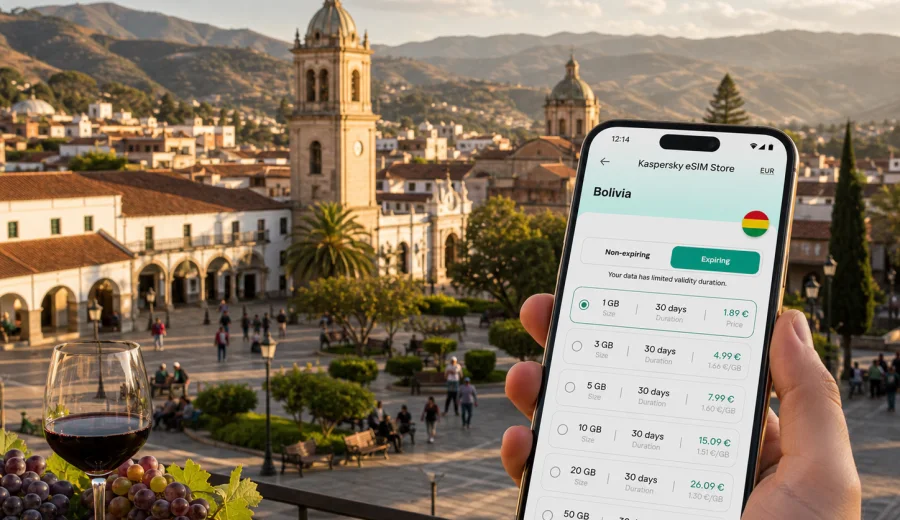
Tarija eSIM: mobile connection and internet for a Bolivia trip
Tarija is a compact city, but it asks a lot from your mobile connection. You may arrive through Capitan Oriel Lea Plaza Airport, check a hotel near Plaza Luis de Fuentes y Vargas, book a taxi to a winery, confirm a bus departure, translate a menu, and message a guide before the afternoon light reaches the valley hills. A working internet connection is not just a comfort here. It helps you move through the city without turning every small decision into a search for Wi-Fi.
For many travelers, an eSIM is the cleanest way to prepare mobile internet before reaching Bolivia. It lets you set up a digital SIM on a compatible phone, keep your main SIM in place, and choose a data package for the trip. In Tarija, that is useful because the city is easy to explore on foot, but many of the best plans involve short rides beyond the center: San Lorenzo, the wine route, Valle de la Concepcion, viewpoints, restaurants outside the plaza area, and the airport road.
This guide focuses on practical connectivity in Tarija: arrival, local transport, hotels, business days, short stopovers, and day trips from the city. It is not a general Bolivia article. The goal is simple: know when mobile data matters, how much you may need, and how to prepare an eSIM without relying only on hotel Wi-Fi.
Why mobile internet matters in Tarija
Tarija is calmer than La Paz or Santa Cruz, but the city is not a place where you want to improvise every connection. Streets around the central plaza are walkable, taxis are common, and many restaurants and hotels can help with local advice. Still, mobile internet saves time in the moments when plans change.
You will likely use data for:
- checking the route from Capitan Oriel Lea Plaza Airport to your hotel;
- messaging a driver, hotel reception, wine tour guide, or colleague;
- opening maps around Plaza Luis de Fuentes y Vargas, Casa Dorada, Mercado Central, and nearby streets;
- translating Spanish menus, signs, and transport details;
- confirming opening hours for museums, restaurants, and wineries;
- using ride coordination, taxi contacts, or WhatsApp groups;
- uploading documents for a work trip or conference visit;
- checking onward bus or flight updates to La Paz, Santa Cruz, Cochabamba, Sucre, Tupiza, or Bermejo.
Tarija also rewards slow movement. You may walk from a hotel to a cafe, then to Casa Dorada, then to a restaurant, then decide to take a taxi to a viewpoint. A steady data connection helps you make those small decisions without returning to the hotel lobby.
Arrival at Capitan Oriel Lea Plaza Airport
Tarija's airport, commonly identified by the code TJA, is close to the city compared with many larger airports. That short distance is convenient, but it also means the arrival window can move quickly: you collect luggage, step outside, find transport, and may be in the city center soon after. If your mobile internet is already prepared, you can check your hotel address, message your host, and share your arrival time before leaving the terminal area.
The most useful arrival tasks are simple:
1. Turn on the eSIM line when your device is ready for mobile data.
2. Keep your main SIM available for banking messages if you need it.
3. Open your offline map first, then let live mobile data update traffic and route details.
4. Send your hotel or meeting contact a short arrival message.
5. Save your accommodation address in Spanish in case you need to show it to a driver.
If you are arriving after a domestic flight, do not wait until the taxi is moving to set everything up. Airport exits, luggage checks, and driver coordination are easier when your connection is already tested.
Getting around the city with data
Tarija's central area is friendly for walking. The plaza, churches, cafes, restaurants, Casa Dorada, banks, and many hotels are close enough for short routes. Mobile data still helps because street names, entrances, and opening hours can be less obvious than they look on a saved map.
For local movement, use mobile internet for four tasks:
| City moment | Why mobile data helps |
|---|---|
| Walking in the center | Maps help you choose safe, direct streets and avoid unnecessary loops. |
| Taking taxis | Messaging, saved addresses, and live location sharing reduce confusion. |
| Visiting restaurants | Menus, reservations, reviews, and payment questions often happen through your phone. |
| Planning day trips | You can confirm pickup points, weather, and schedule changes while away from hotel Wi-Fi. |
Public transport in Tarija can be useful for locals, but first-time visitors often rely on walking, taxis, and arranged transfers. If you plan to use buses or shared transport, data helps you verify the stop, ask for route confirmation, and communicate if your Spanish is limited.
Neighborhoods and hotel areas where connectivity helps
Most first-time visitors choose accommodation around the historic center, close to Plaza Luis de Fuentes y Vargas, Calle Bolivar, Ingavi, or nearby restaurant streets. This area is convenient because you can walk to many places, but you may still need mobile data inside thick-walled historic buildings, on terraces, or while moving between cafes and offices.
Other travelers choose quieter areas toward Zona Sur or roads that make winery visits easier. These can be comfortable for longer stays, but you should not assume that every cafe, small guesthouse, or transfer point has reliable Wi-Fi. An eSIM gives you a fallback for maps, messaging, and work tasks when the connection at a property is weak or shared by many guests.
Before choosing a hotel, think about your data needs:
- If you will mostly walk in the center, a moderate data package may be enough.
- If you will work from the room, use video calls carefully and keep hotel Wi-Fi as the main line when stable.
- If you will visit wineries and villages outside the city, allow extra data for maps, messaging, and photo backup.
- If you travel with family, set expectations for streaming and cloud uploads before the trip.
Mobile internet is most valuable when you are between fixed Wi-Fi points: airport, taxi, street, restaurant, winery, bus station, and hotel check-in.
How much data do you need in Tarija?
The right package depends less on the city's size and more on your habits. Tarija is not a heavy-data destination by default. You can walk, eat, visit museums, and take short taxi rides without consuming much. But travel photos, navigation, cloud backup, and video calls can change the picture quickly.
Use this planning table as a starting point:
| Trip style | Typical use | Practical data approach |
|---|---|---|
| 1-2 day stopover | Maps, messages, taxi coordination, restaurant checks | Small package if you avoid streaming and large uploads. |
| 3-5 day city break | Daily maps, translation, social apps, winery planning | Medium package for comfortable movement around the city. |
| Wine route trip | Navigation, driver messages, photos, route changes | Medium or larger package, especially if you upload media away from Wi-Fi. |
| Business visit | Email, documents, messaging, hotspot backup | Choose more data than a leisure traveler and keep video calls on stable Wi-Fi when possible. |
| Family trip | Several devices, shared maps, photos, entertainment | Estimate per person and avoid automatic cloud backup on mobile data. |
For a practical Tarija stay, keep high-data activities under control. Download maps before departure, save hotel addresses offline, and pause automatic photo and video backup until you are on Wi-Fi. This lets your eSIM data package cover the moments where mobile internet matters most: movement, communication, and decisions outside the hotel.
Preparing an eSIM before you travel
The safest time to prepare mobile internet is before you need it. If your phone supports eSIM, you can choose a data package for Bolivia, install the eSIM profile, and keep the activation steps ready. Some travelers activate before departure, while others wait until arrival; the right choice depends on the tariff conditions, when the validity period starts, and your route.
Before buying or activating, check these points:
- your phone or tablet supports eSIM;
- the device is not locked to one mobile carrier;
- you know which SIM line should handle mobile data;
- data roaming is enabled for the eSIM if the instructions require it;
- you understand the package size, validity period, and destination coverage shown in the tariff conditions;
- you have a stable connection for installation, preferably Wi-Fi before departure.
If you need to confirm support first, use the device check link: Check your device. This is worth doing before payment because eSIM compatibility depends on the exact device model and carrier lock status.
When you are ready to compare options, you can choose an eSIM tariff for your trip to Tarija through Kaspersky eSIM Store. The site and app help you select a suitable data package for Bolivia, install it on a compatible device, and manage mobile internet for the trip.
Installing eSIM for Tarija travel
Installation is usually easiest while you still have a stable Wi-Fi connection. Do not leave the first setup until you are standing outside the airport or trying to find a taxi. Complete the installation steps calmly, then check which line is assigned to mobile data.
Use the official setup guides for your device:
A simple setup sequence works well:
1. Install the eSIM profile using the instructions for your device.
2. Name the line clearly, for example "Bolivia data" or "Travel eSIM".
3. Keep your primary SIM available for calls or bank messages if needed.
4. Set mobile data to the eSIM line when you want to use the package.
5. Turn on data roaming for the eSIM if the tariff instructions require it.
6. Test a webpage or map before leaving a stable connection area.
An eSIM used for travel data usually does not include a regular local phone number, voice calls, or SMS unless the tariff conditions clearly say otherwise. For calls and messages, plan to use internet-based apps.
Practical Tarija scenarios
The value of mobile internet is easiest to understand through real city scenarios.
Airport to hotel. You land at TJA, open your saved hotel address, message reception, and confirm the route. If the driver asks for the location, you can show the map instead of spelling out a street name.
Central walk. You start at Plaza Luis de Fuentes y Vargas, visit Casa Dorada, look for a lunch spot, and check whether a nearby museum is open. Data use is light, but constant.
Wine route day. You leave the city for vineyards or Valle de la Concepcion. Mobile data helps you coordinate with a driver, check pickup times, and share your location if the plan changes.
Business day. You move between a hotel, meeting venue, cafe, and airport. Your eSIM can act as a backup for email, maps, messenger calls, and document access when Wi-Fi is unstable.
Bus station transfer. If you continue toward Tupiza, Sucre, Santa Cruz, La Paz, or the Argentine border area, mobile data helps confirm departure details, ticket messages, accommodation addresses, and onward routes.
In each scenario, the point is not to stay online every second. The point is to avoid losing control of the trip when a pickup point, address, meeting time, or route changes.
Data-saving checklist for Tarija
Use this checklist before leaving your hotel each morning:
- Download the day's map area before you go out.
- Save your hotel address and one backup contact offline.
- Turn off automatic app updates on mobile data.
- Pause automatic cloud backup for photos and videos.
- Keep translation phrases downloaded if you do not speak Spanish.
- Carry a power bank if you will spend the day outside the center.
- Check your eSIM balance or remaining data before a winery or bus-station trip.
- Use hotel Wi-Fi for large uploads, video calls, and streaming.
This routine keeps your mobile internet focused on travel tasks rather than background phone activity.
Short stopovers in Tarija
If Tarija is a short stop between Bolivian cities or before a border route, mobile data becomes more important because you have less time to solve problems. A short visit may include one night near the center, a quick walk around the plaza, dinner, and an early airport or bus departure.
For a stopover, prepare:
- offline map of the city center and airport route;
- hotel address in Spanish;
- eSIM installed before arrival;
- taxi or transfer contact saved in your messenger;
- screenshot of your flight, bus, or booking details;
- enough data for maps, messages, and schedule checks.
With those basics covered, a one-night Tarija stay feels much easier. You can use your time for the city rather than troubleshooting a connection.
Business trips and remote work
Tarija receives business travelers connected with regional government, agriculture, wine, education, logistics, and cross-border routes. Work trips often involve short meetings, hotel Wi-Fi, taxis, and document sharing. An eSIM is useful as a backup line for mobile data, especially when a meeting address changes or hotel Wi-Fi slows down at peak hours.
For work use, be realistic. Mobile data is excellent for email, chat, maps, light document edits, and emergency hotspot use. For long video calls, big uploads, and software updates, use stable Wi-Fi when available. If you must use your phone as a hotspot, track data consumption closely and choose a package that matches the risk.
Business travelers should also keep security and account access in mind:
- install the eSIM before a busy travel day;
- keep your primary number available for verification messages;
- avoid relying on public Wi-Fi for sensitive work when mobile data is available;
- download meeting documents before leaving the hotel;
- keep a charger or power bank in your bag.
Trips from Tarija
Many Tarija itineraries extend beyond the city. The wine route, San Lorenzo, small restaurants outside the center, viewpoints, and regional bus routes all create situations where you may be away from steady Wi-Fi. Mobile internet helps most during these transitions.
For day trips, check the route while you are still in the city, then save essential points offline. Ask your driver or guide how they prefer to communicate. If the trip includes several stops, share your live location only when necessary, because location sharing can use more battery and data than expected.
For longer routes from Tarija, prepare the next destination before departure. Save the address, ticket, booking confirmation, and map area. If you cross toward another country later, remember that a Bolivia data package is for Bolivia unless the selected tariff conditions say it covers more destinations.
Common mistakes to avoid
Avoid these connectivity mistakes in Tarija:
- Installing the eSIM for the first time while rushing at the airport exit.
- Forgetting to check whether the device supports eSIM.
- Leaving mobile data assigned to the wrong SIM line.
- Using mobile data for automatic video backup after a winery day.
- Assuming every small hotel, cafe, or transfer point has fast Wi-Fi.
- Buying too little data for a work trip with hotspot needs.
- Forgetting that travel eSIM data usually does not include a regular phone number.
Most problems are preventable. Install early, check the active data line, understand the tariff conditions, and use Wi-Fi for heavy tasks.
FAQ: eSIM and mobile internet in Tarija
Is Tarija a good city for using an eSIM?
Yes, if your device supports eSIM and the selected tariff covers Bolivia under its stated conditions. It is especially useful for airport arrival, taxis, maps, hotel coordination, and day trips outside the center.
Do I need mobile data if my hotel has Wi-Fi?
Yes, for movement. Hotel Wi-Fi helps in the room, but it does not help when you are at the airport, walking near the plaza, looking for a restaurant, or coordinating a winery pickup.
Can I install the eSIM after landing in Tarija?
You may be able to, but installing before departure is usually calmer. You need a stable connection for setup, and you should check the activation and validity rules of your selected tariff.
Will an eSIM give me a Bolivian phone number?
Travel eSIM data packages usually focus on mobile internet. Regular voice calls and SMS are not included unless the specific tariff conditions say they are. Use internet-based apps for calls and messages.
How can I avoid wasting data?
Download maps, pause cloud backup, avoid streaming on mobile data, and use Wi-Fi for large files. Check remaining data before leaving the city for a longer day trip.
Choose mobile internet for your Tarija trip
Tarija is easy to enjoy when the basics are ready: a saved hotel address, offline maps, a charged phone, and mobile data that works when you leave Wi-Fi. An eSIM helps you prepare that connection before the trip, keep your main SIM in place, and use data for the moments that matter most: arrival, taxis, maps, messages, restaurant plans, work updates, and day trips around the valley.
Before you travel, check device compatibility, choose the right package size, install the eSIM on a stable connection, and make sure the eSIM line is selected for mobile data when you need it. For a smoother arrival and more flexible movement around Tarija, prepare an eSIM tariff for Bolivia in Kaspersky eSIM Store.