
Travel connectivity guide
Tbilisi eSIM: Mobile Internet Guide
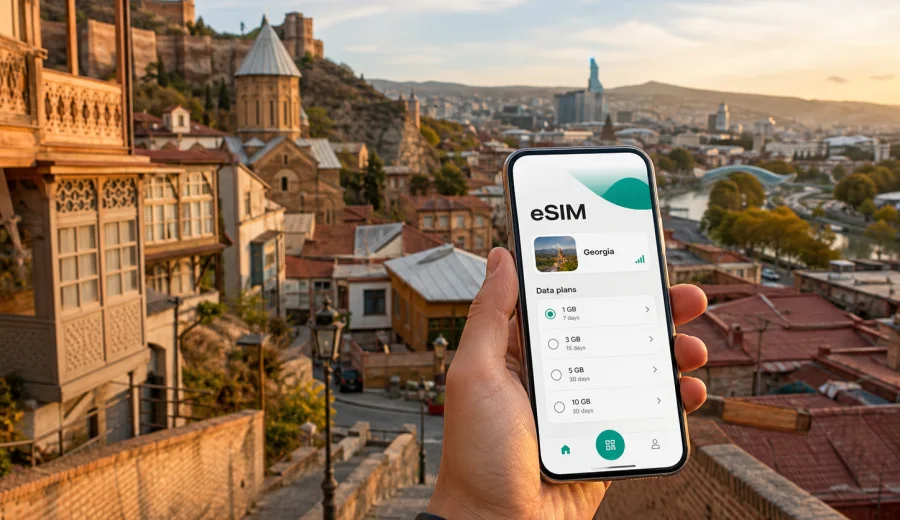
Tbilisi eSIM guide: mobile connection and internet for your trip
Tbilisi is a city where mobile internet quickly becomes part of the route. You may need it before you leave Tbilisi International Airport: to message your hotel, check an apartment address, call a ride, or confirm a transfer. In the center, the same connection helps with walks through Sololaki, restaurant bookings near Rustaveli Avenue, metro navigation, business calls, translation, and day trips.
This guide is focused on Tbilisi, not on Georgia in general. It explains how to plan mobile connection for arrival, hotels, transport, walks, business travel, stopovers, and trips. It shows where an eSIM fits and what to check before you buy a data package.
Why mobile internet matters in Tbilisi
Tbilisi is compact enough for walking, but the city is not always linear. The old town sits under Narikala Fortress, districts climb into the hills, courtyards open behind quiet doors, and streets can change level quickly. A short walk on a map can involve stairs, underpasses, bridges, or a steep climb. Mobile data helps when you need airport directions, hotel messages, traffic checks, walking routes, translation, meeting locations, or day-trip coordination.
Public Wi-Fi can help in hotels, cafes, and some public spaces, but it is not a travel plan by itself. You still need connectivity between places: while changing transport, looking for the right courtyard entrance, or checking a booking in the street. An eSIM gives you a way to prepare mobile data before the trip without buying a physical SIM card after arrival.
Arrival at Tbilisi International Airport
Most international visitors arrive at Tbilisi International Airport, east of the city center. The first online tasks are practical: luggage messages, transport, navigation, and accommodation. If mobile internet is ready before you leave the terminal, you can handle them without looking for a shop or depending on a temporary Wi-Fi session.
If you arrive late at night, mobile internet becomes even more important. Some apartment entrances are inside courtyards, and some drivers may stop near a landmark rather than at the door. A working connection helps you share your location, read check-in instructions, or translate a message outside.
Districts where data helps most
Tbilisi has very different travel patterns by district. In the old town, you move slowly and often walk. In Saburtalo or Vake, you may rely more on rides, buses, or longer cross-city trips. Near Rustaveli Avenue, you might switch between meetings, museums, restaurants, and hotels. Each area creates a different use case for mobile data.
| Area | What you may do there | Why mobile internet helps |
|---|---|---|
| Old Tbilisi and Abanotubani | Sulfur baths, narrow lanes, viewpoints, restaurants | Walking routes, translation, bookings, photo sharing |
| Sololaki | Boutique hotels, cafes, courtyards, architecture walks | Finding entrances, checking steep streets, messaging hosts |
| Rustaveli and Freedom Square | Museums, offices, hotels, shopping, meetings | Calendar updates, ride apps, route changes |
| Vera and Vake | Cafes, residences, parks, business stays | Longer local movement and navigation between addresses |
| Saburtalo | Offices, apartments, metro access, practical stays | Commuting, ride pickup points, errands |
| Avlabari | Hotels, metro, views, links to the old town | Airport movement, bridge walks, quick transport decisions |
Tbilisi rewards flexible movement. You may start with a planned route and then change it because of weather, traffic, a restaurant recommendation, or a hill that looks easier on the map than it feels in real life.
eSIM, roaming, local SIM, and Wi-Fi in Tbilisi
There is no single best option for every traveler. The right choice depends on trip length, device support, budget, and how much time you want to spend arranging connectivity after arrival.
| Option | Best for | Points to check |
|---|---|---|
| eSIM data package | Travelers who want mobile internet ready before or soon after landing | Device support, data amount, validity period, activation steps |
| Standard roaming | Short visits where your home operator has a suitable roaming offer | Price per MB, daily caps, included destinations, speed limits |
| Local physical SIM | Longer stays or travelers who prefer an in-person mobile shop | Shop hours, identification rules, physical SIM slot, plan terms |
| Public Wi-Fi | Hotels, cafes, coworking spaces, light browsing indoors | Availability, login flow, privacy expectations, gaps between places |
An eSIM is useful if your phone supports it and you want to avoid arranging a physical SIM card in the first hour of the trip. In this context, it is mainly for mobile internet: maps, messaging apps, email, browsing, ride services, translation, and travel administration.
Before choosing any data option, check your real use. A traveler who mostly walks, sends messages, and checks maps may need much less data than someone who joins video calls or uses a laptop through tethering.
How much data to plan for Tbilisi
Data use depends on habits, not only on the city. You will probably use maps often, open restaurant pages, send photos, translate short phrases, check transport, and message people. A light city break may need only maps, messaging, tickets, and occasional browsing. A work-heavy stay needs more room for cloud documents, calls, tethering, and file transfers. If you plan to stream video or use your phone as a hotspot, choose a larger package and check whether tethering is allowed.
Choosing an eSIM package before a Tbilisi trip
For Tbilisi, the practical way to choose a package is to start from the itinerary. Count the days when you will be outside Wi-Fi, then consider whether you will make day trips. A two-night weekend in the old town creates different data needs from a week split between Tbilisi, Mtskheta, Kakheti, and mountain routes.
Use this checklist before you buy:
- Confirm that your phone or tablet supports eSIM.
- Check that the device is not locked to a single mobile operator.
- Compare data size and validity period with your itinerary.
- Read when the tariff validity starts.
- Save installation instructions before departure.
- Keep your primary SIM available for bank codes or calls if you need it.
- Decide whether you will activate before travel or after arrival.
Kaspersky eSIM Store is an app and website where you can choose, arrange, and activate an eSIM with a suitable data tariff for mobile internet in an international trip. For Tbilisi, you can prepare an eSIM data option for Georgia before you travel, then use it for maps, messages, translation, and route changes once you are in the city.
Device compatibility and setup
Not every phone supports eSIM, and some supported phones may still be restricted by an operator lock. Before buying a tariff, use the compatibility check: check your device. This prevents a common travel problem: choosing a data option your device cannot install.
The installation process depends on your device and selected tariff. Keep the instructions close: use the Android installation guide or the iOS installation guide before you leave or while you still have reliable Wi-Fi.
An eSIM data tariff usually does not include a regular phone number, voice calls, or SMS unless the terms of a specific tariff say otherwise. For calls and messages in Tbilisi, many travelers use internet-based apps over mobile data or Wi-Fi.
Moving around Tbilisi with mobile data
Tbilisi travel often combines walking, metro, buses, taxis, and short rides between districts. Mobile internet helps because plans can change quickly. You may walk downhill from Narikala into Abanotubani, cross the river to Avlabari, then decide whether to continue by metro, ride, or on foot toward Freedom Square.
Mobile data is useful for checking steep walking routes, choosing a pickup point where a driver can stop, comparing metro and car travel time, saving a hotel address, finding a pharmacy or ATM, messaging a guide, and translating short phrases. The biggest navigation issue is not distance but terrain and street layout. Keep offline maps as a backup, but use mobile data for live adjustments.
Hotels, apartments, and check-in scenarios
Accommodation in Tbilisi ranges from international hotels to boutique guesthouses and apartments in historic buildings. Mobile internet is useful before and during check-in because entrances may be inside courtyards and hosts may send instructions through messaging apps.
Common check-in tasks include opening a door code, sending your arrival time, finding the correct entrance, sharing your live location, translating a reception note, and checking Wi-Fi details after you enter the room. If you are staying in Sololaki, Mtatsminda, Vera, or older parts of the city, do not rely only on the building number. Save screenshots of check-in instructions and keep mobile data ready for messaging.
Business trips and remote work in Tbilisi
Tbilisi is a practical base for meetings, regional work, and remote stays. Business travelers usually need more predictable connectivity than leisure visitors because a delay in messaging, maps, or email can affect the day. Mobile data does not replace hotel or office Wi-Fi for every task, but it gives you a fallback when moving between appointments.
For a business trip, plan mobile internet around the day schedule: morning traffic, email between meetings, cafe work if Wi-Fi login is slow, evening transport, and departure details. If you expect video calls or large file transfers, use hotel, office, or coworking Wi-Fi when possible and keep eSIM data for mobility and backup.
Stopovers and short visits
A short Tbilisi stopover needs a different connectivity plan from a long stay. You may have only a few hours to move from the airport to the old town, have dinner, walk near the sulfur baths, and return. In that case, losing time to connectivity setup can take a large share of the visit.
For a short stopover, install the eSIM before the flight or while on airport Wi-Fi, save the airport and return route, keep the package active for the full stopover window, and check ride pickup points carefully. If your stopover is overnight, add hotel check-in instructions and a backup route to the airport.
Day trips from Tbilisi
Many visitors use Tbilisi as a base for trips to Mtskheta, Jvari Monastery, Kakheti wine areas, Gori, Uplistsikhe, or mountain routes that start from the city. These trips make mobile data more valuable because you leave the dense hotel-and-cafe environment and depend more on maps, driver messages, and meeting times.
Before a day trip, save the pickup point, departure time, return address in Tbilisi, booking confirmations, driver contact details, and enough battery for maps and messaging. Coverage and speeds can vary by area, route, building, terrain, and selected tariff conditions. Keep essential information saved offline, and use mobile data as the active layer for live changes.
Practical checklist before you fly
Use this checklist one or two days before your trip: your phone supports eSIM, the device is not operator-locked, the selected data amount matches your itinerary, you know when validity starts, your hotel address is saved, booking details are available offline, and your primary SIM remains available if you need calls or SMS. For Tbilisi specifically, also save the airport route, the district name of your accommodation, and at least one landmark near the entrance.
Common mistakes to avoid
The biggest mistakes are usually small planning gaps: buying a data package before checking eSIM support, waiting until the airport exit to read installation instructions, assuming hotel Wi-Fi will solve street navigation, forgetting that data-only tariffs may not include ordinary calls or SMS, choosing a package that expires before the final airport transfer, or not saving apartment entry instructions offline. Also check the mobile data line after landing so the travel eSIM, not your home SIM, is selected for data.
FAQ: eSIM and mobile internet in Tbilisi
Is an eSIM useful for a Tbilisi city break?
Yes, if your device supports eSIM and you want mobile internet ready for maps, messaging, translation, hotel check-in, and transport. It is especially useful for late arrivals, apartment stays, short stopovers, and routes that include day trips from Tbilisi.
Does an eSIM include calls and SMS?
Usually, the relevant travel eSIM tariff is for mobile internet. A regular phone number, voice calls, and SMS are not included unless the specific tariff conditions say otherwise. For calls and messages, use internet-based apps or keep your primary SIM available if you need it.
Should I activate eSIM before arriving in Georgia?
Install it while you have reliable Wi-Fi and read the activation rules for the selected tariff. Some travelers install before departure and activate after arrival. The important point is to know when validity begins and which mobile data line to select.
Prepare mobile internet for Tbilisi
Tbilisi is easier when your phone is ready before the first route. With mobile data prepared, you can leave the airport, find your district, message your host, compare transport, follow walking routes, and adjust plans without relying only on Wi-Fi.
Before you travel, check device compatibility, choose a data amount that fits your itinerary, and save the installation steps. Then use Kaspersky eSIM Store to choose an eSIM data tariff for your trip to Georgia and keep Tbilisi navigation, messaging, and travel tasks within reach from arrival to departure.