Travel connectivity guide
Telecel eSIM in the Central African Republic: Traveler Guide
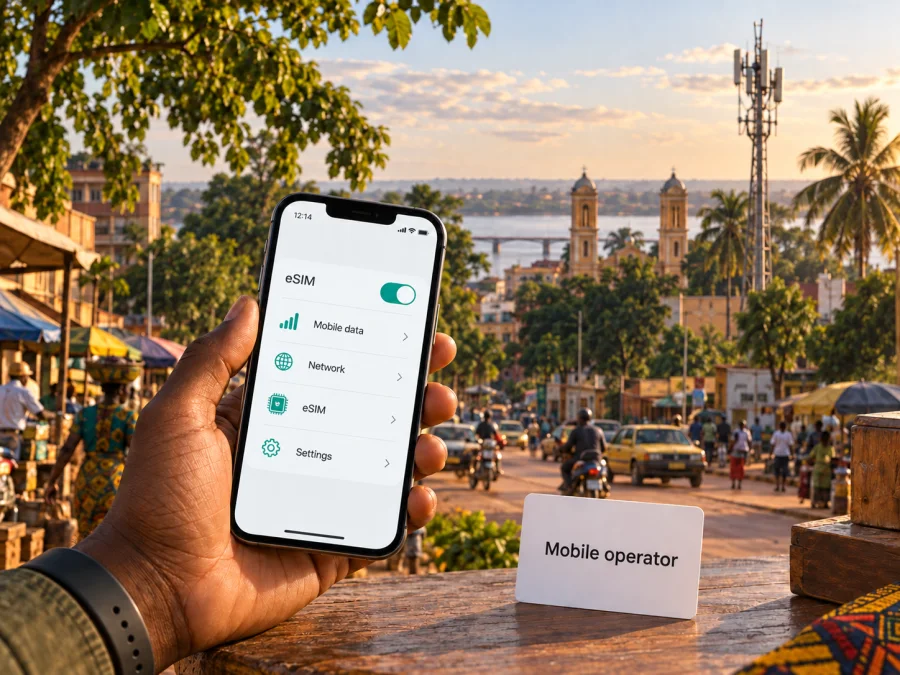
Telecel eSIM in the Central African Republic: what travelers should know
Telecel is a mobile operator in the Central African Republic, where its public service information describes mobile telephony, mobile internet, prepaid and postpaid SIM options, and eSIM support. That makes Telecel relevant to visitors who are considering a local connection, but the public information checked for this article leaves important practical questions open: it does not explain how a visitor orders or activates a Telecel eSIM, whether every prepaid customer can use one, or what identity documents a non-resident must present. Confirm those details directly with Telecel before relying on the eSIM option for a trip.
The operator’s English mobile page also lists 3G and 4G mobile internet and describes service coverage across the country. Such general descriptions do not guarantee a signal at a specific address, road, or time. Telecel Group reported that Telecel launched 4G in Bangui in May 2026 and noted that extending coverage to secondary cities and major road corridors remained a next step. Treat coverage and technology as location-dependent, and check current information for the places on your itinerary.
This guide separates what Telecel publicly confirms from what a traveler should ask before purchase. It covers eSIM availability, connection steps, identification, device compatibility, network technology, coverage planning, and the difference between a local operator service and a travel eSIM. For any purchase, ask Telecel for the service terms that apply to your circumstances.
What Telecel confirms about eSIM
Telecel Centrafrique’s current mobile page lists prepaid SIM cards, postpaid SIM cards, quick line activation, SIM replacement, and eSIM support. This publicly confirms eSIM as one of Telecel’s mobile service capabilities. The English and French pages were checked on 26 September 2026.
The listing does not explain whether visitors can obtain an eSIM, whether it is available on prepaid service, whether a physical line can be converted, or how the profile is ordered and activated. It also provides no eSIM installation, transfer, or replacement guide. Do not assume that general support means tourists can complete the process remotely.
Telecel’s general connection guidance says to explore its services, contact the company, then activate the selected service. It lists agency visits, WhatsApp, an online contact route, and customer service at 611. Ask which route handles eSIM applications and whether an in-person visit is needed. Confirm:
- Whether new eSIM profiles are issued to non-resident visitors and prepaid customers.
- Whether an existing physical SIM can be converted or the eSIM is a separate line.
- Which identity documents and local details are required, and where registration can take place.
- How the profile is issued and installed, and whether installation can happen before arrival.
- How to recover or reissue a profile if installation fails or the phone is replaced.
Ask before relying on the connection for arrival-day maps or messages. The operator’s eSIM listing confirms a capability; customer eligibility and the activation flow still need direct confirmation.
Prepaid service and traveler eligibility
Telecel lists both prepaid and postpaid SIM options and refers generally to prepaid offers. This confirms prepaid service in general, not that a tourist offer exists or that a visitor can register for eSIM. No tourist-only eSIM or dedicated visitor offer was identified on the public pages checked on 26 September 2026. Ask Telecel whether a short-term visitor can open a prepaid line and use it as an eSIM.
The pages reviewed do not state what identification a foreign visitor must provide. Requirements may depend on current rules and the operator’s process, so ask in advance whether a passport, visa, local address, or other information is required. Do not apply another country’s SIM-registration rules to the Central African Republic.
If Telecel directs you to an agency, confirm that it can issue eSIMs, where it is, and what to bring. Also ask whether the application needs an in-person identity check and whether payment methods for visitors differ. For an existing Telecel line, clarify whether eSIM is a conversion or replacement, when the old SIM stops working, and how a profile can be restored if needed.
Local Telecel connection or travel eSIM?
A local Telecel line is a subscription with the operator in the Central African Republic. It may suit someone who needs a local number, expects a longer stay, or wants to ask about local voice, text, and data services. Eligibility, registration, coverage, and service conditions are determined by Telecel and local requirements.
A travel eSIM is arranged for connectivity while away from home. Kaspersky’s official launch announcement, dated 17 June 2025 and checked on 26 September 2026, describes Kaspersky eSIM Store as an app and website for selecting, purchasing, and activating an eSIM for mobile internet during an international trip. It is not a mobile operator, network owner, or mobile internet provider; connectivity is delivered through the arrangements shown for the selected destination. Check the destination and current product details. Do not assume a travel eSIM includes a local number, ordinary calls, or SMS unless its terms say so.
A travel eSIM may be useful when mobile data is the main need and arranging a local subscription is uncertain. A local line may be more suitable when a local number or direct operator support matters. Some travelers keep their home SIM for calls while using a travel eSIM for data; this depends on device dual-SIM features and home-provider settings. Check roaming terms with your home provider before departure.
Explore eSIM options for the Central African Republic
For either option, confirm the destination, eligibility, installation process, and what starts the service. Keep local Telecel signup separate from travel eSIM setup: one does not automatically activate or replace the other.
Check the phone before you travel
An eSIM requires a compatible, unlocked device. Support can vary by exact model, sales region, and software configuration. Check the manufacturer’s specifications, look for an “Add eSIM” option in mobile-network settings, and make sure the phone is not carrier-locked.
If you plan to keep a home SIM active, check that your phone supports the required dual-SIM combination. Multiple profiles may be stored even when only a limited number of lines can be active. Menu names differ by device and software version; see eSIM device compatibility for general guidance.
Before departure, update the phone, make sure you can unlock it, and keep access to the account used to receive installation instructions. Do not delete a profile during troubleshooting until the provider explains how to restore it. Ask Telecel whether setup uses a QR code, an app, or another method, and whether installation must happen in the country; its public page does not specify this.
How to plan installation and first connection
Use this as a preparation sequence, not as a description of Telecel’s unpublished eSIM process:
- Confirm eligibility. Ask Telecel whether visitors can obtain a new eSIM, whether prepaid service is available, and which identity documents are required.
- Confirm the device. Verify eSIM support for the exact handset and make sure it is unlocked. Check dual-SIM settings if keeping a home line.
- Ask how the profile is issued. Confirm whether it is provided at an agency, by QR code, through an app, or another way, and whether it can be installed before travel.
- Keep instructions available. Save any installation details securely. Avoid deleting a profile until it works and you understand the recovery process.
- Choose the data line. After installation and activation, select the intended line for mobile data. Leave roaming off on the home SIM unless you intend to use that service and have checked its terms.
- Test the connection. Confirm network registration and data access before relying on the line. Follow provider guidance if setup fails; do not repeatedly remove and reinstall the profile.
On iPhone, eSIM setup is generally in Settings under mobile or cellular service; Android wording varies. Follow the provider’s steps. If the device has no eSIM option, check manufacturer support for the exact model instead of assuming an update can add the capability.
Registration, profile installation, device settings, and local coverage are separate parts of the process. Identify which step failed before troubleshooting, and contact the provider that issued the profile.
Network technology and coverage in the Central African Republic
Telecel’s mobile page lists 3G and 4G internet. Telecel Group reported a 4G launch in the Central African Republic in May 2026, with an event in Bangui. Its report described expansion beyond the capital to secondary cities and key road corridors as a next step. This confirms that 3G and 4G are named in Telecel’s service information, but not that each technology is available at every location.
Telecel describes coverage as nationwide, a broad operator statement rather than a detailed coverage map. The Telecel Group report dated 15 May 2026 said Bangui had 4G service and noted further rollout beyond the capital. Coverage can change, and neither statement predicts indoor reception or uninterrupted service on a particular route. Ask for current coverage information for every town and road segment on your itinerary.
Save offline maps, bookings, and essential contacts before travelling outside areas where you can connect. The operator’s public page names 3G and 4G but does not list radio bands in the information reviewed. Check the exact phone model’s specifications and ask Telecel which bands it uses. An eSIM profile alone does not guarantee radio compatibility.
A technology label is not a quality rating. Performance can vary with location, congestion, handset support, buildings, and temporary service conditions. If connectivity is important for work or logistics, plan a backup and verify options before departure.
Questions to settle with Telecel
| Topic | What to confirm |
|---|---|
| eSIM access | Whether visitors can obtain a new eSIM and which customer types are eligible |
| Registration | Which identity documents and local details are required for a non-resident |
| Application | Whether you need to visit an agency or can complete the process remotely |
| Activation | How the profile is delivered, installed, and activated; whether installation can happen before arrival |
| Prepaid service | Whether prepaid service is available to visitors and whether eSIM can be used on it |
| Device | Whether the exact phone model and radio bands are supported |
| Coverage | Current service information for Bangui and the other places on your route |
| Support | The contact route to use if registration, installation, or network access fails |
Telecel’s published pages reviewed here do not settle all of these points. Ask for the current answer from the operator before purchase, and keep a record of any instructions you receive.
Frequently asked questions
Does Telecel support eSIM in the Central African Republic?
Telecel’s current mobile page lists eSIM support. It does not explain visitor eligibility or installation. Contact Telecel for current steps before travel.
Can a tourist buy a Telecel eSIM online?
The public pages reviewed do not confirm remote purchase by tourists or a visitor-specific offer. Ask whether a non-resident can apply remotely or must register in person.
Does Telecel offer prepaid service?
Yes, Telecel lists prepaid SIM service generally. Whether a visitor can obtain prepaid eSIM is not specified; confirm with the operator.
Which network technologies does Telecel list?
Its page lists 3G and 4G. Telecel Group reported a 4G launch in Bangui in May 2026 and further expansion as a next step. Coverage depends on location.
What documents does a visitor need?
The pages reviewed do not specify visitor identification requirements. Ask Telecel what to bring and whether registration is in person.
Does a travel eSIM replace a Telecel line?
No. A travel eSIM arranged through Kaspersky eSIM Store is a separate mobile-internet option, not a Telecel subscription or local phone number. Check its terms and keep your usual line if you need its number or voice service.
Practical checklist before departure
- Confirm whether Telecel issues eSIM to visitors and whether it is available on prepaid service.
- Ask about identity documents, registration, application channel, and activation method.
- Verify that your exact phone supports eSIM, is unlocked, and supports relevant network bands.
- Check current coverage for Bangui and other planned locations.
- Decide whether you need a local number and voice/SMS service or mobile data only.
- Save essential travel information offline and keep a backup way to connect.
A note on independence
This is an independent travel information guide and is not affiliated with, endorsed by, or sponsored by Telecel. Operator procedures can change. The eSIM and prepaid information reflects public Telecel pages checked on 26 September 2026; contact Telecel for current eligibility, documents, activation, coverage, and service conditions.
Kaspersky eSIM Store is an app and website for selecting, purchasing, and activating an eSIM for mobile internet during an international trip. It is not a mobile operator, network owner, or mobile internet provider. Check device compatibility and the selected destination’s current terms before purchase.