
Travel connectivity guide
Trebinje eSIM for mobile internet
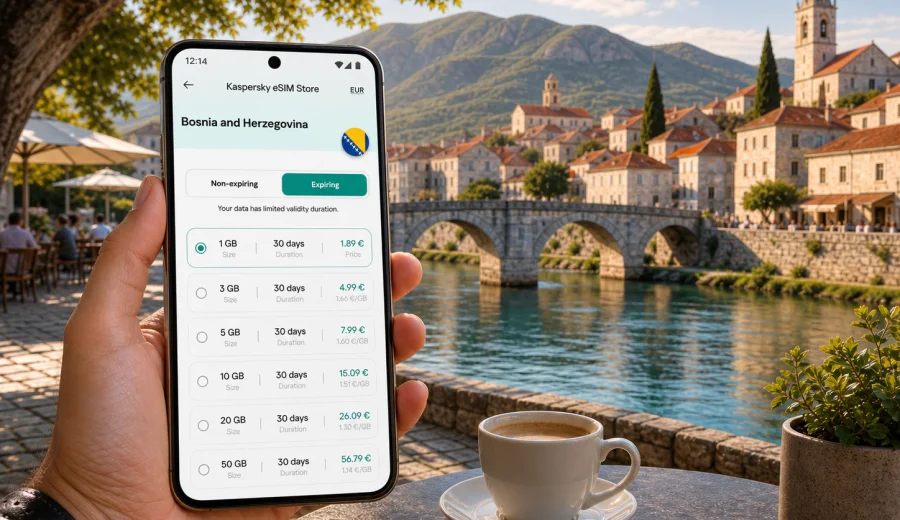
Trebinje eSIM: mobile connection and internet for a smooth city trip
Trebinje is a small city that rewards slow movement: a walk along the Trebisnjica River, coffee under the plane trees, a climb toward the Hercegovacka Gracanica viewpoint, and short drives to wineries, monasteries, and the Adriatic border region. For travelers, that relaxed rhythm works best when mobile internet is already planned. You may need maps for narrow streets, messaging for hotel check-in, translation at a restaurant, ride coordination, or a quick route check before leaving the city for Dubrovnik, Mostar, or the Herzegovina countryside.
An eSIM helps you prepare mobile internet for Trebinje without looking for a physical SIM card after arrival. With Kaspersky eSIM Store, you can use the app or website to choose a destination, review a suitable prepaid tariff, install the eSIM on a compatible phone, and activate it when the trip begins. It is a practical option for visitors who want data for navigation and daily travel tasks while keeping their usual SIM card in the device.
This guide focuses on Trebinje itself: arrival routes, city movement, hotels, day trips, work visits, and the moments when a reliable data connection makes the trip easier.
Why mobile internet matters in Trebinje
Trebinje is compact, but it is not a city where every useful stop is on one straight tourist path. The old town, riverbanks, markets, hotels, hill viewpoints, wineries, bus station, and surrounding villages are spread across different directions. Many visitors also treat Trebinje as a calm base between Bosnia and Herzegovina, Montenegro, and Croatia.
Mobile internet is useful because you can:
- navigate from your hotel to the old town gates, river bridges, and viewpoints;
- message apartment hosts when arrival time changes;
- check cafe, restaurant, and winery opening hours before walking across town;
- use translation for menus, taxi instructions, and local notices;
- coordinate day trips to Mostar, Dubrovnik, Stolac, or Montenegro;
- keep travel documents, bookings, and boarding passes available in cloud apps;
- share your location with colleagues, family, or a driver.
Trebinje can feel easy once you are settled, but the first hour after arrival is often the most dependent on data. You may be coming by bus, rental car, private transfer, or a cross-border route. Having mobile internet ready before you need it reduces the number of small decisions at exactly the time when your luggage, schedule, and accommodation details are all competing for attention.
Arrival scenarios: where eSIM helps first
Trebinje does not have a large international airport of its own, so many travelers arrive from other cities. The route you take affects how quickly you will need mobile data.
| Arrival route | Typical data needs | Practical tip |
|---|---|---|
| From Dubrovnik | Border updates, driver messages, hotel arrival time | Keep your booking address and host contact available offline and online. |
| From Mostar | Bus timing, road navigation, onward taxi coordination | Save the hotel location before departure in case signal varies on the road. |
| From Sarajevo | Longer route planning, rest stops, weather checks | Download key maps, then use mobile data for live changes. |
| From Montenegro | Cross-border navigation and messenger calls | Check whether your selected tariff covers the countries on your route. |
| By rental car | Parking search, fuel stops, directions to apartment entrances | Use navigation before entering the tightest old-town streets. |
If you arrive late in the evening, mobile internet can be especially useful. Smaller hotels and apartments may rely on messaging for door codes, parking instructions, or exact meeting points. A prepaid eSIM data tariff lets you handle those tasks from your phone instead of depending on public Wi-Fi or searching for a shop after a long journey.
Moving around the city
Trebinje is walkable, but the city is not just one old-town square. A typical day can include the old town, the river promenade, the market, cafes under the plane trees, a monastery or hilltop viewpoint, and dinner in a different neighborhood. Mobile connection supports these small transitions.
For walking, data helps with:
- choosing a route that avoids unnecessary climbs in hot weather;
- finding shaded streets and river paths;
- checking the distance to the bus station or a meeting point;
- translating a local sign or menu;
- paying attention to real-time weather before a viewpoint walk.
For taxis, transfers, and rental cars, data helps with:
- sending a pin instead of explaining a street name by phone;
- checking whether a driver is at the right bridge, hotel, or gate;
- avoiding missed turns on roads outside the city center;
- confirming pickup times for cross-border or winery routes.
Trebinje is often part of a wider itinerary, so your mobile internet plan should not be chosen only for one afternoon in the center. Think about how many days you will stay, how often you will use maps, whether you will tether a laptop, and whether you will take day trips.
Choosing a data amount for Trebinje
The right eSIM tariff depends on behavior, not only trip length. A traveler who uses offline maps and hotel Wi-Fi may need far less data than someone who uploads video, joins work calls, or uses a laptop hotspot.
| Trip style | Suggested planning logic | Main data uses |
|---|---|---|
| Short stopover | Small data package may be enough | Maps, messaging, hotel check-in, restaurant search |
| Weekend city break | Moderate package gives more flexibility | Navigation, photos, translation, local searches |
| Remote work visit | Choose more data and check hotspot needs | Email, video calls, cloud files, tethering |
| Road trip base | Consider route and country coverage | Navigation, border routes, fuel stops, day trips |
| Family trip | Plan for shared use and backup | Messaging, maps, activity searches, child entertainment |
Do not choose data only by price. Check the validity period, included data volume, destination coverage, activation rules, and whether the tariff fits the route. If you plan to keep your primary SIM active for calls while using eSIM for data, also check your device settings before departure.
Neighborhoods, hotels, and useful data moments
Trebinje hotels and apartments can be close to the old town, on quieter residential streets, by the river, or on roads that are easier for parking. This matters because your first impression of the city often depends on finding the entrance correctly.
Mobile internet is useful around accommodation because you may need to:
- send your estimated arrival time to the host;
- receive a door code or parking location;
- find the correct side street for an apartment building;
- call through a messenger app if the host does not use your usual phone number;
- check whether the hotel restaurant, laundry, or reception desk is open;
- compare walking time to the old town, river, and bus station.
Business travelers have a different pattern. Trebinje is calm, but work trips still require dependable access to calendars, maps, files, messages, and sometimes a laptop connection. If you have meetings outside the center, prepare the route in advance and keep contact details available in a messenger. If you need video calls, treat hotel Wi-Fi as useful but not your only plan.
A practical Trebinje day with mobile internet
Here is how mobile data supports a normal city day without taking attention away from the trip:
1. Morning: check the weather and walking time before heading to the market or river.
2. Late morning: use maps to choose a route from the old town to a viewpoint or monastery.
3. Lunch: translate menu details and confirm whether card payment is accepted.
4. Afternoon: coordinate a taxi, winery visit, or short drive outside town.
5. Evening: message your hotel, book dinner, and navigate back through quieter streets.
6. Next morning: check bus timing, border route, or the road toward Mostar, Dubrovnik, or Montenegro.
The goal is not to be online constantly. The goal is to have mobile internet available at the exact moments when a small connection gap could create confusion.
Preparing eSIM before your trip
Before you travel, check three things: device compatibility, route coverage, and activation timing. Many recent smartphones support eSIM, but support depends on the model, region, and whether the device is locked to a carrier. Before selecting a tariff, check your device and make sure the phone can use eSIM for mobile data.
When you are ready to plan the data side of the trip, you can choose an eSIM tariff for Bosnia and Herzegovina through Kaspersky eSIM Store. For a Trebinje city trip, use the Bosnia and Herzegovina destination page because the city belongs to that country. Review the available data amounts, validity periods, and tariff details before you decide.
It is usually better to install the eSIM while you still have a stable connection, for example at home, at the office, or on hotel Wi-Fi before departure. Activation rules can differ by tariff, so read the conditions before turning the eSIM on. If you are unsure, keep the QR code, installation information, and account access easy to find.
How to install and activate eSIM
The exact installation flow depends on your phone. In general, the process is:
1. Choose the destination and tariff in Kaspersky eSIM Store.
2. Check the data volume, validity period, price, and activation details.
3. Complete the order.
4. Install the eSIM profile on your compatible smartphone.
5. Set the eSIM as the mobile data line when you want to use it.
6. Keep your primary SIM settings under control, especially for calls, SMS, and roaming.
For device-specific steps, use the Android installation instructions or the iOS installation instructions. Follow the instructions for your operating system and avoid deleting an eSIM profile unless you are sure it can be restored under the tariff conditions.
One important detail: eSIM data tariffs for travel usually focus on mobile internet. They may not include a regular phone number, voice calls, or SMS unless the tariff conditions say so. For calls and messages in Trebinje, many travelers use internet-based apps over mobile data.
Trebinje routes and day trips
Trebinje is a strong base for short trips, and this is where data planning becomes more important. A city-only traveler may mainly need maps and messaging. A traveler using Trebinje as a regional base may need navigation and connection across longer routes.
Popular trip patterns include:
- old town, river promenade, and cafe areas in the center;
- Hercegovacka Gracanica and hill viewpoints above the city;
- wineries and countryside restaurants around Trebinje;
- monastery visits and heritage sites in the region;
- road travel toward Mostar or Stolac;
- cross-border travel toward Dubrovnik or Montenegro.
If your route crosses borders, check the coverage rules of the selected tariff carefully. A Bosnia and Herzegovina tariff is the natural fit for Trebinje itself, but a wider itinerary may need a regional or additional country option. Do not assume that one destination tariff covers every border crossing on a Balkan road trip.
Data-saving tips for Trebinje
You can make a modest data package last longer with a few simple habits:
- download offline maps for Trebinje and the wider Herzegovina route;
- save hotel addresses, booking confirmations, and transfer details offline;
- disable automatic cloud photo backup on mobile data;
- update apps before departure using Wi-Fi;
- use lower quality for video calls when the connection is limited;
- restrict background data for apps that are not needed during the trip;
- keep map navigation active only when you need live directions.
These settings are especially useful if you plan to spend time outside the center, where you may use navigation more often and may not want to rely on public Wi-Fi. A prepared phone also keeps the trip calmer because you are not adjusting settings while standing with luggage or trying to meet a driver.
Quick checklist before arrival
Use this checklist one or two days before you reach Trebinje:
- Your phone supports eSIM and is not restricted by a carrier lock.
- You have selected a tariff that covers Bosnia and Herzegovina.
- The data volume and validity period fit your stay and route.
- You understand when the tariff validity starts.
- The eSIM is installed or the installation information is easy to access.
- Your primary SIM settings are clear, especially for roaming and calls.
- Offline maps and hotel details are saved.
- Messenger apps used by hosts, drivers, or colleagues are signed in.
- Battery saving and hotspot settings are ready if you expect long travel days.
For a short stopover, this checklist may take only a few minutes. For a longer road trip, it can prevent problems later, especially if you are crossing borders or changing accommodation often.
Common mistakes to avoid
The most common eSIM mistakes are not technical; they are planning mistakes.
| Mistake | Why it causes trouble | Better approach |
|---|---|---|
| Buying too little data | Maps, photos, and messaging can add up | Match data to your real habits, not just trip length. |
| Ignoring validity | A tariff can expire before the trip ends | Check both data amount and duration. |
| Waiting until arrival to install | You may need Wi-Fi or time to complete setup | Install in advance if the tariff rules allow it. |
| Forgetting device compatibility | Not every phone can use eSIM | Check support before choosing a tariff. |
| Assuming border coverage | Trebinje routes often continue abroad | Review destination coverage for the full itinerary. |
| Deleting the eSIM profile | Reinstallation may not always be possible | Keep the profile unless instructions say otherwise. |
FAQ
Is eSIM useful for a short visit to Trebinje?
Yes, especially if you arrive by road, stay in an apartment, or need maps and messaging right away. Even a short stay can involve hotel coordination, navigation, restaurant searches, and onward travel planning.
Should I choose a Bosnia and Herzegovina tariff for Trebinje?
For a city article and a city stay, yes: Trebinje is in Bosnia and Herzegovina, so the country destination is the right starting point. If your trip continues to Croatia, Montenegro, or other countries, check whether you need additional or regional coverage.
Can I keep my usual SIM card active?
On many compatible phones, you can keep your usual SIM for calls or SMS and use eSIM for mobile data. The exact setup depends on the device, your primary operator, and the selected eSIM tariff.
Does eSIM replace hotel Wi-Fi?
Not completely. Hotel Wi-Fi can be useful for large downloads, calls, and uploads. eSIM is most useful when you are outside the hotel, arriving in the city, navigating, or coordinating transport.
When should I activate eSIM?
Check the tariff conditions first. Many travelers prefer to install before departure and activate when the trip begins or shortly before arrival. Do not activate too early if the validity period starts immediately.
Final preparation for Trebinje
Trebinje is easiest to enjoy when the practical details are handled before you arrive. Save your hotel address, prepare offline maps, check your phone settings, and decide how much mobile data you need for the way you actually travel. If you will use Trebinje as a base for day trips, include those routes in your data planning instead of thinking only about the old town.
Kaspersky eSIM Store helps you prepare mobile internet for the trip through an app or website where you can choose, arrange, install, and activate an eSIM tariff for travel. Before you go, review eSIM options for Bosnia and Herzegovina and choose a tariff that fits your Trebinje stay, route, and expected data use.