
Travel connectivity guide
Venezuela eSIM: mobile internet guide
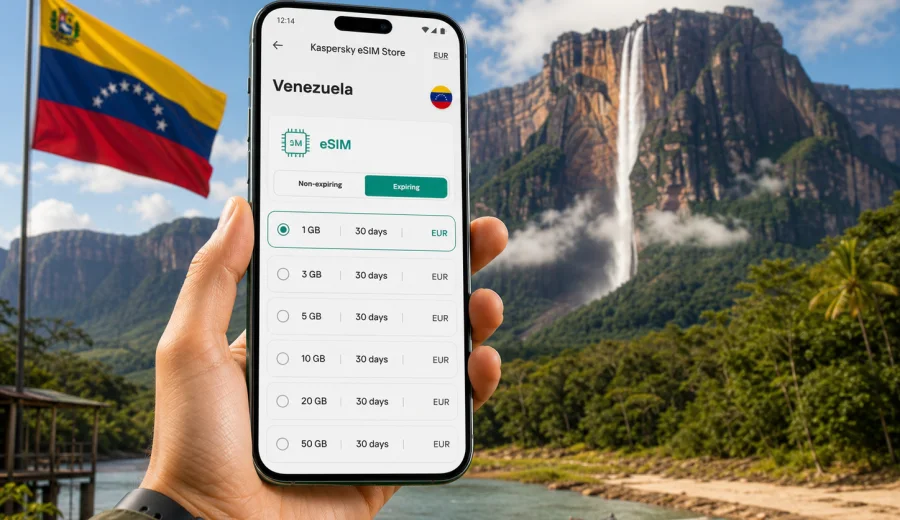
Venezuela eSIM: mobile connection and internet for your trip
Venezuela is a country where mobile internet can quickly become part of the travel plan rather than an afterthought. The route may include Caracas and the Avila mountain views, the Caribbean beaches of Margarita Island or Los Roques, the Andes around Merida, or a carefully arranged trip to Canaima National Park and Angel Falls. Each place creates a different connectivity scenario: airport arrival, hotel check-in, transfers, maps, messaging, weather checks, and updates for people at home.
An eSIM can make that preparation simpler because it lets you set up mobile data on a compatible phone without looking for a physical SIM card after arrival. You choose a suitable data package for the destination, install the eSIM profile, and use it for mobile internet during the trip according to the conditions of the selected tariff. For Venezuela, that practical control matters: distances can be large, plans may change, and reliable access to maps, bookings, and messages helps you move with fewer surprises.
Why mobile internet matters in Venezuela
Venezuela is not a single-city destination. Many trips combine a large urban arrival point with nature, coast, or regional travel. That variety makes internet access useful in different ways:
- In Caracas, you may need maps, hotel addresses, ride details, and messaging from the moment you leave the airport area.
- On Margarita Island, mobile data is useful for beach transfers, restaurant searches, accommodation messages, and route changes.
- In Canaima or other remote areas, coverage can be more limited, so preparation and offline backups become important.
- In Merida and the Andes, mobile internet helps with route planning, weather checks, and local coordination.
The key point is not to assume that one method will cover every situation equally. Public Wi-Fi may be available in hotels, airports, cafes, and some public places, but it is not always convenient at the moment you need it. A travel eSIM gives you a dedicated mobile data option on your phone, while offline maps and saved documents remain useful backups.
What an eSIM does for a Venezuela trip
An eSIM is a digital SIM profile installed on a compatible smartphone or tablet. Instead of inserting a plastic SIM card, you add a mobile data profile through your device settings, often by scanning a QR code or following an installation flow. In travel use, the eSIM is usually selected for data access abroad.
For Venezuela, an eSIM can help you prepare mobile internet before departure, avoid searching for a SIM shop immediately after arrival, keep your primary SIM in the phone if your device supports dual SIM use, and see the data volume, validity period, destination, and price before choosing.
An eSIM for travel is usually about mobile data. It does not automatically include a local phone number, voice calls, or SMS unless those options are explicitly included in the selected tariff. For everyday trip communication, many travelers use internet-based messaging and calling apps over mobile data.
eSIM, roaming, physical SIM, and Wi-Fi: practical comparison
Different connectivity options can work for different travelers. The best choice depends on your route, phone, data needs, and preference for setup.
| Option | When it can help | What to check |
|---|---|---|
| Travel eSIM | You want mobile data ready on a compatible device without a physical SIM card | Device compatibility, data volume, validity period, activation rules |
| Home operator roaming | You prefer using your existing mobile plan abroad | Roaming price, daily limits, speed policy, covered services |
| Local physical SIM | You plan a longer stay and are ready to handle local setup | Store availability, registration process, phone unlock status |
| Public Wi-Fi | You mainly need internet at hotels or cafes | Security, availability, speed, whether it works when you are moving |
| Offline mode | You visit remote areas or want a backup | Downloaded maps, saved bookings, saved emergency contacts |
For many trips, these methods are not mutually exclusive. You might use an eSIM for mobile data, keep your home SIM active for essential account messages, use trusted Wi-Fi at your hotel, and save key documents offline before leaving.
Check device compatibility before choosing a tariff
Before you pay for any eSIM tariff, confirm that your device supports eSIM and is not locked to one mobile operator. This step is important because eSIM support varies by device model, market version, and carrier settings. A phone can look modern and still have restrictions that affect eSIM installation.
Use the compatibility check before purchase: check your device.
Also review these points:
- Your phone should support eSIM installation.
- Your device should be unlocked for use with another mobile data profile.
- Your operating system should be updated enough to support stable eSIM setup.
- You should have internet access during installation, either through Wi-Fi or another mobile connection.
- If your phone supports dual SIM, decide which SIM will handle mobile data and which will remain available for calls or messages.
If you are traveling with family or colleagues, check each device separately.
How much data do you need in Venezuela?
Data usage depends less on the country and more on how you use your phone. A traveler who mostly sends messages and checks maps needs far less data than someone who uploads videos or uses the phone as a hotspot.
Use this planning table as a practical estimate:
| Travel style | Typical use | Data approach |
|---|---|---|
| Light use | Messaging, maps, email, occasional browser searches | Smaller package may be enough for a short trip |
| Standard use | Maps, social media, booking apps, photo sharing, daily browsing | Mid-size package gives more comfort |
| Heavy use | Video calls, cloud backups, frequent uploads, hotspot use | Larger package is safer |
| Remote work | Email, documents, calls, laptop tethering | Choose more data and keep Wi-Fi backup |
| Remote-area travel | Offline maps plus occasional mobile data when available | Combine eSIM with saved offline materials |
The safest method is to list what you expect to do daily. Navigation, messaging, and simple searches usually use modest amounts of data. Video streaming, automatic photo backup, app updates, and hotspot use can consume data quickly.
Venezuela travel scenarios where eSIM is especially useful
Many international arrivals use Simon Bolivar International Airport near Caracas. The first hour after landing is often when mobile data feels most useful: confirming accommodation details, contacting a driver, checking route timing, or telling someone you have arrived. If the eSIM is installed before the trip and activated according to the tariff rules, you can reduce dependence on airport Wi-Fi or the need to find a SIM card immediately.
For Canaima National Park, Angel Falls, or remote nature areas, mobile coverage can vary, so eSIM should be paired with offline preparation. Save booking confirmations, meeting points, emergency numbers, maps, and important messages before leaving reliable internet. On Margarita Island or coastal routes, mobile data is useful for restaurant searches, ferry or flight details, local transport, and accommodation messages.
When to install and activate your eSIM
The best timing depends on the activation rules of the selected tariff. Some eSIM profiles can be installed before departure and begin using data after connecting in the destination. Others may start validity when installed or activated. Always read the plan conditions before setup.
A practical preparation flow looks like this:
1. Check that your device supports eSIM and is unlocked.
2. Choose Venezuela as your destination.
3. Select the data volume and validity period that match your route.
4. Install the eSIM while you still have stable internet access.
5. Keep your primary SIM settings clear, especially for calls and SMS.
6. On arrival, switch mobile data to the travel eSIM if the plan requires it.
7. Monitor data use during the trip.
If you need a clear country-specific starting point, you can choose an eSIM tariff for a Venezuela trip and compare available options by data volume, duration, and price before you travel.
How to install eSIM on iPhone or Android
Installation is usually straightforward, but it is worth doing carefully. You need a compatible device, a stable internet connection during setup, and access to the installation details for the eSIM profile.
For step-by-step setup, use the relevant guide:
General setup tips:
- Install the eSIM when you are not rushed.
- Do not delete the eSIM profile unless you are sure it is no longer needed.
- Give the eSIM a clear label, such as Venezuela data, so it is easy to identify in settings.
- Check which SIM is selected for mobile data.
- Turn data roaming on for the eSIM if the tariff instructions require it.
- Keep your original SIM available for calls or account messages if you need it.
After setup, open your phone settings and confirm that the eSIM profile is visible. If you are still at home, avoid accidentally using the travel profile before the trip unless the plan conditions say that is expected.
What to check in the tariff conditions
Before choosing any eSIM tariff for Venezuela, review the details rather than selecting only by data size:
- Destination: confirm that the tariff is for Venezuela or covers Venezuela as part of the stated area.
- Data volume: choose enough GB for your expected use.
- Validity period: match the number of travel days, including arrival and departure.
- Activation rule: check when the validity period starts.
- Top-up options: see whether you can add more data if needed.
- Hotspot use: confirm whether tethering is allowed if you plan to share data.
- Refund and usage conditions: review them before purchase.
This careful check matters more than choosing the largest package automatically. A traveler staying four days in Caracas has different needs from a traveler spending two weeks across several regions.
Data-saving checklist for Venezuela
Use these settings before departure to make your mobile internet last longer:
- Download offline maps for Caracas, your accommodation area, and planned regions.
- Save hotel addresses and transport details in a note that works offline.
- Turn off automatic app updates and cloud photo backup over mobile data.
- Limit video streaming quality when using mobile data.
- Turn off background data for apps you do not need during the trip.
- Use trusted Wi-Fi for large downloads when available.
- Check data usage in your phone settings every few days.
Navigation and messaging are usually manageable; automatic uploads, streaming, tethering, and app updates are what often drain data unexpectedly.
Common mistakes to avoid
- Buying a tariff before checking whether the device supports eSIM.
- Choosing a package only by price without checking validity.
- Installing the eSIM in a hurry at the airport with unstable Wi-Fi.
- Deleting the eSIM profile after installation and expecting it to be reusable.
- Forgetting to switch mobile data from the home SIM to the travel eSIM.
- Assuming that mobile data includes voice calls and SMS.
Most problems are preventable with a short routine: know your device, understand the tariff, and keep essential travel information available offline.
Quick answers about eSIM for Venezuela
Can I use eSIM for mobile internet in Venezuela?
Yes, if your device supports eSIM, is unlocked, and you choose a tariff that includes Venezuela. Always check the plan conditions and device compatibility before purchase.
Does an eSIM give me a Venezuelan phone number?
Usually, travel eSIM data packages are intended for mobile internet. A phone number, voice calls, and SMS are not included unless the selected tariff explicitly says so.
Should I install the eSIM before I fly?
Often this is convenient, but the right timing depends on the activation rules of the tariff. Read when validity starts before installation or activation.
Is eSIM enough for remote areas?
It can help where mobile data is available, but remote routes require offline preparation. Save maps, addresses, tickets, and important messages before you leave reliable internet.
Final preparation checklist
Before you leave for Venezuela, make sure you have completed these steps:
- Device checked for eSIM support.
- Phone confirmed as unlocked for another mobile data profile.
- Travel dates matched with the tariff validity period.
- Data volume chosen for your real usage.
- Installation instructions saved.
- Offline maps downloaded.
- Hotel, transport, and booking details saved offline.
- Mobile data settings reviewed.
- Automatic updates and cloud backups controlled.
This checklist is useful whether you are going to Caracas for a few days, combining the capital with Margarita Island, or adding nature routes that require more planning.
Choose mobile internet for Venezuela before you travel
If you want to prepare your phone before departure, Kaspersky eSIM Store helps you choose, arrange, and activate an eSIM with a suitable data tariff for a foreign trip. Compare the available options for destination, data volume, validity period, and price, then follow the installation steps for your device.
You can prepare an eSIM tariff for Venezuela before the trip and arrive with a clearer plan for mobile internet, maps, messaging, and everyday travel coordination.