
Travel connectivity guide
Venice eSIM for Mobile Internet in Italy
Venice eSIM: mobile connection and internet for a city built on water
Venice rewards travelers who can move lightly: a phone, a map, a hotel address, a vaporetto stop, and enough mobile internet to check the next bridge, dock, or platform without slowing down. The city is compact on paper, but streets turn into canals, bridges interrupt direct routes, and a destination that looks five minutes away can require a careful walk or a boat ride.
That is why an eSIM for Venice is less about scrolling during a trip and more about control. You use data to find the right waterbus line, message a hotel before late arrival, check a restaurant booking, open digital tickets, compare walking routes, and keep a ride plan visible when crowds fill the main paths between Santa Lucia station, Rialto, San Marco, Dorsoduro, Cannaregio, Castello, and the islands of the lagoon.
This guide focuses on mobile connection and internet use in Venice itself: arrival, local transport, hotel check-in, short business stays, stopovers, trips to Murano or Burano, and the practical choice between roaming, public Wi-Fi, a physical SIM, and an eSIM prepared before the journey.
Why Venice makes mobile internet especially useful
Venice is a city where many ordinary travel habits need small adjustments. Taxis are boats, buses may be waterbuses, and the fastest walking route is not always the most comfortable one with luggage. Mobile data helps you adapt without turning every change into a detour.
Common Venice situations where a stable data plan helps:
- arriving at Venice Marco Polo Airport and deciding between bus, boat, taxi, or transfer;
- walking from Venezia Santa Lucia station to a hotel through bridges and crowded lanes;
- checking vaporetto stops and line directions before boarding;
- opening hotel instructions for late check-in or apartment access;
- navigating from San Marco to a less obvious dinner address in Castello or Cannaregio;
- coordinating with colleagues during a conference, cruise departure, film festival, or trade visit;
- using translation, maps, tickets, and messaging while away from hotel Wi-Fi;
- planning a half-day route to Murano, Burano, Torcello, Lido, Padua, or Verona.
The point is not to stay online all day. It is to avoid losing time at the exact moments when Venice is least forgiving: with luggage, in rain, after dark, on a crowded bridge, or when a boat schedule changes your plan.
Arrival scenarios: airport, train station, cruise terminal
Venice has several arrival patterns, and each one affects how soon you will want mobile data.
| Arrival point | Typical next step | Why mobile internet matters |
|---|---|---|
| Venice Marco Polo Airport | Bus, waterbus, water taxi, hotel transfer | Compare route time, open ticket details, message accommodation |
| Treviso Airport | Shuttle to Venice or Mestre | Track arrival time and onward connection |
| Venezia Santa Lucia station | Walk or vaporetto to the hotel | Check bridge-heavy routes and the nearest boat stop |
| Venezia Mestre station | Train, tram, bus, or taxi to Venice | Confirm platform, local transfer, and hotel timing |
| Cruise terminal area | People mover, taxi, or boat transfer | Coordinate luggage, meeting points, and boarding windows |
If your eSIM is already installed before the trip, you can turn on the travel line when it is time to use it according to the selected tariff conditions. This is especially helpful if your first task in Italy is not sightseeing but finding the correct transport option.
Venice neighborhoods and how data usage changes
Venice does not have a single travel pattern. Your internet needs vary by district, hotel location, and trip style.
In San Marco, you may use mobile data for crowd-aware walking routes, attraction tickets, restaurant reservations, and meeting points around the basilica, waterfront, and luxury hotels.
In Cannaregio, data helps with quieter evening walks, local restaurants, and hotel approaches from Santa Lucia or the Jewish Ghetto area.
In Dorsoduro, maps help with galleries, university areas, Zattere, Accademia, and routes toward Santa Croce or San Polo.
In Castello, mobile internet is useful for Biennale venues, Arsenal-area appointments, waterfront walks, and less central accommodation. Some destinations are straightforward by vaporetto but slower on foot.
On Lido, Murano, Burano, and other lagoon islands, data helps you manage boat timings, return plans, and weather changes.
eSIM, roaming, public Wi-Fi, or local SIM in Venice
There is no single best option for every traveler. The right choice depends on your phone, trip length, data use, and whether you prefer to prepare before arrival.
| Option | Good for | Watch out for |
|---|---|---|
| eSIM | Travelers with compatible phones who want to prepare mobile internet before or shortly after arrival | You must check device compatibility and tariff conditions |
| Standard roaming | Short trips where your home operator offers acceptable terms | Cost, speed, and data limits depend on your home plan |
| Public Wi-Fi | Light use in hotels, cafes, stations, and some venues | Availability, login pages, speed, and security can vary |
| Physical local SIM | Longer stays or users whose phone does not support eSIM | Requires a shop visit and may take time after arrival |
For Venice, the main advantage of eSIM preparation is timing. You can choose a tariff for Italy before departure, install it on a compatible device, and keep your primary SIM available for calls or banking messages if your phone supports dual SIM settings.
Check your phone before you choose an eSIM
Before you plan your Venice mobile internet setup, make sure the device supports eSIM and is not locked in a way that prevents adding another mobile profile. A recent iPhone, many Samsung Galaxy models, Google Pixel devices, and selected tablets support eSIM, but support depends on model, region, and carrier settings.
Use this quick checklist:
- confirm that your phone model supports eSIM;
- check that the device is not locked to one operator;
- update the operating system before travel if an update is pending;
- keep enough battery for activation and navigation on arrival;
- save installation details somewhere you can access offline;
- understand whether your chosen tariff includes data only or any additional services.
If you are unsure, check your device before choosing a tariff. This avoids the most common problem: preparing a data plan that cannot be installed on the phone you bring to Venice.
How much data do you need for Venice?
Data use in Venice depends on behavior, not only trip length. Maps, messaging, browser searches, transport information, and ticket apps usually require modest data. Video calls, cloud backup, streaming, and hotspot use consume much more.
Practical estimates for a city trip:
| Traveler type | Typical use | Suggested thinking |
|---|---|---|
| Light traveler | Maps, messages, tickets, restaurant searches | A smaller package may be enough for a weekend |
| Active explorer | Navigation, translation, photo sharing, boat schedules | Choose extra margin for full days outside |
| Business traveler | Email, chat, calendar, document checks | Prioritize reliability and enough validity days |
| Family coordinator | Several reservations, messaging, route checks, hotspot moments | Consider a larger allowance or separate plans |
| Remote-work stopover | Video calls, file sync, laptop tethering | Review hotspot terms and choose data carefully |
Venice can encourage more data use than expected because travelers check routes repeatedly. A canal crossing, closed lane, or wrong vaporetto direction may lead to extra map searches. If your hotel is far from the main station or you plan island trips, choose a buffer rather than matching your estimate too tightly.
A practical setup plan before departure
Preparing an eSIM for Venice works best when it is treated as one item in the trip checklist, not as an emergency fix at the airport.
1. Confirm your phone supports eSIM and can use an additional mobile plan.
2. Choose Italy as the destination because Venice is in Italy.
3. Pick a tariff by data volume and validity period, not only by headline size.
4. Install the eSIM while you still have stable home Wi-Fi, if the tariff instructions allow it.
5. Keep your main SIM active for calls and SMS if you need bank codes or hotel calls.
6. Turn mobile data to the travel eSIM when you are ready to use the plan.
7. Disable heavy background updates, automatic cloud backup, and app downloads on mobile data.
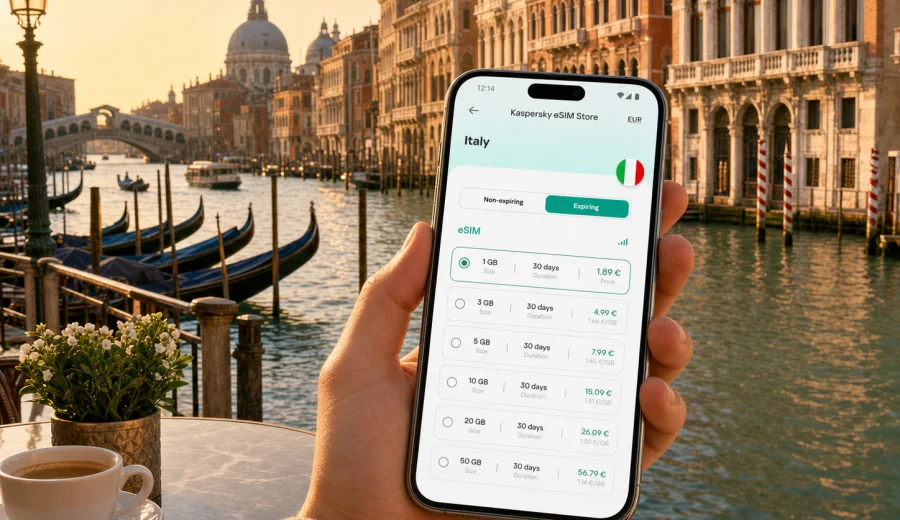
Kaspersky eSIM Store is an app and website where you can choose, arrange, and activate an eSIM with a suitable tariff for mobile internet during an international trip. For a Venice visit, use the Italy destination and review the data volume, duration, and activation details before you travel.
When you are comparing options, you can prepare an eSIM tariff for a trip to Venice in Italy and choose the package that fits your route, stay length, and expected mobile data use.
Using mobile data on Venice transport
Venice transport is unusual because many key routes are on water. Mobile internet helps most when you combine walking and vaporetto travel.
Typical uses on local movement:
- checking which side of the Grand Canal your destination is on;
- confirming whether walking or vaporetto is faster with luggage;
- saving the stop name before you board;
- checking a return route from Murano, Burano, Lido, or Giudecca;
- messaging a hotel if the boat is delayed or the queue is longer than expected;
- opening a digital ticket or reservation at the right moment.
Do not rely on data as the only copy of critical information. Save your hotel address, booking number, and first route offline. Venice is not difficult because it lacks information; it is difficult because you may need that information while standing on a bridge with people moving behind you.
Hotel, apartment, and late check-in use cases
Many Venice stays involve detailed arrival instructions. A hotel near a canal may tell you which vaporetto stop to use. An apartment host may send a door code, photo guide, or exact meeting point. A boutique hotel may have a reception route that is easier from one bridge than another.
Mobile internet helps with:
- reading check-in messages after landing;
- sending your updated arrival time;
- opening maps from the exact hotel instruction link;
- checking whether luggage storage is near the station or hotel;
- translating short messages if needed;
- sharing a live location with someone in your group.
For late arrival, keep one extra precaution: save the property address and access instructions offline before you leave home. eSIM data makes arrival smoother, but offline copies protect you if your phone battery is low or you need to troubleshoot settings.
Business travel and events in Venice
Venice is not only a leisure destination. Travelers come for exhibitions, cultural events, conferences, academic visits, cruise operations, film-related work, hospitality meetings, and regional business trips. In these cases, mobile connection is less about discovery and more about punctuality.
A business traveler may need to:
- join a messaging thread while moving between hotel and venue;
- check a meeting room address near San Marco, Dorsoduro, or Lido;
- open calendar changes without waiting for Wi-Fi;
- use maps when a walking route is interrupted by crowds or high water;
- send documents or confirmations from a cafe before a meeting;
- coordinate with colleagues arriving through different stations or airports.
For this kind of trip, choose a data package with enough validity for the whole stay, including arrival and departure days. If you use hotspot for a laptop, review whether tethering is allowed under the selected tariff and watch your data balance closely.
Stopovers and one-day Venice trips
A one-day Venice visit can be more demanding than a longer stay. There is little time to recover from a wrong route. If you arrive from Florence, Milan, Verona, Padua, or a cruise itinerary, your data plan may be used intensely for a short window.
For a day trip, prepare:
- offline copy of your train or transfer ticket;
- map pin for Santa Lucia station, Piazzale Roma, or your departure point;
- plan for either walking to Rialto and San Marco or using a vaporetto;
- dinner or luggage storage details if needed;
- enough mobile data for navigation, messaging, and ticket checks.
If Venice is one city in a wider Italy route, the same Italy eSIM tariff may also support mobile internet in places such as Rome, Florence, Milan, Naples, Bologna, Verona, or the lakes, depending on the selected plan conditions. Check the destination and validity terms before relying on one setup for the whole journey.
Installation and activation notes
Install the eSIM only on a compatible device and follow the instructions for your operating system. If you need a step-by-step guide, use the Android installation instructions or the iOS installation instructions. Keep Wi-Fi available during installation, and avoid deleting the eSIM profile after activation unless the tariff instructions say it can be reinstalled.
Important settings to review:
| Setting | What to check |
|---|---|
| Mobile data line | Select the travel eSIM for mobile data when you want to use it |
| Data roaming | Some eSIM profiles require data roaming to be enabled |
| Default voice line | Keep your main SIM selected if you need your usual number |
| Background data | Reduce automatic updates, cloud backup, and video autoplay |
| Hotspot | Check whether tethering is supported by the selected tariff |
Activation terms differ by tariff. Some plans begin when installed, some when connected to a supported network, and some follow other conditions. Read the plan details before departure so that your validity period matches the Venice schedule.
Saving data during a Venice trip
Even a generous package can disappear quickly if the phone treats mobile data like home Wi-Fi. Venice is photogenic, so automatic photo and video backup is one of the easiest ways to spend data without noticing.
Simple ways to keep control:
- download offline map areas before departure;
- pause cloud backup on mobile data;
- send compressed photos in messaging apps;
- use hotel Wi-Fi for app updates and large uploads;
- avoid streaming video on vaporetto rides;
- close navigation when you know the route;
- check data balance regularly in the app or device settings.
These habits do not make the trip less connected. They keep data available for the moments that matter: finding the right dock, messaging a host, opening tickets, or changing plans when rain, crowds, or timing require a different route.
Quick Venice mobile internet checklist
Before you leave:
- choose Italy as the destination for a Venice trip;
- check eSIM support and device lock status;
- install the eSIM using stable Wi-Fi if the instructions allow;
- save hotel address, booking details, and first route offline;
- download offline maps for central Venice and the lagoon islands;
- confirm whether your plan is data-only;
- keep your main SIM available if you need your regular number.
On arrival:
- switch mobile data to the eSIM when you are ready to use the plan;
- test maps and messaging before leaving the airport or station;
- keep a screenshot of the hotel route;
- avoid heavy downloads on mobile data;
- watch your battery, especially when navigating for long periods.
FAQ: eSIM and mobile internet in Venice
Do I need an eSIM only for Venice?
If your trip is only in Venice, choose Italy as the destination because Venice is in Italy. If you continue to other Italian cities, review whether the same tariff suits the full route and validity period.
Can I use eSIM for calls and SMS in Venice?
Many travel eSIM tariffs are designed for mobile data. They may not include a regular phone number, voice calls, or SMS unless the selected tariff states otherwise. You can use internet-based messaging and calling apps over data.
Is hotel Wi-Fi enough?
Hotel Wi-Fi is useful, but it does not help while you are crossing the city, waiting for a boat, searching for an apartment entrance, or checking a route on an island. A travel eSIM is most useful between Wi-Fi locations.
Should I activate eSIM before flying?
Install and activation timing depends on the selected tariff. You can often install the eSIM in advance using Wi-Fi, then use it when the trip begins according to the plan conditions. Always read the tariff details before activation.
What if my phone does not support eSIM?
Use another connection option, such as roaming, public Wi-Fi, or a physical SIM if appropriate for your trip. Do not choose an eSIM until compatibility is clear.
Is one package enough for Venice, Murano, and Burano?
For most travelers, the same Italy destination setup is the relevant direction for Venice and lagoon islands. Your actual experience depends on the selected tariff terms, device settings, and local network conditions.
Choose an eSIM tariff for your Venice trip
Venice is easier when your phone is ready before the first bridge, boat stop, or hotel message. With Kaspersky eSIM Store, you can choose Italy, review available data packages, arrange the tariff that matches your trip, and activate the eSIM on a compatible device following the instructions.
Before you travel, choose a mobile internet option for Italy that fits your Venice stay, whether you are arriving for a weekend, a business event, a lagoon island route, or a longer journey through Italy.