
Travel connectivity guide
Victoria eSIM for Mobile Internet in Canada
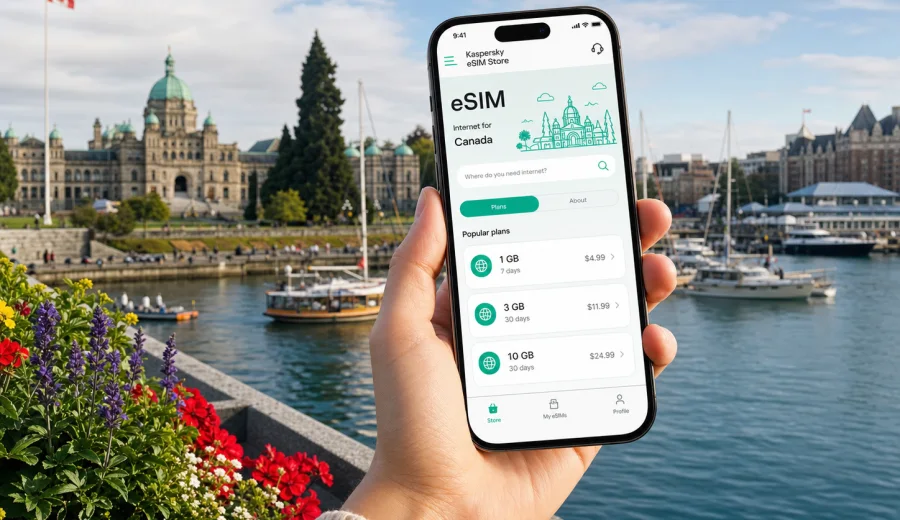
Victoria eSIM: mobile connection and internet for a trip to Canada
Victoria is a city where travel plans often depend on small, time-sensitive decisions: finding the right bus from the airport, checking a ferry schedule, confirming a hotel address near the Inner Harbour, or opening a map before a coastal walk. If you are visiting the capital of British Columbia, an eSIM can make mobile connection and internet access easier to plan before you arrive.
For many travelers, the practical question is not simply "Do I need internet in Canada?" It is more specific: "Will I be able to use maps, messaging, bookings, ride apps, email, and travel updates during my first hours in Victoria?" A travel eSIM is designed for that scenario. It gives mobile internet on a compatible device without requiring a physical SIM card, so you can prepare a data plan for your trip and keep your main SIM in place for calls or banking messages if your phone supports dual SIM use.
This guide focuses on Victoria rather than Canada in general. It covers arrival, local movement, business trips, hotels, short stopovers, day trips, and the kinds of data use that are common in a compact coastal city with ferries, buses, waterfront routes, and many visitors moving between Vancouver Island and mainland British Columbia.
Why mobile internet matters in Victoria
Victoria is easy to enjoy, but it is not always a city where you want to improvise offline. The airport is outside the downtown core, ferries connect different parts of the region, and many popular places are spread across neighborhoods or nearby municipalities. Mobile internet helps you keep those pieces organized.
Common moments when data is useful in Victoria include:
- checking the route from Victoria International Airport to Downtown, James Bay, Fairfield, Oak Bay, Saanich, or Esquimalt;
- opening a map around the Inner Harbour, Government Street, Chinatown, Beacon Hill Park, Fisherman's Wharf, or Dallas Road;
- confirming hotel check-in details, entry codes, parking instructions, or late-arrival messages;
- using messaging apps to coordinate with family, colleagues, guides, hosts, or taxi drivers;
- checking transit times when moving between Downtown Victoria, the University of Victoria area, Swartz Bay, and suburban hotels;
- planning trips to Butchart Gardens, Sidney, Sooke, the Malahat, Nanaimo, Vancouver, or the Gulf Islands;
- working from a hotel, cafe, conference venue, or coworking space without relying only on public Wi-Fi.
An eSIM does not replace every part of mobile service. In most travel use cases it is for mobile data, not a local phone number, standard voice calls, or SMS unless the selected plan says otherwise. For calls and messages, you can usually use internet-based apps over the data connection.
Arrival scenarios: airport, ferry, and first route into town
Victoria has several common arrival patterns, and each one creates a different data need.
| Arrival route | What you may need internet for | Practical eSIM use |
|---|---|---|
| Victoria International Airport | Transport options, hotel address, pickup coordination, map route | Activate mobile data after landing and check the route before leaving the terminal |
| Swartz Bay ferry terminal | Bus connections, ferry updates, onward route to Downtown or Saanich | Use maps and transit information while moving from the ferry to the city |
| Downtown harbour or cruise arrival | Walking route, booking details, restaurant or tour confirmations | Keep navigation and messaging available without searching for Wi-Fi |
| Road trip on Vancouver Island | Weather, maps, EV charging, accommodation messages, detours | Choose a data allowance that fits both city use and travel outside Victoria |
If you arrive at Victoria International Airport, the city center is not directly outside the terminal. You may need to compare shuttle, taxi, car rental, ride, or bus options. If you arrive by ferry, you may be moving from Swartz Bay toward Downtown or another part of Greater Victoria. In both cases, mobile internet is most valuable during the first hour: you can confirm the route, share your location, and avoid depending on the first public Wi-Fi network you find.
For a short weekend, a small data package may be enough if you mostly use maps, messaging, and booking apps. For a longer stay, a conference, remote work, or a route that continues across Vancouver Island, choose more data and a validity period that covers the full trip rather than only your first day in Victoria.
How to estimate data for a Victoria trip
The right eSIM plan depends on what you do in the city. Victoria is compact enough for walking, but data use can grow quickly if you use video calls, hotspot mode, cloud backups, or streaming while moving between hotels, ferries, and day trips.
Use this simple planning table before choosing a plan:
| Travel style in Victoria | Typical data use | What to prioritize |
|---|---|---|
| One-day stopover | Maps, messaging, ferry or tour updates, quick searches | Short validity and modest data |
| Weekend break | Navigation, restaurant searches, photos, hotel apps, messaging | Enough data for 2-4 days plus a small buffer |
| Business trip | Email, calendar, ride apps, maps, messaging, light tethering | Larger data allowance and reliable validity through the whole stay |
| Family trip | Several devices, route planning, attraction tickets, photo sharing | More data or a clear plan for who uses the eSIM |
| Vancouver Island route | Victoria plus Sooke, Sidney, Nanaimo, parks, or ferries | Data allowance that covers navigation outside the city |
Victoria districts and where eSIM is especially useful
Downtown Victoria and the Inner Harbour are walkable, but visitors often move between several distinct areas. Mobile internet helps because you may be switching between walking, transit, taxi, ferry, and hotel routes.
- Downtown and the Inner Harbour: maps, restaurant bookings, harbour tours, museum tickets, and hotel directions.
- James Bay, Fisherman's Wharf, and Beacon Hill Park: walking routes, pickup points, and timing around the waterfront.
- Fairfield, Cook Street Village, and Oak Bay: local streets, beaches, cafes, and transit stops away from the main tourist grid.
- Saanich and the University of Victoria area: meetings, campus visits, events, and bus routes outside Downtown.
- Sidney and Swartz Bay: airport or ferry transfers, onward transport, and pickup coordination.
If your itinerary crosses several of these areas, plan your eSIM as a city-and-region tool rather than only a hotel-to-attraction backup.
Choosing an eSIM plan for Victoria, Canada
For a city article, the correct plan destination is the country where the city belongs. Victoria is in Canada, so you should look at Canada coverage and conditions when choosing a travel eSIM. Check the data amount, validity period, destination, price, and any activation notes before you proceed.
In Kaspersky eSIM Store, you can choose an eSIM plan for a trip to Canada and compare the available options for mobile internet in the selected destination. This is the main country-level page to use for a Victoria trip, whether you stay only in the city or continue elsewhere in British Columbia.
When comparing plans, ask five questions:
1. Does the plan cover Canada for the dates of your trip?
2. Is the data allowance enough for maps, messaging, bookings, and any work tasks?
3. Does the validity period cover arrival day, departure day, and possible delays?
4. Does your phone or tablet support eSIM and allow the profile to be installed?
5. Do the plan conditions fit how you intend to use data, including hotspot mode if you need it?
Do not choose only by the smallest data amount. Victoria travel often includes route checks, ferry or bus timing, and weather changes, so a small buffer can be useful. At the same time, do not overestimate if you will spend most evenings on trusted hotel Wi-Fi and only need mobile data for navigation during the day.
Before you choose: device compatibility and setup checks
Before preparing an eSIM for Victoria, check that your device supports eSIM and is not locked to another carrier. Some device models differ by region, and some phones can support eSIM in one version but not another. Check your device before choosing a plan so you do not discover a compatibility issue during travel.
A practical pre-trip checklist:
- confirm that your phone supports eSIM in its settings;
- check that the device is not carrier-locked;
- update the operating system if you have postponed important updates;
- make sure you have internet access during installation, because downloading an eSIM profile requires a connection;
- keep your primary SIM active if you need banking codes or regular calls;
- read the selected plan conditions, including validity, data allowance, destination, and activation behavior.
If you are traveling with more than one device, decide where the eSIM should be installed before you begin. In many cases, an eSIM profile cannot simply be moved to another phone after activation. Install it on the device you will actually carry around Victoria.
How to install an eSIM before or after arriving in Victoria
You can install an eSIM before your trip or after arrival, depending on the plan conditions and your preference. Installing before departure can reduce friction when you land, but you should follow the activation rules shown for the selected plan so that the validity period starts when expected.
The basic flow is:
1. Choose Canada as the destination and select a suitable data plan.
2. Check your device compatibility and carrier-lock status.
3. Complete the plan setup in Kaspersky eSIM Store.
4. Install the eSIM profile by following the on-screen instructions or using the QR code if provided.
5. Set the eSIM as the mobile data line when you are ready to use it.
6. Enable data roaming for the eSIM if the device or plan instructions require it.
7. Wait a few minutes for registration on the local network after activation.
If you need platform-specific steps, use the Android eSIM installation guide or the iOS eSIM installation guide. Keep the instructions available before you travel, especially if you will arrive late, take a ferry connection, or need mobile data immediately after landing.
Practical Victoria use cases
First hour after arrival. Turn on the eSIM data line when you are ready to use mobile internet, confirm your route, and message your hotel or host if your arrival time changes. This is especially useful if you arrive at the airport or ferry terminal and still need to reach Downtown Victoria.
Hotel check-in. Many hotels, apartments, and guest stays use digital confirmations, entry instructions, or messaging. With mobile internet, you can open the booking details outside the building without depending on lobby Wi-Fi.
Business meetings. Victoria has government, education, marine, tourism, technology, and conference travel. An eSIM helps with calendar updates, route changes, and messaging between meetings. If you plan to tether a laptop, choose data accordingly and check whether hotspot use is allowed by the selected plan.
Walking routes. The Inner Harbour, Beacon Hill Park, Dallas Road, Chinatown, and Cook Street Village are easy to explore, but mobile maps help you adjust the route without losing time.
Weather-aware plans. Coastal weather can change how you spend the day. Mobile internet helps you switch from a waterfront walk to an indoor plan, check transport timing, or update a booking.
Trips from Victoria. Butchart Gardens, Sidney, Sooke, the Malahat, Nanaimo, Vancouver, and Gulf Island routes all make data useful beyond the city center. If you plan several of these trips, choose a plan that covers the full travel period.
FAQ: eSIM for Victoria
Is an eSIM useful for a trip to Victoria?
Yes. An eSIM can be useful if you want mobile internet for maps, messaging, transport, bookings, work, and day trips without replacing your physical SIM card. It is especially helpful during arrival, ferry transfers, and movement between neighborhoods.
Does an eSIM include calls and SMS in Victoria?
Usually, travel eSIM plans for this scenario are focused on mobile data. Standard voice calls, SMS, and a local phone number are not included unless the selected plan says otherwise. You can use messaging and calling apps over mobile internet.
Can I install the eSIM before flying to Canada?
In many cases you can install the eSIM before departure, but you should follow the activation and validity rules shown for the selected plan. Some plans start counting validity after activation or first network connection, depending on their conditions.
What if my phone does not support eSIM?
If your device does not support eSIM or is carrier-locked, you will need another option such as your home carrier's roaming service, a different compatible device, or a physical SIM solution. Check compatibility before choosing a plan.
Choose an eSIM plan for your Victoria trip
Victoria rewards travelers who can move easily: from the airport to the harbour, from a hotel to a meeting, from a downtown walk to a ferry or day trip. Preparing mobile internet in advance helps you keep maps, messages, bookings, and travel updates available when they matter.
Before you go, check that your device supports eSIM, choose a data allowance that fits your itinerary, and read the plan conditions carefully. In Kaspersky eSIM Store, you can prepare an eSIM plan for mobile internet in Canada and use it as part of a smoother trip to Victoria.