
Travel connectivity guide
Vietnam eSIM: mobile connection and internet
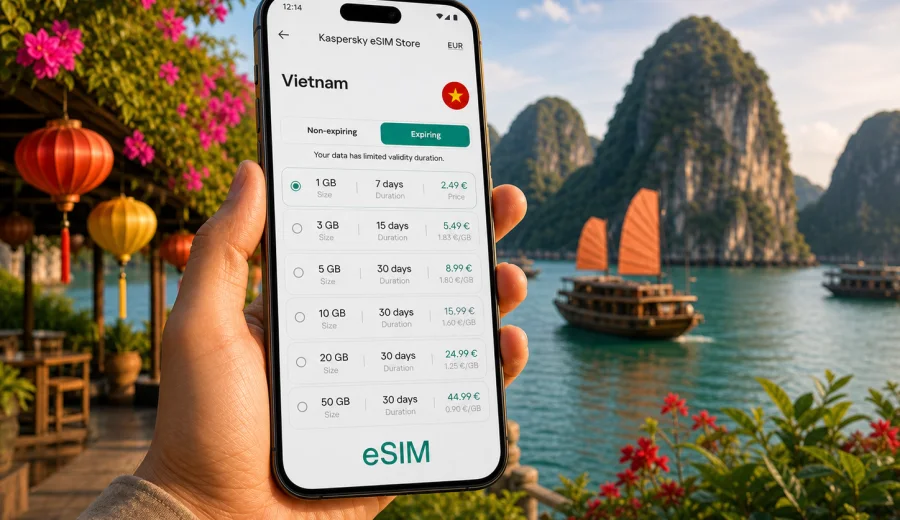
eSIM in Vietnam: mobile connection and internet for your trip
Vietnam is an easy country to explore with a phone in your hand: you can compare routes in Hanoi, call a ride in Ho Chi Minh City, check train times for Da Nang, translate a menu in Hue, or upload photos from Ha Long Bay before the boat returns to shore. The practical question is not whether you will need mobile internet, but how you want to prepare it before the trip.
An eSIM is a digital SIM profile that can be installed on a compatible smartphone or tablet. For travel, it helps you use mobile data abroad without looking for a physical SIM card after arrival. In Vietnam, that matters because many trips combine busy cities, domestic flights, buses, trains, coastal resorts, and day tours where public Wi-Fi is uneven or inconvenient.
Kaspersky eSIM Store is an app and website where you can choose, arrange, and activate an eSIM with a suitable data tariff for mobile internet during an international trip. It is not a mobile operator and does not replace the local network behind the service. The useful part for travelers is the preparation workflow: choose the destination, review data volume and validity, install the eSIM on a compatible device, and keep the travel data option ready.
Why mobile internet matters in Vietnam
Vietnam rewards flexible travel. A plan can change quickly because of weather, traffic, flight times, or a recommendation from a hotel desk. Mobile data makes those changes manageable. You can check whether a museum is open, message a driver, find the right entrance to a railway station, or confirm a pickup point for a food tour.
Typical online tasks in Vietnam include:
- navigation in dense city streets and smaller lanes;
- translation between English and Vietnamese for menus, signs, and short conversations;
- ride-hailing, taxi coordination, and route checks;
- mobile boarding passes and hotel confirmations;
- messaging with guides, hosts, and family;
- checking weather before boat trips, mountain drives, or beach days;
- booking domestic buses, trains, flights, and activities;
- using maps when walking between cafes, markets, temples, and museums.
Wi-Fi is common in hotels, cafes, and airports, but it is not always where you need it. A traveler may have Wi-Fi at breakfast and no practical connection ten minutes later while trying to find the correct bus stop. Mobile internet fills that gap.
Where eSIM is especially useful in Vietnam
Vietnam is a country of long distances and varied travel styles. The same trip might include Hanoi, Ninh Binh, Ha Long Bay, Hoi An, Da Nang, Ho Chi Minh City, and the Mekong Delta. eSIM is useful because your internet setup follows your device instead of depending on a shop, hotel network, or a single public hotspot.
| Travel situation | Why mobile data helps |
|---|---|
| Arrival at Noi Bai or Tan Son Nhat airport | You can message your hotel, open a map, and coordinate transport before leaving the terminal. |
| City travel in Hanoi or Ho Chi Minh City | Navigation and ride apps are easier when you are not searching for Wi-Fi. |
| Train or bus routes | You can check delays, station names, pickup points, and accommodation details. |
| Coastal stays in Da Nang, Nha Trang, or Phu Quoc | Mobile data helps with local transfers, restaurant searches, and weather checks. |
| Tours to Ha Long Bay, Ninh Binh, Sapa, or the Mekong Delta | You can keep key travel information available when group plans change. |
The exact network experience depends on local coverage, device settings, location, congestion, and the selected tariff conditions. That is true for any mobile data option. The advantage of preparing eSIM in advance is that you reduce the number of decisions you need to make when you are tired after a flight.
eSIM, roaming, local SIM, or Wi-Fi: what fits your trip?
There is no single best option for every traveler. The right choice depends on trip length, data needs, device compatibility, and how much time you want to spend arranging connectivity after arrival.
| Option | Useful when | Things to consider |
|---|---|---|
| Travel eSIM | You want mobile data ready on a compatible device without a physical card. | Check device compatibility, tariff validity, data volume, and activation rules. |
| Standard roaming | You prefer to keep your home operator setup and accept its conditions. | Roaming prices and data limits can vary significantly by home operator. |
| Local physical SIM | You need a local-style mobile setup and are comfortable visiting a shop. | It may take time after arrival, and your phone needs a free SIM slot or dual-SIM setup. |
| Public Wi-Fi | You mostly stay in hotels and cafes. | It is not reliable for movement, transport, maps, or urgent messages. |
For many visitors, eSIM is a practical middle option: you can keep your main SIM for your usual number and use eSIM for travel data. If your device supports dual SIM, you can often choose which line handles mobile data and which line remains available for calls or messages, subject to your device and home operator settings.
How much data do you need in Vietnam?
Data use depends more on habits than on the country. A traveler who uses maps, messages, and occasional searches needs much less than someone who streams video, backs up photos, joins video calls, and uses social media throughout the day.
Use this rough planning guide:
| Traveler type | Typical use | Practical data approach |
|---|---|---|
| Light user | Maps, messaging, email, occasional browsing | Choose a smaller package and keep large downloads for Wi-Fi. |
| Standard traveler | Maps, ride apps, reviews, translation, social updates | Pick a balanced data volume for the full stay. |
| Heavy user | Video calls, frequent uploads, work apps, hotspot use | Consider a larger package and monitor usage daily. |
| Multi-city traveler | Transport apps, booking changes, maps in several regions | Choose enough data for travel days, not only hotel days. |
Some activities consume data faster than expected. Short videos, cloud photo backups, app updates, and hotspot sharing can drain a package quickly. Before the trip, disable automatic app updates and cloud backups on mobile data if you want the eSIM tariff to last longer.
A practical Vietnam mobile internet checklist
Before you travel, it helps to make a short technical checklist. It takes only a few minutes and can prevent most avoidable connection problems.
- Confirm that your phone or tablet supports eSIM.
- Check that the device is not locked to one mobile operator.
- Make sure your operating system is up to date enough for stable eSIM installation.
- Keep your main SIM active if you need banking SMS or calls from home.
- Save the eSIM installation information somewhere accessible.
- Install the eSIM while you have a stable internet connection.
- Read the tariff validity rules before activation.
- Decide which SIM line will be used for mobile data in Vietnam.
- Turn off mobile-data-heavy automatic backups before travel.
If you are not sure whether your smartphone or tablet supports eSIM, check your device before choosing a tariff. Compatibility is an essential step because eSIM cannot be used on every device, and some models can differ by market or operator lock status.
When to install and activate eSIM for Vietnam
The safest approach is to install the eSIM before departure while you have reliable Wi-Fi. Installation and activation are not always the same thing: installation adds the eSIM profile to the device, while activation and data use depend on the selected tariff conditions and device settings.
For installation steps, use the official guides for your device type: Android installation guide and iOS installation guide. Read the steps before travel so you know where to find mobile data, roaming, and SIM-line settings on your phone.
A simple timeline works well:
1. A few days before departure, check device compatibility and choose a suitable data tariff.
2. Before leaving home, install the eSIM profile while connected to stable Wi-Fi.
3. Keep your regular SIM selected for calls and messages if you still need it.
4. After landing in Vietnam, select the eSIM line for mobile data if your tariff requires it.
5. If needed, enable data roaming for the eSIM line according to the instructions and tariff details.
6. Test maps or a browser page before leaving the airport or hotel.
Do not delete an installed eSIM profile unless you are sure it is no longer needed. In many cases, deleting a profile can make reuse or transfer impossible, depending on the tariff and profile conditions.
Choosing an eSIM tariff for Vietnam
For a short city break in Hanoi or Ho Chi Minh City, a smaller data package may be enough if you mainly use maps and messages. For two weeks across several regions, a larger data volume can be more comfortable. For remote work, video calls, or frequent hotspot use, plan more carefully and check whether tethering is allowed under the selected tariff conditions.
The main choice factors are:
- data volume, such as 1 GB, 3 GB, 5 GB, 10 GB, or more;
- validity period, for example a short trip or a longer stay;
- destination coverage, especially if you also visit nearby countries;
- activation rules and when the validity period begins;
- whether top-up is available;
- whether your device and operating system support the required eSIM workflow.
If your Vietnam trip is part of a wider Southeast Asia route, compare a country-specific tariff with regional options. A single-country tariff can be convenient for a Vietnam-only itinerary, while a regional tariff may be useful if you also plan Cambodia, Thailand, Laos, Malaysia, or Singapore. Check the destination list before you decide.
For a Vietnam-focused trip, you can choose an eSIM tariff for Vietnam in Kaspersky eSIM Store and compare the available data volumes, validity periods, and conditions before you travel.
Vietnam travel scenarios and data planning
Different Vietnam routes create different mobile internet needs. Use the scenarios below to estimate what matters most for your trip.
Hanoi, Ha Long Bay, and Ninh Binh
This northern route is map-heavy and coordination-heavy. You may need mobile data for airport transfer, hotel messaging, old-quarter navigation, tour pickup points, and weather checks before a boat trip. In Ninh Binh, mobile data helps with bike routes, taxis, and finding the right pier or viewpoint.
Practical tip: save hotel addresses in both English and Vietnamese if available. It can help when showing the destination to a driver or comparing it with a map result.
Da Nang, Hoi An, and Hue
Central Vietnam is often a mix of beach time, historic areas, day trips, and intercity transfers. Mobile data is useful for ride-hailing, restaurant searches, route planning over the Hai Van Pass, and checking weather during the rainy season.
Practical tip: download offline map areas before long day trips, but keep mobile data available for live route changes and messaging.
Ho Chi Minh City and the Mekong Delta
Ho Chi Minh City is busy, fast, and spread out. Mobile data helps you coordinate rides, find entrances, compare routes, and message local contacts. In the Mekong Delta, a guide or hotel may update pickup details, and mobile internet can make those changes easier to manage.
Practical tip: keep battery power in mind. Navigation, camera use, and mobile data together can drain a phone quickly on long tour days.
Phu Quoc, Nha Trang, and coastal resorts
For beach destinations, the need may feel lighter, but mobile data still helps with transfers, restaurant reservations, maps, and messaging. If you stream video or share a hotspot from the beach or hotel room, data use can rise quickly.
Practical tip: use hotel Wi-Fi for large uploads and keep eSIM data for movement, transport, and essential apps.
How to keep mobile data under control
A travel eSIM works best when you treat data as a planned resource. You do not need to count every megabyte, but a few settings can make the package last longer.
- Download offline maps for the cities and regions you will visit.
- Set cloud photo backup to Wi-Fi only.
- Disable automatic app updates on mobile data.
- Lower video streaming quality or save streaming for Wi-Fi.
- Use messaging apps instead of sending large media files repeatedly.
- Check data usage in your phone settings every few days.
- Avoid leaving hotspot mode on when you are not using it.
If you travel with another person, do not assume one eSIM package will comfortably cover two users through hotspot sharing. It can work for short tasks, but shared navigation, video, and uploads may use data faster than planned.
What eSIM does and does not include
For travel planning, it is important to separate mobile data from full mobile service. eSIM tariffs for international trips are commonly focused on data. They may not include a local phone number, standard voice calls, or SMS unless the tariff conditions say otherwise.
That is usually fine for a Vietnam trip because many travel tasks use internet-based apps: messaging, calls through messengers, maps, email, booking apps, and translation. Still, if you need standard calls or SMS for banks, airlines, or work, keep your primary SIM active and check the roaming conditions with your home operator.
Clear expectations help:
- eSIM is for mobile internet unless the tariff states additional services.
- Your home number may remain on your physical SIM or primary eSIM line.
- Messenger calls depend on data quality and app availability.
- Coverage and speed depend on local networks and conditions.
- Some phones require data roaming to be enabled for the travel eSIM line.
Common mistakes to avoid
Many eSIM problems are not caused by the tariff itself but by rushed setup. Avoid these mistakes before and during your Vietnam trip:
| Mistake | Better approach |
|---|---|
| Buying before checking device compatibility | Check eSIM support and operator lock status first. |
| Installing eSIM only after arrival with poor Wi-Fi | Install before departure on a stable connection when possible. |
| Deleting the eSIM profile too early | Keep it until the trip is over and you are sure you no longer need it. |
| Using mobile data for automatic backups | Set backups, updates, and large downloads to Wi-Fi only. |
| Forgetting which SIM line handles data | Label your lines clearly and select the travel eSIM for mobile data in Vietnam. |
| Expecting a voice number by default | Read the tariff conditions and plan messenger calls if the tariff is data-only. |
Quick answers about eSIM in Vietnam
Can I use eSIM throughout Vietnam?
You can use an eSIM tariff in Vietnam where the underlying local mobile network has service for your device and tariff conditions. Experience can vary by city, rural area, building, island, weather, congestion, and device settings.
Is eSIM better than airport Wi-Fi?
It solves a different problem. Airport Wi-Fi may help you while you are in the terminal. eSIM is useful after you leave the airport, when you need maps, messages, ride apps, and booking information on the move.
Should I install eSIM before flying to Vietnam?
In most cases, yes. Installing before departure on stable Wi-Fi gives you time to read the steps and check settings calmly. Activation timing depends on the selected tariff rules, so review them before the trip.
Can I keep my regular number?
Usually, yes, if your device supports dual SIM settings and your home SIM remains active. You can often use the travel eSIM for data and keep your regular line for calls or SMS, depending on your device and home operator conditions.
Will eSIM replace all public Wi-Fi?
Not necessarily. Public or hotel Wi-Fi can still be useful for large downloads, video calls, or backups. eSIM is best used for mobile tasks when you are away from a trusted Wi-Fi connection.
Is eSIM suitable for business travel to Vietnam?
It can be useful for email, maps, messengers, calendar updates, and transport coordination. If you need heavy video calls, large file transfers, or hotspot sharing, choose data volume carefully and keep hotel or office Wi-Fi as a backup.
A compact preparation plan
Use this plan if you want a straightforward setup before departure:
1. Confirm that your device supports eSIM and is not operator-locked.
2. Estimate your data use based on trip length and online habits.
3. Choose a Vietnam tariff with suitable volume and validity.
4. Install the eSIM on Wi-Fi before travel.
5. Read the activation and roaming-data instructions.
6. Save hotel addresses, booking confirmations, and key maps offline.
7. On arrival, select the eSIM line for mobile data and test the connection.
This preparation is helpful if you arrive late, travel with children, connect to another domestic flight, or need to meet a driver.
Choose mobile internet for Vietnam before you travel
Vietnam is easier to navigate when your phone is ready for maps, messages, translation, rides, and booking updates from the moment you need them. An eSIM can be a practical way to prepare mobile internet for the trip while keeping the setup digital and manageable on a compatible device.
Kaspersky eSIM Store helps you choose, arrange, and activate an eSIM with a suitable data tariff for your route. Before buying, check your device, read the tariff conditions, and choose enough data for real travel days, not only for hotel evenings.
If Vietnam is your next destination, prepare an eSIM tariff for your Vietnam trip in advance and keep your mobile connection ready for arrival, transfers, city walks, and regional travel.