
Travel connectivity guide
Vitebsk eSIM for mobile internet
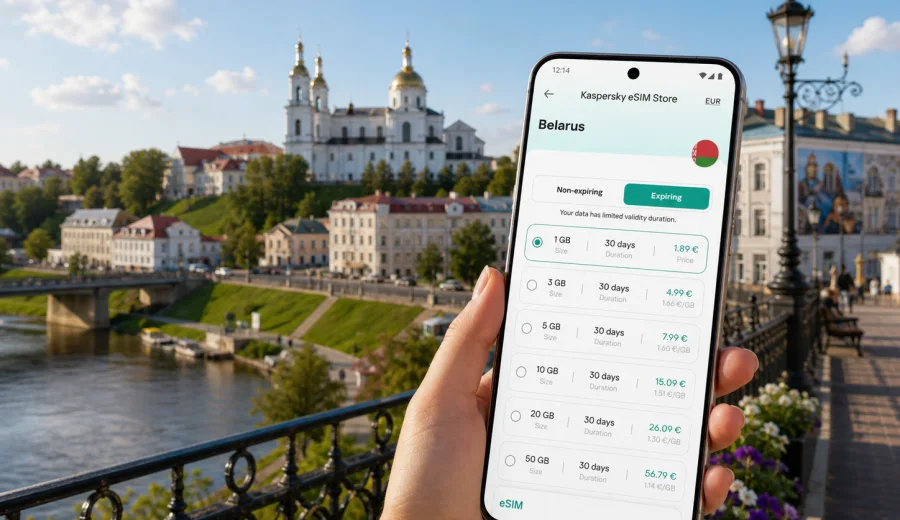
Vitebsk eSIM: mobile connection and internet for a trip to Belarus
Vitebsk is a city where a reliable mobile connection is useful from the first minutes of a trip. You may need maps for the route from the station, a messenger to reach your hotel, translation tools in cafes and museums, or mobile internet for a business call between meetings. An eSIM can make this easier because you can prepare a digital SIM profile before departure and use mobile data in Belarus without looking for a physical SIM card after arrival.
This guide is focused on Vitebsk, not on Belarus in general. It explains where mobile internet is most useful in the city, how to plan data for short stays and longer visits, what to check before buying an eSIM tariff, and how to keep your phone ready for navigation, transport, hotel check-in, remote work, and side trips from Vitebsk.
Why mobile internet matters in Vitebsk
Vitebsk is compact enough for walking, but travel days still involve many small online tasks. You may arrive by train or bus, continue by taxi, check the exact hotel entrance, message a host, or confirm a meeting address. If your itinerary includes the historic center, the Western Dvina riverside, cultural venues, business districts, or trips to nearby towns, offline planning can quickly become inconvenient.
Mobile internet is especially useful for:
- checking maps around the railway station, bus station, hotels, and central streets;
- using taxi and ride services where available;
- opening digital bookings, tickets, and hotel confirmations;
- messaging family, colleagues, drivers, hosts, and local contacts;
- translating menus, signs, and service messages;
- checking opening hours saved in travel apps;
- joining video calls or uploading documents during a business trip;
- planning onward travel through Minsk or other Belarusian cities.
An eSIM is not a separate phone number by default. In most travel scenarios, it is used for mobile data, while calls and messages can continue through internet-based apps. If voice calls or SMS are important, check the conditions of the specific tariff before you rely on it.
Arrival scenarios: when you will want data first
Many visitors reach Vitebsk by rail or road. Some travelers come from Minsk after an international flight, while others arrive directly by train, coach, or private transfer. In all of these cases, the first hour is when mobile internet feels most practical: you are orienting yourself, confirming transport, and moving from arrival point to accommodation.
| Travel moment | What you may need online | Why eSIM helps |
|---|---|---|
| Before departure | Install the eSIM profile and save booking details | You can prepare while you still have stable home Wi-Fi |
| On the way to Vitebsk | Check route changes and message your hotel | Mobile data keeps plans easier to adjust |
| At the station or bus stop | Open maps, taxi apps, and messenger chats | You do not need to search for public Wi-Fi immediately |
| Hotel check-in | Show booking details and receive access instructions | Confirmation messages stay available on your phone |
| First walk in the city | Navigate between streets, squares, cafes, and museums | Maps and translation tools work when you need them |
If you are traveling through Minsk, mobile data can be useful before you even reach Vitebsk. You may need to compare train and road options, message a driver, check the location of your departure point, or keep colleagues updated during the transfer. In that case, choose a tariff for Belarus rather than thinking only about one city block in Vitebsk.
City movement: maps, streets, taxis, and walking routes
Vitebsk rewards slow movement. The city center, riverside views, bridges, churches, cultural spaces, cafes, and hotels are easier to connect when your phone can update maps in real time. Even if you save an offline map, mobile data gives you live search, address confirmation, taxi communication, and route adjustments.
For a practical day in Vitebsk, mobile internet helps with:
1. Checking the walking route from your hotel to the historic center.
2. Finding a cafe or restaurant near your current location.
3. Confirming whether a venue is closer to the Western Dvina side or another district.
4. Sending your live location to a colleague or travel companion.
5. Opening a translator if you need help with signs, menus, or service messages.
6. Adjusting plans when weather, meetings, or transport timing changes.
The most common mistake is to treat city travel as if everything will be decided before leaving the hotel. In practice, Vitebsk trips often include small changes: a meeting runs late, a walk along the river takes longer, a museum visit moves to another day, or you decide to continue to another part of the city after dinner. A prepared eSIM tariff keeps those changes manageable.
How much data to plan for Vitebsk
The right data amount depends on your habits, not only on the length of the trip. Navigation and messaging use less data than video calls, cloud backups, social video uploads, or laptop tethering. Before choosing a tariff, think about what your phone will actually do during the trip.
| Traveler profile | Typical mobile data needs | Practical planning note |
|---|---|---|
| Weekend visitor | Maps, messages, bookings, light browsing | A modest package may be enough if you avoid heavy video |
| Business traveler | Email, messengers, maps, occasional calls | Choose more data if you use video meetings or file sharing |
| Family trip organizer | Navigation, tickets, chats, photos, restaurant search | Leave a reserve because one phone may support several people |
| Remote worker | Calls, documents, hotspot for a laptop | Check whether tethering is allowed in the selected tariff |
| Regional traveler | Vitebsk plus Minsk or other cities | Choose a tariff that matches the whole Belarus route |
To reduce unnecessary data use, download offline maps before departure, turn off automatic cloud photo uploads on mobile data, update apps over Wi-Fi, and use hotel Wi-Fi for large files when you trust the network and the task is not urgent. eSIM is most useful for the moments when you need dependable mobile access outside the hotel: streets, stations, taxis, meetings, and day trips.
Choosing an eSIM tariff for a Vitebsk trip
When you choose an eSIM tariff, start with the country of use. For a city trip to Vitebsk, the relevant destination is Belarus. Then compare the data amount, validity period, price, and any specific conditions shown for the tariff.
Use this checklist before you buy:
- Destination: the tariff should cover Belarus for a Vitebsk trip.
- Duration: the validity period should cover arrival, the stay, and the day you leave.
- Data volume: allow extra data for navigation, calls, and unexpected plan changes.
- Activation rules: check when the validity period starts and what steps are required.
- Device support: confirm that your phone or tablet supports eSIM.
- Operator lock: make sure the device is not locked to one mobile operator.
- Hotspot needs: check the tariff conditions if you plan to share data with a laptop.
- Existing SIM: decide which SIM profile will handle calls and which will handle mobile data.
For a simple city break, a smaller package may work if you mainly use maps and messages. For a work trip, a family itinerary, or a route that includes Vitebsk plus Minsk, it is safer to choose more data and a validity period that covers the full journey.
If you want to prepare before arrival, you can choose an eSIM tariff for Belarus in Kaspersky eSIM Store and compare the available data packages, validity periods, and conditions for your trip. Place the purchase in the context of your actual Vitebsk itinerary: arrival route, hotel location, meetings, sightseeing time, and onward travel.
Vitebsk travel situations where eSIM is useful
Different visits create different data needs:
- Short stopover: maps, luggage details, a cafe near the station, and messages before the next transfer.
- Business visit: email, meeting addresses, shared documents, quick calls, and route changes between appointments.
- Cultural weekend: map pins for the center, riverside walks, cafes, museums, and translation when needed.
- Family trip: one phone may handle bookings, routes, taxi messages, and group coordination.
- Route beyond Vitebsk: Minsk, Polotsk, or other Belarusian stops make the country-level tariff and validity period more important.
In each case, the eSIM tariff should match the real route, not an abstract idea of travel. A weekend visitor who mainly uses maps may need less data than a remote worker using video calls or hotspot access.
Before you buy: compatibility and phone settings
Before purchasing any eSIM tariff, confirm that your device supports eSIM and is not restricted by an operator lock. This matters more than the destination: without device support, you cannot install the eSIM profile correctly.
Check your device before you buy, especially if you use an older phone, a model bought through a carrier, or a device with regional differences. Also check whether your phone can keep your regular SIM active for calls while using the eSIM profile for mobile data.
Practical settings to review before the trip:
- Keep your primary SIM for calls and important SMS if needed.
- Assign the eSIM profile to mobile data after installation.
- Turn on data roaming for the eSIM profile if the tariff instructions require it.
- Turn off automatic app updates over mobile data.
- Disable cloud photo and video backups on mobile data unless you intentionally need them.
- Save your QR code or installation details somewhere accessible before departure.
Do not remove the eSIM profile after installation unless you are sure the tariff conditions allow reinstalling it. Some eSIM profiles cannot be transferred to another device after activation.
How to install and activate eSIM for Vitebsk
Install the eSIM while you still have stable internet, ideally before you leave or at your hotel over trusted Wi-Fi. After purchase, the eSIM details usually appear in your account or app, and you can follow the on-screen steps or use a QR code when provided.
Basic setup flow:
1. Check that your phone supports eSIM and is unlocked for use with other mobile services.
2. Choose Belarus as the destination and select a tariff that matches your Vitebsk trip.
3. Complete the purchase and open the installation details.
4. Add the eSIM profile to your phone.
5. Set the eSIM as the mobile data line when you are ready to use it.
6. Check whether data roaming must be enabled for that eSIM profile.
7. Test mobile data after arrival or when the tariff instructions say activation is available.
For device-specific setup, follow the Android installation instructions or the iOS installation instructions. Keep in mind that menu names may vary slightly by phone model and operating system version.
Practical data tips for hotels, cafes, and public Wi-Fi
Hotel and cafe Wi-Fi can be convenient, but it should not be your only plan. You may need mobile data before check-in, after leaving the hotel, in a taxi, on the riverside, or while moving between meetings. An eSIM tariff helps reduce dependence on public Wi-Fi in places where you do not control the network.
Use this simple approach:
- Use trusted Wi-Fi for large app updates, cloud backups, and long video calls.
- Use eSIM mobile data for maps, messenger calls, taxis, route changes, and urgent work.
- Keep important booking documents available offline as a backup.
- Avoid letting apps refresh in the background if your data package is limited.
- Check data usage in your phone settings during multi-day stays.
FAQ: eSIM and mobile internet in Vitebsk
Can I use eSIM only for mobile internet in Vitebsk?
Yes, that is the usual travel use case. Many eSIM tariffs are data-focused. Calls and SMS are not included unless the selected tariff says so. You can use messengers and internet calling apps over mobile data.
Should I install the eSIM before arriving in Belarus?
In many cases, yes. Installing it before the trip is convenient because you can use stable Wi-Fi and avoid rushing at the station or hotel. Check the activation rules of the selected tariff so you understand when validity starts.
Is eSIM enough for remote work in Vitebsk?
It can help with email, messengers, maps, and urgent online tasks. For long video calls, large uploads, or laptop hotspot use, choose a data amount with care and check the tariff conditions.
Final checklist before your Vitebsk trip
Before you leave, make sure the practical details are covered:
- Your phone supports eSIM and is not operator-locked.
- The selected tariff covers Belarus and fits your Vitebsk itinerary.
- The data amount is enough for maps, messages, bookings, and work needs.
- You understand when the tariff validity period begins.
- The eSIM installation details are saved and available.
- Your regular SIM and eSIM data settings are configured correctly.
- Offline backups are saved for hotel addresses and essential bookings.
Vitebsk is easier to navigate when your phone is ready for the small online tasks that shape a trip: finding the right street, contacting a host, opening a booking, checking a route, or sending a work update. Kaspersky eSIM Store is an app and website where you can choose, arrange, and activate an eSIM with a suitable mobile data tariff for a trip abroad.
If Vitebsk is on your itinerary, prepare your connection before you travel and select an eSIM tariff for Belarus that matches your route, stay length, and expected mobile internet use.