Travel connectivity guide
Vivo V40 lite eSIM: Compatibility and Setup
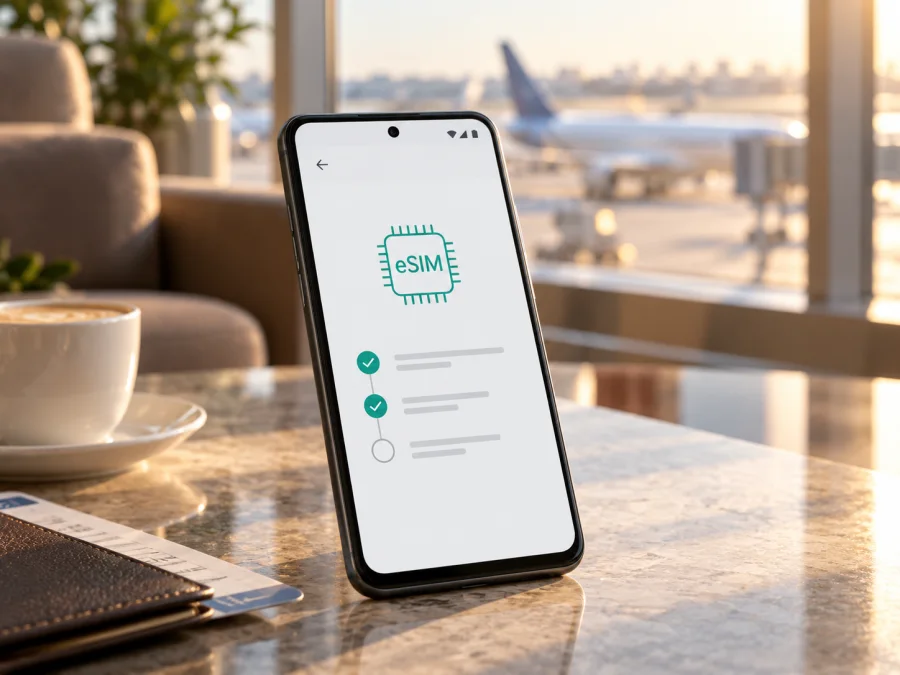
Vivo V40 lite eSIM: compatibility, setup and travel use
Quick answer
Does the Vivo V40 lite support eSIM? It depends on the exact regional version. Vivo explicitly lists eSIM support for the European V40 Lite 5G. Its European announcement says that this version can use two physical nano-SIMs and one eSIM, with up to eight eSIM profiles. That is useful confirmation for that market-specific model, but it does not prove that every phone sold as Vivo V40 lite has the same capability.
Vivo’s regional product pages describe several phones under the V40 Lite name with different specifications and SIM arrangements. Some list eSIM as supported; others list physical SIM slots but do not clearly state eSIM support. A missing eSIM entry is not enough to prove that eSIM is disabled, and a feature confirmed for Europe should not be assumed for a phone bought in another market. Check the model number, original sales region and the phone itself before buying a travel plan.
The European confirmation comes from Vivo Europe’s V40 launch announcement and the Vivo Europe V40 Lite 5G specifications page, checked on 18 October 2026. The announcement identifies the 5G model and its eSIM profile capacity. Vivo’s specifications pages for other regions show why the name alone is not a reliable compatibility test.
Vivo V40 lite at a glance
The table separates facts confirmed for the European V40 Lite 5G from information that cannot safely be generalized to every regional version.
| Check | What can be confirmed | What it means for eSIM |
|---|---|---|
| Device name in the request | Vivo V40 lite | This name does not specify 4G or 5G, a model code, or a sales market. |
| European version | Vivo V40 Lite 5G | Vivo identifies eSIM support for this specific regional 5G version. |
| European eSIM capacity | Up to eight profiles, according to Vivo Europe’s announcement | This is the published profile capacity for that version; it does not mean all profiles can be active at once. |
| Physical SIM arrangement | Varies between regional specification pages | A SIM tray description alone does not establish eSIM support. |
| Other markets | Specifications and names differ by market | Confirm the exact model code and check the device settings before purchase. |
| Network use abroad | Depends on device support, carrier lock status and the plan’s destination and network terms | eSIM hardware alone does not guarantee service in a particular country. |
Does the Vivo V40 lite support eSIM?
The most accurate answer is: the European Vivo V40 Lite 5G is listed by Vivo as eSIM-capable; the general name Vivo V40 lite is not specific enough to give every regional version a yes or no. If your phone is the European 5G model and its settings show an EID or an option to add an eSIM, those are strong practical signs that its eSIM hardware and software are available. Confirm the actual handset before relying on that conclusion.
Vivo’s European announcement describes support for two physical nano-SIM cards and one eSIM with storage for up to eight profiles. The related European specifications page identifies the European product as V40 Lite 5G and lists eSIM support. This is specific evidence for that market’s V40 Lite 5G rather than a rule for all phones with a similar name.
The V40 Lite family has regional variation. For example, Vivo’s Uzbekistan product page labels a 4G V40 Lite with a different platform and a physical SIM/microSD tray arrangement. Vivo’s Colombia specifications also describe regional differences in card slots and standby behavior. These pages do not establish that all such versions have eSIM, and their published physical SIM details should not be treated as an eSIM confirmation. Nor should a feature absent from a regional specifications table automatically be treated as proof that the feature is unavailable. The correct conclusion for an unconfirmed version is not verified until the model code, EID and system menu have been checked.
Check the actual geographic market, not just the language selected on the phone. A device marketed in Spain or elsewhere in Europe may follow Vivo’s European specification, while a similarly named handset imported from another market may use different hardware or firmware. The carrier you plan to use also matters: it may apply its own device eligibility rules, activation process or network restrictions. An eSIM-compatible phone can still be carrier-locked or unable to use a particular plan.
Check compatibility before you buy
Use this checklist for the specific handset in your hand:
- [ ] Find the full model code in Settings → About phone or on the original box. Save the code exactly as shown.
- [ ] Confirm which country or sales region the phone was intended for. “V40 Lite” by itself is not a regional identifier.
- [ ] Look for an EID in Settings → About phone, Status information or a similar device-information screen. Menu labels vary by Funtouch OS version.
- [ ] Open the SIM or mobile-network settings and look for Add eSIM, Add mobile plan, Download a SIM or an equivalent option.
- [ ] If the phone has a physical SIM tray, inspect its configuration, but do not use the tray as the only eSIM test.
- [ ] Confirm that the phone is not locked to a carrier that prevents adding another provider’s eSIM.
- [ ] Check that the operating system is up to date and that the intended plan accepts the phone’s market and model.
An EID is the identifier associated with the phone’s embedded SIM capability. If you find an EID, it is a useful sign that the phone has eSIM hardware. If the settings also offer adding or downloading an eSIM, that is stronger confirmation that the current software exposes the feature. Still check carrier lock status and the plan’s device requirements. A phone can display SIM information and support physical dual SIM without supporting eSIM.
If the EID is not visible, search all settings for “EID” and “eSIM,” inspect the SIM manager, and check the model code with Vivo support or the seller. The dial code *#06# may display device identifiers on some Android phones, but its behavior varies; do not treat the absence of an EID in that screen as conclusive. Do not publish or send your EID or IMEI in a public post. Share identifiers only with an official support channel when asked.
Check whether your device is compatible before you choose a plan. If you cannot confirm the exact V40 Lite version, pause the purchase until Vivo or the seller confirms the model-specific eSIM support.
Before installing an eSIM for travel
After confirming compatibility, update the phone, charge it and connect to reliable Wi-Fi. Review the plan’s destination, data allowance, validity, network terms and installation directions. Confirm that the phone is unlocked; ask the original carrier or seller if you cannot tell. Keep your home SIM if you still need its number, and check its roaming terms.
Follow the selected plan’s timing instructions. Some profiles can be installed before departure and connect only in a supported destination; activation and the start of validity can vary. Keep the QR code or manual details available during setup, and do not remove an installed profile to troubleshoot unless the provider instructs you to. A deleted profile may not be reusable without support.
How to install and activate eSIM on Vivo V40 lite
The names and placement of settings can vary by Vivo market, Android release and Funtouch OS version. Treat the following as a general Android workflow, and follow the exact prompts on your own phone. For detailed steps, see the Android eSIM installation instructions and the iOS eSIM installation instructions. The iOS guide is included for readers setting up a different Apple device; the Vivo uses Android.
Install with a QR code
- Confirm support first. Check for an EID and an eSIM-add option as described above. Connect to Wi-Fi and make sure the phone is unlocked.
- Open the mobile network controls. Go to Settings → Network & internet, Mobile network, SIM manager or the closest equivalent. Look for Add eSIM or Add mobile plan. If none appears, do not assume that a QR code can add eSIM to a physical-SIM-only model.
- Start the add flow. Choose the option to add or download a SIM. The phone may show an activation screen or ask you to scan a QR code.
- Scan the provider’s code. Use the phone camera flow opened by the eSIM settings. If the QR code was delivered to the same phone, display it on another trusted screen or use manual activation details if the provider offers them. Do not send the code to someone else; it may allow them to install the profile.
- Review the profile details. Give it a clear label such as “Travel data” so you can distinguish it from your home SIM. Confirm the plan or provider details shown before proceeding.
- Download and add the profile. Keep the phone connected while it downloads. Wait for the system to confirm that the eSIM was added. The wording and next steps depend on the Funtouch OS build.
- Choose when to use it. If you are still at home, follow the plan’s activation directions. You may be able to leave the new line switched off until arrival. Do not turn on data roaming for your home SIM by mistake.
- At the destination, select the eSIM for mobile data. In SIM settings, enable the travel line and choose it as the mobile-data SIM. Turn on data roaming for that eSIM only if the plan’s instructions require it.
- Check the connection. Disable Wi-Fi briefly, confirm that mobile data is assigned to the travel profile, and open a simple page or messaging app. If it does not connect, use the troubleshooting steps below before changing or deleting the profile.
Install from an app or manual details
If the eSIM service offers in-app installation, use it while connected to the internet and follow the Android prompts. Review the plan name and destination before confirming. For manual activation, enter the supplied details exactly. When installation finishes, check that the profile appears in the SIM manager. Adding a profile does not necessarily mean that it is connected or that data use has begun; follow the plan’s separate activation and validity instructions.
Using the Vivo V40 lite for mobile data on a trip
Before leaving, decide how to use both lines. Keep the home SIM for calls or messages if needed, but select the travel eSIM for mobile data when ready. Check home-carrier roaming terms; enable roaming on the travel eSIM only if its instructions require it.
At arrival, turn off Wi-Fi briefly to test. Verify that the travel line is enabled and selected for data, airplane mode is off, and mobile data is on. If the phone asks for network selection, follow the plan’s guidance. Network availability depends on the destination and provider arrangements.
A travel eSIM can support maps, ride booking, translation, messaging, email and tickets. Download essential maps or reservation details in advance as a backup. Data-based calls and messages use your existing app accounts; a data plan does not automatically supply a phone number. Hotspot use depends on the device and plan terms.
A practical two-line setup is:
| Setting | At home before the trip | During the trip |
|---|---|---|
| Home SIM | Leave enabled if you need its number; check roaming charges | Keep for calls or messages if useful; leave mobile data roaming off unless you knowingly want it |
| Travel eSIM | Install only after confirming compatibility; follow the plan’s timing instructions | Enable at the appropriate time and select for mobile data |
| Default data line | Home SIM or Wi-Fi, as usual | Travel eSIM, once its destination service is available |
| Wi-Fi | Use for setup and downloads | Use when convenient, but test the eSIM connection with Wi-Fi turned off |
| Data roaming | Follow home carrier terms | Enable on the travel profile only if its instructions require it |
If you cross borders, check whether the selected plan covers each country on your route. A plan for one destination does not necessarily include neighboring countries. Review the displayed coverage area and conditions before travel, especially for a multi-country itinerary. Kaspersky eSIM Store is an app and website where you can review current destination options, choose and arrange a travel data eSIM, and activate it on a compatible device. The available plans and terms can change, so check the current details for your destination.
Common problems and what to check
“Add eSIM” is missing
Search Settings for “eSIM” and “EID,” then check the SIM manager and model code. Update Funtouch OS and restart the phone. If the menu is still absent, ask Vivo or the original seller about the exact market SKU. A dual physical-SIM tray does not confirm eSIM support, and the European V40 Lite 5G specification does not apply automatically to other regions.
The QR code will not scan or download
Use the scan flow inside the eSIM settings, increase the code’s brightness and size, and check that it has not already been used. Keep Wi-Fi connected during installation. If the provider supplies manual activation details, enter them exactly as shown. When a code is marked as used or rejected, contact the plan’s support team before deleting a profile or requesting another code.
The profile appears, but there is no signal
Confirm that the travel line is enabled and that you have reached a destination included in the plan. Check the plan’s activation instructions, then toggle airplane mode briefly or restart the phone. If the provider recommends manual network selection, follow its directions. An installed profile does not guarantee a signal in every location.
There is a signal but no mobile data
Select the travel eSIM as the mobile-data line, turn on mobile data, and enable roaming for that line if the plan requires it. Turn Wi-Fi off for a clear test. Verify destination eligibility, remaining allowance and validity. If APN details are provided, compare them with the phone’s settings; avoid changing unrelated network options.
The home SIM seems to be using data
Check which line is selected for mobile data and whether automatic data switching is enabled. Turn off roaming for the home SIM if you do not want it to use roaming data. Keep the travel eSIM selected for data once its service is available.
The plan cannot activate on this handset
Check the exact model code, sales region and carrier-lock status. The European V40 Lite 5G confirmation cannot be generalized to every Vivo V40 lite. Ask the device or plan support team to verify that precise version. If it is not eSIM-capable, use an unlocked compatible phone or another connection option for your trip.
Frequently asked questions
Can I add an eSIM to every Vivo V40 lite?
This is not confirmed for every regional version. Vivo explicitly lists eSIM support for the European V40 Lite 5G. Check the exact model’s EID and eSIM settings before buying.
Does the European V40 Lite 5G support physical SIMs and eSIM?
Vivo Europe says it supports two physical nano-SIMs and one eSIM, with up to eight eSIM profiles. Stored profiles are not the same as simultaneously active lines; check the SIM manager on your software version.
Does a dual-SIM tray prove eSIM support?
No. The tray describes physical cards. Look for an EID and an Add eSIM option.
Can I install the eSIM before flying?
Often yes, but installation, activation and the start of validity can be separate. Follow the selected plan’s timing instructions.
Do I need to remove my regular SIM, and will the eSIM include a phone number?
Usually you can keep the home SIM for its number and select the travel eSIM for data, subject to device settings. A travel data plan generally does not include a phone number, calls or SMS unless its terms say otherwise.
What if I cannot find an EID?
Search Settings and the SIM manager, then verify the model code with Vivo or the original seller. Menu names vary. If the EID and add-eSIM option remain absent, get confirmation before assuming compatibility.
Does eSIM support guarantee service abroad?
No. The phone must also be unlocked, and the plan must include your destination and have a usable network there. Availability varies by location and plan.
Before your trip: verify, then choose
For the Vivo V40 lite, the dependable decision starts with the exact regional version. Vivo confirms eSIM support for the European V40 Lite 5G, including the published capacity for up to eight eSIM profiles. The broader Vivo V40 Lite name covers other regional configurations for which that same support cannot be assumed. Find the model code, look for an EID and an Add eSIM option, and confirm the handset is unlocked before paying for a plan.
When your phone passes those checks, compare current travel data options for the countries on your route. Review each plan’s destination list, allowance, validity and installation directions. You can browse current eSIM options for your trip on the Kaspersky eSIM Store website or app, then follow the plan’s steps to install and activate the profile. This is the general store homepage for checking current destinations and plans, not a country-specific tariff page.
A few minutes of model and settings checks can prevent a frustrating surprise at the airport. If the exact Vivo V40 lite version remains uncertain, get confirmation from Vivo or the original seller first; if it is confirmed compatible and unlocked, install the travel eSIM according to its instructions and select it for mobile data when you reach a supported destination.


